How to Estimate Uncertainty and Absolute Error in Cambridge AS Physics Practical Exams (Paper 3)
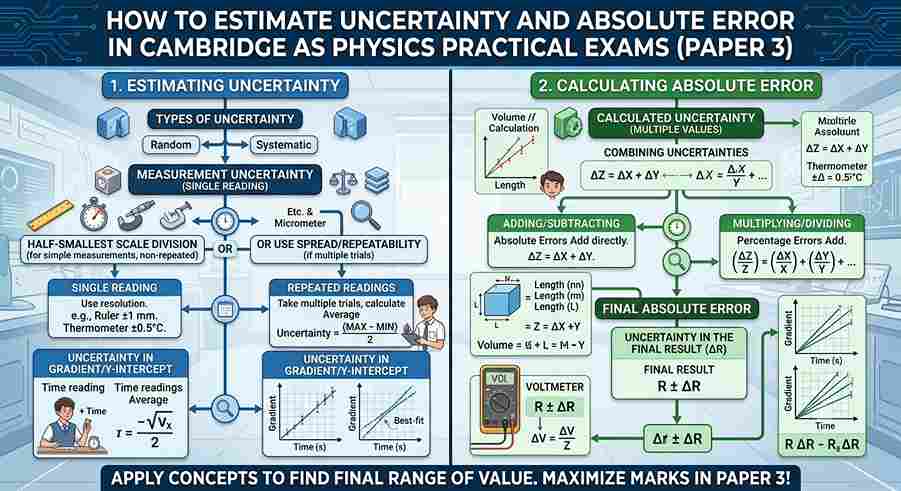
Last Updated: October 2026 | By EdFlik Education Team
For high school students preparing for the Cambridge International AS Level Physics (9702) qualification, Paper 3 (Advanced Practical Skills) represents a high-stakes, 40-mark examination designed to test laboratory technique, data collection precision, graphical analysis, and error estimation.
While students often spend months memorizing theoretical derivations for Paper 2, many lose up to 25% of their total Paper 3 marks due to avoidable errors in calculating absolute uncertainties, combining percentage errors, drawing error bars, and determining lines of worst fit. In Cambridge practical mark schemes, uncertainty and error estimation questions are strictly marked: if your method or calculation format deviates from accepted conventions, zero marks are awarded.
In this comprehensive, exam-focused masterclass guide, our expert Cambridge physics educators break down instrument precisions, uncertainty propagation rules, step-by-step practical data handling, graphical error analysis, common examiner traps, and supply a 100% copy-paste JSON-LD schema markup for your study resources.
Part 1: Instrument Precision and Absolute Error Fundamentals
Every physical measurement made in a laboratory carries a degree of uncertainty due to the limited precision of the measuring instrument and human observation limits.
                     INSTRUMENT PRECISION & ABSOLUTE ERROR
                                       |
        +------------------------------+------------------------------+
        |                                                             |
1. SINGLE READING RULE                                         2. REPEATED READING RULE
• Absolute uncertainty = **Half the smallest division**        • Absolute uncertainty = **Half the range**
  of the instrument (e.g., $\pm 0.05 \text{ mm}$ for             of repeated measurements
  a micrometer reading to $0.01 \text{ mm}$).                    ($\frac{\text{max} - \text{min}}{2}$).
Standard Instrument Precisions in Cambridge Paper 3:
- Metre Rule: Smallest division is $1 \text{ mm}$ ($0.1 \text{ cm}$). Absolute uncertainty is $\pm 0.5 \text{ mm}$ ($0.05 \text{ cm}$) per end, or $\pm 1 \text{ mm}$ if both ends of an object are measured.
- Vernier Calipers: Smallest division is usually $0.1 \text{ mm}$ or $0.02 \text{ mm}$. Absolute uncertainty is $\pm 0.05 \text{ mm}$ or $\pm 0.01 \text{ mm}$.
- Micrometer Screw Gauge: Smallest division is $0.01 \text{ mm}$. Absolute uncertainty is $\pm 0.01 \text{ mm}$.
- Analogue Stopwatch: Human reaction time ($\sim \pm 0.2 \text{ s}$) usually outweighs the instrument's mechanical precision, so absolute uncertainty is standardly estimated as $\pm 0.2 \text{ s}$ (or half the smallest division for digital timers, typically $\pm 0.01 \text{ s}$, unless specified otherwise).
- Digital Voltmeter / Ammeter: Half the smallest scale division on the last decimal place (e.g., for a digital multimeter reading to $0.01 \text{ V}$, uncertainty is $\pm 0.01 \text{ V}$).
Part 2: Rules for Combining Uncertainties
When calculated quantities depend on multiple measured variables, their uncertainties must be propagated according to strict mathematical rules.
                      UNCERTAINTY PROPAGATION RULES
                                     |
      +------------------------------+------------------------------+
      |                              |                              |
 1. ADDITION & SUBTRACTION      2. MULTIPLICATION & DIVISION   3. POWERS / EXPONENTS
 • When adding/subtracting quantities • When multiplying/dividing,      • When a quantity is raised to a
   ($z = x + y$), **add the absolute   **add the percentage/fractional  power ($z = x^n$), **multiply
   uncertainties** ($\Delta z = \Delta x + \Delta y$). uncertainties** ($\frac{\Delta z}{z} = \frac{\Delta x}{x} + \frac{\Delta y}{y}$). the percentage uncertainty by $n$** ($%z = n \cdot %x$).
Step-by-Step Worked Uncertainty Propagation Example:
Question: The radius of a solid cylinder is measured as $r = 1.20 \pm 0.02 \text{ cm}$, and its height is $h = 5.00 \pm 0.05 \text{ cm}$. Calculate the percentage uncertainty in the volume of the cylinder, and determine the absolute uncertainty in volume. ($V = \pi r^2 h$).
Step 1: Calculate Percentage Uncertainty of Each Variable
- Percentage uncertainty in radius ($r$):$$\%r = \left(\frac{0.02}{1.20}\right) \times 100\% = 1.667\%$$
- Percentage uncertainty in height ($h$):$$\%h = \left(\frac{0.05}{5.00}\right) \times 100\% = 1.000\%$$
Step 2: Combine Percentage Uncertainties Using Rules
Since $V = \pi r^2 h$, the formula involves $r$ squared (multiplied by 2) and $h$ (multiplied by 1):
$$\%V = (2 \times \%r) + \%h$$$$\%V = (2 \times 1.667\%) + 1.000\% = 3.333\% + 1.000\% = 4.333\% \approx 4.3\%$$
Step 3: Calculate Nominal Volume and Absolute Uncertainty
- Nominal Volume ($V$):$$V = \pi (1.20)^2 (5.00) = \pi (1.44)(5.00) = 22.6195 \text{ cm}^3$$
- Absolute Uncertainty in Volume ($\Delta V$):$$\Delta V = V \times \left(\frac{\%V}{100}\right) = 22.6195 \times 0.04333 = 0.980 \text{ cm}^3 \approx 1.0 \text{ cm}^3$$
- Final Form: $V = 22.6 \pm 1.0 \text{ cm}^3$.
Part 3: Graphical Error Analysis (Lines of Best and Worst Fit)
In Cambridge Paper 3, graphical questions require you to plot error bars for experimental points and draw both a Line of Best Fit and a Line of Worst Fit to determine the maximum and minimum acceptable gradients.
                      GRAPHICAL ERROR ANALYSIS WORKFLOW
                                       |
  Step 1: Plot Error Bars       ---> Draw vertical/horizontal error bars based on absolute uncertainty
  Step 2: Draw Line of Best Fit ---> Balance points equally on both sides with maximum linearity
  Step 3: Draw Line of Worst Fit---> Steepest or shallowest acceptable line passing through all/most error bars
  Step 4: Calculate Gradients   ---> Find gradient of best fit ($m_{\text{best}}$) and worst fit ($m_{\text{worst}}$)
  Step 5: Percentage Uncertainty---> Evaluate uncertainty: $\frac{|m_{\text{best}} - m_{\text{worst}}|}{m_{\text{best}}} \times 100\%$
Key Rules for Lines of Worst Fit:
- The line of worst fit must be the steepest possible or shallowest possible line that still passes cleanly through the error bars of the extreme first and last data points.
- Never force your line of best fit or worst fit through the origin ($0,0$) unless the physics formula explicitly dictates direct proportionality with no systematic intercept.
Part 4: Top 4 Traps That Cost Students Marks in Paper 3
- Incorrect Significant Figures in Uncertainties: Reporting an absolute uncertainty to 2 or 3 decimal places (e.g., $\pm 0.234 \text{ cm}$) when final uncertainties must always be rounded to 1 significant figure (or exceptionally 2 sig figs if the leading digit is 1).
- Mismatched Decimal Places Between Value and Uncertainty: Writing a final measured value as $12.4 \pm 0.05 \text{ cm}$. Because the uncertainty is given to two decimal places, the nominal value must match the exact same decimal precision: $12.40 \pm 0.05 \text{ cm}$.
- Forgetting to Multiply by Powers in Percentage Formulas: Failing to multiply the percentage uncertainty of a radius by 2 when calculating the uncertainty of a circular area ($\pi r^2$) or sphere volume ($\frac{4}{3}\pi r^3$).
- Drawing Error Bars with Arbitrary Sizes: Guessing the size of error bars instead of calculating the exact absolute uncertainty for every plotted data point on the graph grid.
Preparing for Cambridge AS Level Physics Paper 3 practical exams and aiming for an $A^$ grade? EdFlik connects international school students globally with expert, 1-to-1 online physics tutors, helping you master practical techniques, error analysis, uncertainty propagation, and past-paper mark scheme strategies. *Book a Free Demo Class Today!
Frequently Asked Questions (FAQs)
Q1: How do I know whether to use half the range or instrument precision for my uncertainty?
Ans: If you take repeated measurements of the same physical quantity (e.g., timing 5 oscillations three times), use half the range ($\frac{\max - \min}{2}$). If you take a single static measurement using a calibrated instrument (e.g., measuring length with a ruler once), use the instrument precision limit (half the smallest division).
Q2: Should error bars be plotted on the X-axis, Y-axis, or both?
Ans: Plot error bars on both axes if the independent variable (X) and dependent variable (Y) both carry significant experimental uncertainty. However, if the X-axis values are exact or have negligible uncertainty (such as predetermined masses or set time intervals), error bars are only required on the Y-axis.
Q3: How many significant figures should final calculated physical quantities be given to?
Ans: Match the significant figures of your final calculated answer to the number of significant figures in your raw data (typically 2 or 3 significant figures), ensuring that the absolute uncertainty dictates the decimal place position.
Q4: How does EdFlik support Cambridge AS Physics students?
Ans: EdFlik connects international school students worldwide with vetted, expert 1-to-1 online tutors specializing in CAIE AS & A Level Physics (9702). Our personalized coaching covers theory fundamentals, Paper 3 practical techniques, error analysis calculations, and rigorous past-paper drilling.