How to Get A* in IGCSE Maths | EdFlik UAE
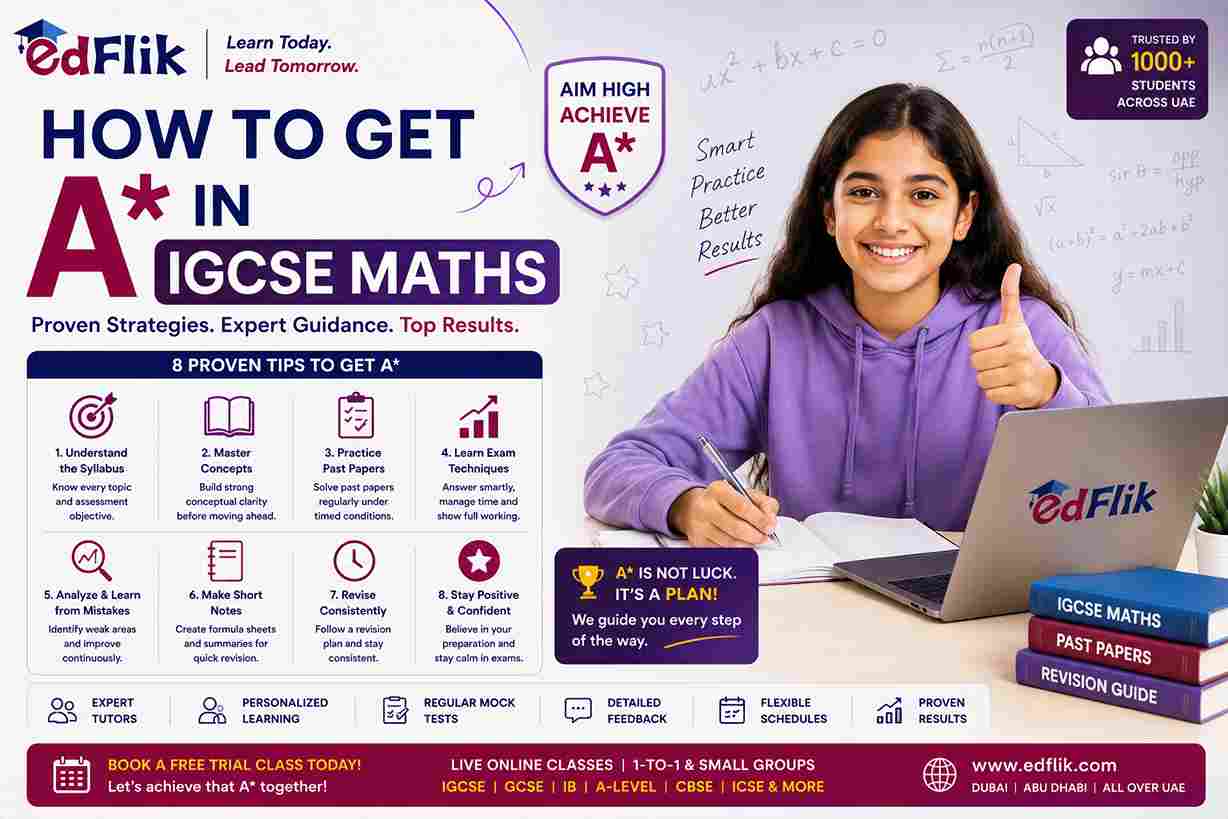
How to Get A* in IGCSE Mathematics: 7 Expert Tips for UAE Students
Scoring A* in Cambridge IGCSE Mathematics (0580) requires more than completing past papers — it demands consistent accuracy, confident algebraic technique, and the ability to apply unfamiliar problem structures under timed examination conditions. For UAE students at international schools following the IGCSE curriculum in Dubai, Sharjah, Abu Dhabi, and beyond, this guide provides the seven strategies that reliably separate A* candidates from those who finish with a solid A.
Understanding the IGCSE Maths (0580) Assessment Structure
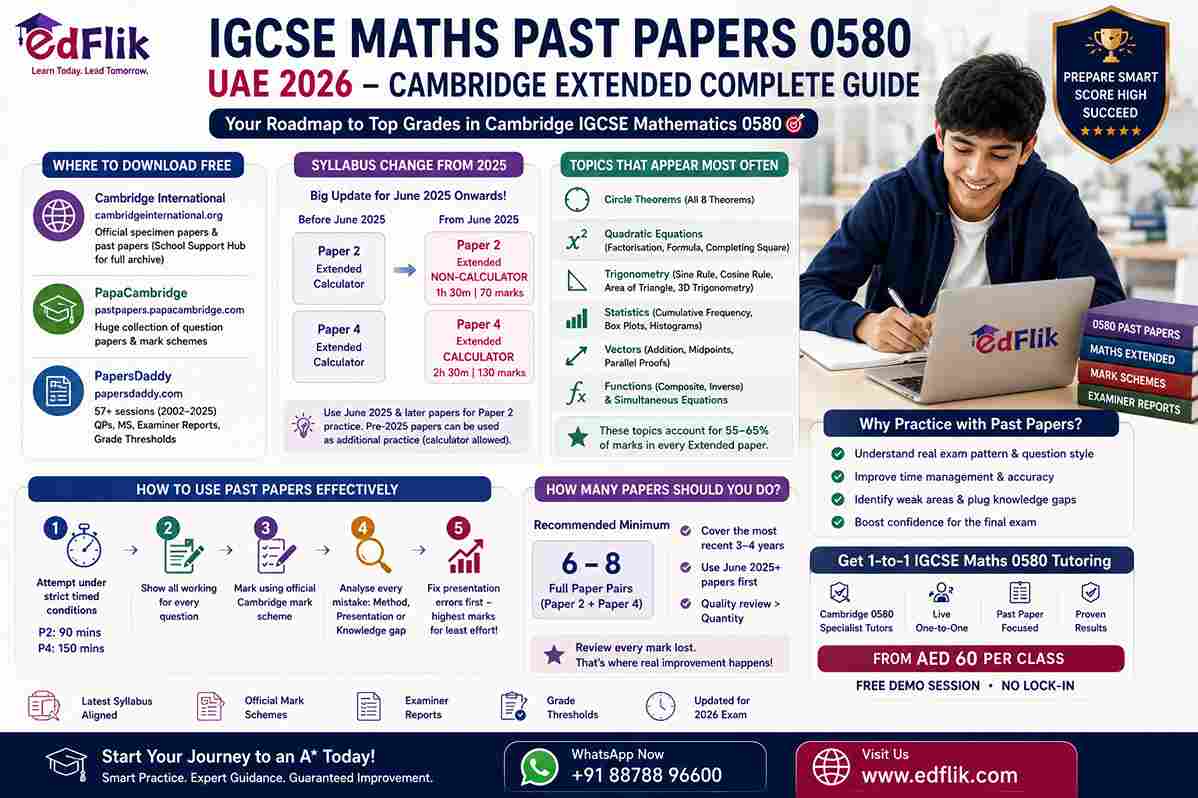
Cambridge IGCSE Mathematics 0580 Extended tier comprises two papers:
· Paper 2 — non-calculator, 90 minutes, 70 marks. Tests all topic areas through short and medium-length questions. No calculator means arithmetic accuracy is critical.
· Paper 4 — calculator allowed, 2 hours 30 minutes, 130 marks. Structured longer questions covering graph work, geometry, algebra, and multi-step problem solving in depth.
Both papers carry substantial mark weight, and neglecting either in favour of the other is one of the most common causes of A* candidates finishing with an A. The A* boundary typically sits around 85–90% combined. At that threshold, a student losing eight marks on Paper 2 through arithmetic errors has already spent most of their A* margin.
7 Tips to Score A* in IGCSE Mathematics
Tip 1: Treat Paper 2 as a Separate Discipline
Most students prepare for IGCSE Maths primarily through calculator-assisted practice. Paper 2 — the non-calculator paper — then catches them off guard. Build a specific Paper 2 preparation routine: practise mental arithmetic of fractions, decimals, and percentages daily; practise squaring and cubing small numbers without a calculator; and time yourself on Paper 2 past papers without any calculator nearby. Paper 2 rewards speed and accuracy. Students who are not specifically practised at non-calculator work lose marks they understand perfectly.
Tip 2: Master Algebraic Manipulation Before Moving to Applied Topics
A* performance across both papers depends on fluent algebraic manipulation — the ability to expand brackets, factorise expressions, complete the square, rearrange formulae, and solve simultaneous equations reliably and quickly. These skills underpin vectors, functions, and coordinate geometry. A student who hesitates over factorisation in the middle of a coordinate geometry problem loses time and confidence. Dedicate early revision to algebra until it is fully automatic.
Tip 3: Learn Vectors Systematically — They Are a Reliable A* Discriminator
Vectors appear on most Extended tier Paper 4 papers and carry between 6 and 12 marks. They are taught at many UAE schools in a way that students memorise without understanding, leading to errors on unfamiliar question structures. Learn vectors from first principles: column vector notation, addition and subtraction, scalar multiplication, magnitude, and route vectors through diagrams. A student who can reason spatially about vectors — not just apply formulae — earns full marks on these questions reliably.
Tip 4: Memorise Circle Theorems and Be Able to Prove Them
Circle theorem questions appear regularly at Extended tier and require students to name the theorem used, state angles, and sometimes construct a formal proof. There are eight key circle theorems in the 0580 specification. Most students can name them from memory but cannot reliably apply them to unfamiliar diagrams or construct proofs under timed conditions. Practice answering circle theorem questions from blank paper, writing the theorem name alongside each step.
Tip 5: Use the Mark Scheme to Understand Method Marks
Cambridge IGCSE Maths uses a method-mark system. If a student sets up the problem correctly but makes an arithmetic error, they can still earn method marks for the correct approach. Many students do not realise this and abandon questions when they make an error partway through. Always write your working clearly, even if you are not sure the answer is right. A correct method shown clearly can earn two or three marks even when the final answer is wrong.
Tip 6: Time Yourself Strictly on Full Past Papers
IGCSE Maths Paper 4 allows 2 hours 30 minutes for 130 marks — approximately 69 seconds per mark. Students who have not practised under strict timing regularly run out of time in the final section, which often contains the highest-mark questions. Practise full Paper 4 sittings with a timer running. At the 2-hour mark, note how many marks remain. Work on reducing that gap every session until you are consistently finishing with 10 to 15 minutes to check your work.
Tip 7: Work With a Specialist IGCSE Maths Tutor for Targeted Gap-Filling
A specialist IGCSE Maths tutor analyses your past paper performance and builds a session plan around your specific weak topics — not a generic curriculum. EdFlik provides one-to-one IGCSE Maths tutoring for Grade 9 and 10 students across the UAE, with sessions from AED 45 per session and a free trial class. Book at edflik.com.
Frequently Asked Questions
What grade boundaries are needed for A* in IGCSE Maths 0580?
Cambridge IGCSE Mathematics (0580) Extended tier A* grade boundaries vary by series but typically require a combined score across Paper 2 and Paper 4 in the range of 85 to 90 percent. For UAE students sitting the May/June or October/November series, this means leaving very few marks on the table across both papers. The best preparation strategy is to analyse grade boundaries from the last five series and aim consistently above the highest recent A* threshold, so that a slightly harder paper on the day does not cost you the top grade.
What are the hardest topics in IGCSE Extended Mathematics?
The topics that consistently cause the most mark loss for Extended tier students are vectors and transformations, functions and calculus (introduced at Extended level), probability and set notation, and circle theorem proofs. Algebraic manipulation — factorisation, completing the square, simultaneous equations — is another significant source of avoidable errors. These topics benefit from a structured problem-solving approach with a tutor who can identify whether errors are conceptual or procedural.
How is IGCSE Maths Paper 2 different from Paper 4?
Cambridge IGCSE Mathematics 0580 Paper 2 is a non-calculator paper of 90 minutes, testing all topic areas with short to medium-length questions. Paper 4 is a calculator-allowed paper of 2 hours and 30 minutes with structured longer questions covering topics in more depth, including graph drawing, geometry proofs, and multi-step problem solving. Many students overinvest in Paper 4 preparation and underestimate Paper 2, which has no calculator safety net — arithmetic accuracy and mental estimation are critical.
Can EdFlik tutors help with IGCSE Maths at both Foundation and Extended tier?
Yes. EdFlik provides IGCSE Mathematics tutoring for students on both the Core and Extended tier across Dubai, Sharjah, Abu Dhabi, Ajman, and the wider UAE. For Extended tier students targeting A or A*, tutors focus on the higher-order topics that differentiate between grade bands. For Core tier students, the focus is on building reliable performance across the grade C content and identifying whether a tier change to Extended is realistic.
Book a Free IGCSE Maths Trial Class
EdFlik's IGCSE Mathematics tutors work one-to-one with UAE students targeting A and A*, providing past paper practice, mark-scheme feedback, and topic-specific support. Sessions from AED 45. Free trial at edflik.com.