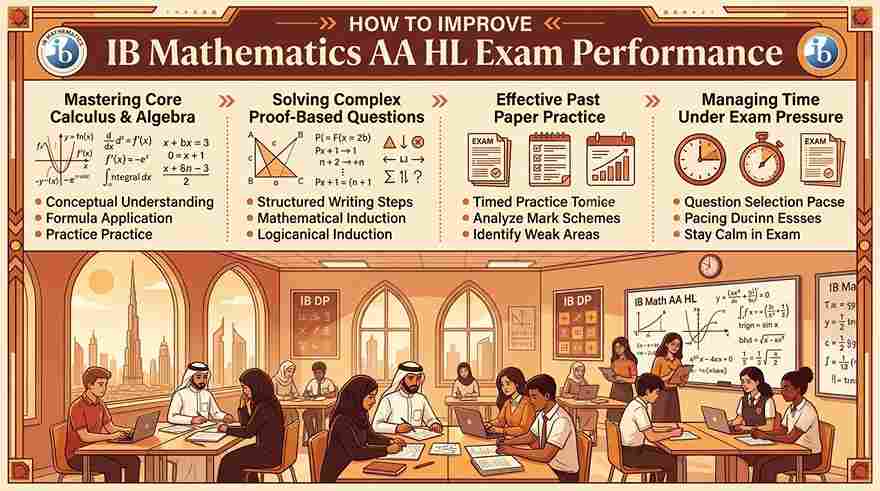
How to Improve IB Mathematics AA HL Exam Performance
By EdFlik Team | November 2, 2026
For students enrolled in the International Baccalaureate (IB) Diploma Programme, Mathematics: Analysis and Approaches Higher Level (AA HL) is widely regarded as one of the most rigorous and demanding high school courses in the world.
Whether you are aiming to secure a Grade 7 for top-tier university STEM, Computer Science, or Economics programs—such as Imperial College London, Cambridge, MIT, or NUS—or simply working to lift your performance from a Grade 5 to a Grade 6, succeeding in IB Math AA HL requires much more than memorizing formulas.
The AA HL examination tests deep conceptual understanding, algebraic agility, multi-step problem solving, and long-form proof construction under strict time constraints across three distinct papers: Paper 1 (Non-Calculator), Paper 2 (Calculator Allowed), and the dreaded Paper 3 (Extended Problem-Solving Portfolio).
This masterclass revision guide breaks down the structural architecture of IB Math AA HL, details high-yielding topic strands, provides paper-specific exam strategies, exposes top mark-loss traps.
Part 1: The IB Math AA HL Assessment Architecture
To maximize your revision efficiency, you must first understand how your final IB Diploma grade is calculated across external papers and the Internal Assessment (IA):
                   IB MATH AA HL ASSESSMENT BREAKDOWN
                                   |
  +--------------------------------+--------------------------------+
  |                                |                                |
1. PAPER 1: NON-CALCULATOR       2. PAPER 2: CALCULATOR ALLOWED   3. PAPER 3: COMPREHENSIVE INVESTIGATION
  • Weight: 30% | Time: 120 mins   • Weight: 30% | Time: 120 mins   • Weight: 20% | Time: 60 mins
  • Marks: 110 marks               • Marks: 110 marks               • Marks: 50 marks
  • Section A (Short) & B (Long)   • Section A (Short) & B (Long)   • 2 Extended Novel Problem Sets
  +--------------------------------+--------------------------------+
  |                                                                 |
4. INTERNAL ASSESSMENT (EXPLORATION)                                |
  • Weight: 20% | Written Mathematical Exploration (12–20 pages)        |
Assessment Objectives (AOs) Breakdown:
- AO1 Knowledge and Understanding: Recalling concepts, terms, and methods accurately.
- AO2 Problem Solving: Applying mathematical techniques to familiar and unfamiliar contexts.
- AO3 Communication and Interpretation: Formatting proofs logically, defining variables, and interpreting solutions in context.
- AO4 Technology: Utilizing Graphic Display Calculators (GDC) efficiently for complex numerical procedures.
- AO5 Reasoning and Proof: Constructing formal mathematical proofs (e.g., Proof by Induction, Contradiction, Deductive Proofs).
Part 2: High-Yield Topic Strands in Analysis & Approaches HL
While all five topics in the syllabus are tested, HL exam papers allocate significant weighting to advanced calculus, vectors, complex numbers, and proof techniques:
                      HIGH-TARIFF AA HL SYLLABUS STRANDS
                                       |
        +------------------------------+------------------------------+
        |                                                             |
1. CALCULUS (DIFFERENTIAL & INTEGRAL)                          2. ALGEBRA & COMPLEX NUMBERS
• Implicit differentiation, related rates.                     • Complex numbers ($re^{i\theta}$, De Moivre's Theorem).
• Integration by parts, substitution, partial fractions.       • Proof by Mathematical Induction.
• Maclaurin series expansion & differential equations.         • Polynomial roots & Vieta's formulas.
        |                                                             |
        +------------------------------+------------------------------+
        |                                                             |
3. VECTORS & 3D GEOMETRY                                       4. FUNCTIONS & EQUATIONS
• Vector cross product ($\mathbf{a} \times \mathbf{b}$).       • Composite and inverse functions.
• Vector equations of lines and planes in 3D.                  • Transformations of graphs & absolute value functions.
• Shortest distance between lines/planes.                      • Logarithmic and exponential identities.
1. Calculus & Differential Equations (Core HL Focus)
Calculus forms the backbone of AA HL, often accounting for $35\%\text{ to }40\%$ of the total available marks.
- Key Techniques: You must master Integration by Parts ($\int u \frac{dv}{dx} dx = uv - \int v \frac{du}{dx} dx$), integration using partial fractions, and integration by trigonometric substitution.
- Differential Equations: Practice solving first-order differential equations using separating variables and the Integrating Factor method ($I(x) = e^{\int P(x) dx}$). Be ready to apply Euler’s method for numerical approximations in Paper 2/3.
2. Proof by Mathematical Induction
Proof by Induction is a guaranteed question type on Paper 1 or Section B. Follow the 4-step formal proof structure strictly to claim all communication marks:
- Base Case: Prove true for $n = 1$ (or specified starting integer).
- Inductive Hypothesis: State "Assume true for $n = k$, i.e., $P(k)$ is true."
- Inductive Step: Show true for $n = k + 1$ using the hypothesis statement explicitly.
- Conclusion Statement: Conclude with the mandatory standard phrasing: "Since $P(1)$ is true and $P(k)$ being true implies $P(k+1)$ is true, by the principle of mathematical induction, $P(n)$ is true for all $n \in \mathbb{Z}^+$."
Part 3: Paper-by-Paper Execution Strategies
Mastering mathematical content is only half the battle; paper-specific execution tactics determine whether you hit the Grade 7 threshold (which historically sits between $68\%\text{ and }75\%$ overall).
                 PAPER-SPECIFIC REVISION & EXAM TACTICS
                                    |
  • Paper 1 (Non-Calc)   ---> Build mental algebraic agility; memorize exact trig values and log laws.
  • Paper 2 (Calculator) ---> Master GDC speed (solving polynomials, numerical integration, matrices).
  • Paper 3 (Extended)   ---> Train for novel problem structures; break questions into guided steps.
Paper 1: Non-Calculator Mastery (120 Minutes)
Without access to a GDC, Paper 1 rewards students with fluent algebraic manipulation and exact arithmetic skills:
- Memorize Exact Values: Instantly recall trigonometric ratios for $0, \frac{\pi}{6}, \frac{\pi}{4}, \frac{\pi}{3}, \frac{\pi}{2}$ radians.
- Keep Expressions Exact: Leave answers in terms of exact surds ($\sqrt{3}$), fractions ($\frac{2}{7}$), $\pi$, or natural logarithms ($\ln 2$), unless instructed otherwise.
- Section B Strategy: Section B contains long, multi-part questions (15–20 marks each). If you get stuck on part (b), remember you can still use the given result of (b) to solve part (c)!
Paper 2: Graphic Display Calculator (GDC) Optimization (120 Minutes)
On Paper 2, your calculator (Texas Instruments TI-Nspire CX II CAS/non-CAS or Casio FX-CG50) is your primary efficiency tool:
- Do Not Do By Hand What GDC Does in Seconds: Use GDC features to find numerical integrals, solve system of linear equations, compute matrix inverses, find polynomial roots, and locate intersection points of functions.
- Set GDC to Radians Mode: $99\%$ of IB HL calculus and trigonometry problems operate in radians. Keep your calculator locked in Radians mode to avoid catastrophic angle conversions.
- Write Down the Setup Before GDC Entry: Examiners cannot award Method ($M$) marks if you write a wrong final number without showing the underlying equation or integral set up on paper.
Paper 3: The Extended Investigation (60 Minutes)
Paper 3 consists of two high-level, multi-part mathematical investigations designed to push candidates into unfamiliar mathematical territory:
- Follow the Scaffold: Paper 3 questions are heavily scaffolded. Part (a) is usually a simple "show that" question designed to introduce a pattern. Use the patterns established in earlier sub-parts to tackle the abstract generalizations at the end.
- Don't Panic at Unfamiliar Notations: Paper 3 frequently introduces a new theorem or definition at the start. Read the opening definition carefully, annotate the examples given, and apply the rules step-by-step.
Part 4: 4-Step Action Plan to Elevate Your Math Grade
                  THE 4-STEP MATH GRADE ELEVATION FRAMEWORK
                                     |
  Step 1: Conduct a Topic Audit   ---> Identify weak syllabus strands (e.g., Complex Numbers vs Integration).
  Step 2: Classified Question Drills-> Solve 10 years of past IB questions grouped by topic strand.
  Step 3: Timed Full Mock Sets    ---> Complete full Paper 1 + 2 + 3 sets under strict timed constraints.
  Step 4: Maintain an Error Log   ---> Log every missed question, classify the error, and re-solve 7 days later.
- Conduct a Topic Audit: Review your past tests and mock papers. Categorize your weak areas into Algebraic Fluency, Calculus Integration, Vectors, or GDC Operations.
- Practice Classified Past-Paper Questions: Do not jump straight into full timed past papers if you haven't mastered topic fundamentals. Solve classified past-paper packs (e.g., 20 consecutive HL integration by parts questions) until the method becomes automatic.
- Execute Full Timed Simulations: In the 3 months leading up to the May or November IB exams, complete full sets of Paper 1, Paper 2, and Paper 3 under authentic exam conditions.
- Maintain a Rigorous Error Logbook: Record every question where you dropped marks. Note down whether the error was due to:
- Conceptual Gap (didn't know how to start),
- Algebraic Slip (made a sign error), or
- Command Word Failure (e.g., gave an approximate decimal when an exact value was requested).Re-attempt every question in your error log 7 days later to ensure long-term mastery.
Part 5: Top 4 Traps That Cost Students Marks in IB Math AA HL
- Early Rounding in Multi-Step Calculations: Rounding intermediate values during multi-step probability, vector, or trigonometry calculations. Always store exact values in your GDC memory and round only the final answer to 3 Significant Figures (unless specified otherwise).
- Ignoring Command Words: Misinterpreting exam verbs:
- "Find / Calculate": Requires numerical working and a final value.
- "Show that": Requires full, step-by-step logical proof leading to the exact given expression. You cannot skip algebraic steps!
- "Hence": Demands that you use the result from the previous part of the question. Ignoring previous parts will cost you time and marks.
- Omitting Constant of Integration ($+ C$): Forgetting $+ C$ when evaluating indefinite integrals, or omitting the constant in differential equations, which invalidates subsequent boundary value calculations.
- Poor Time Management on Paper 3: Spending 25 minutes on a single 4-mark sub-part in Paper 3, leaving insufficient time to attempt the final 10-mark multi-part investigation.
For expert 1-on-1 tutoring support to master IB Mathematics AA HL, refine your Internal Assessment (IA), navigate past-paper mark schemes, and secure a Grade 7, book a class on EdFlik.
Frequently Asked Questions (FAQs)
Q1: What is the threshold percentage for a Grade 7 in IB Math AA HL?
Ans: While grade boundaries shift slightly based on global paper difficulty, the lower threshold for a Grade 7 in IB Math AA HL historically ranges between $68\%\text{ and }75\%$ combined raw mark total across Paper 1, Paper 2, Paper 3, and the Internal Assessment.
Q2: How should I prepare for the IB Math AA HL Internal Assessment (IA)?
Ans: Choose a mathematical topic that extends beyond the standard HL syllabus (e.g., differential equations applications, Fourier series approximations, non-Euclidean geometry, or modeling complex fluid surfaces). Focus heavily on Criterion D (Reflection) and Criterion E (Use of Mathematics) by explaining your mathematical reasoning thoroughly and highlighting limitations of your model.
Q3: Which Graphic Display Calculator (GDC) is best for IB Math AA HL?
Ans: The Texas Instruments TI-Nspire CX II (non-CAS or CAS depending on school setup) and the Casio FX-CG50 are the two most popular and widely approved GDCs for IB examinations. Ensure your calculator is running the latest allowed firmware and operating in IB Press-to-Test mode.
More on IB
- The IB in the UAE: A Complete Guide to PYP, MYP and the Diploma Programme
- IB Mathematics AA & AI: Complete Tutoring Guide for HL & SL Students in Dubai
- Mastering IB Mathematics (AI SL & AA HL): Common Student Pitfalls and How to Avoid Them
- IB Business Management Tutor UAE — HL & SL Exam Strategy Guide (2026)
- All IB articles