IB Revision Timetable: A Six-Week Plan for May Exams
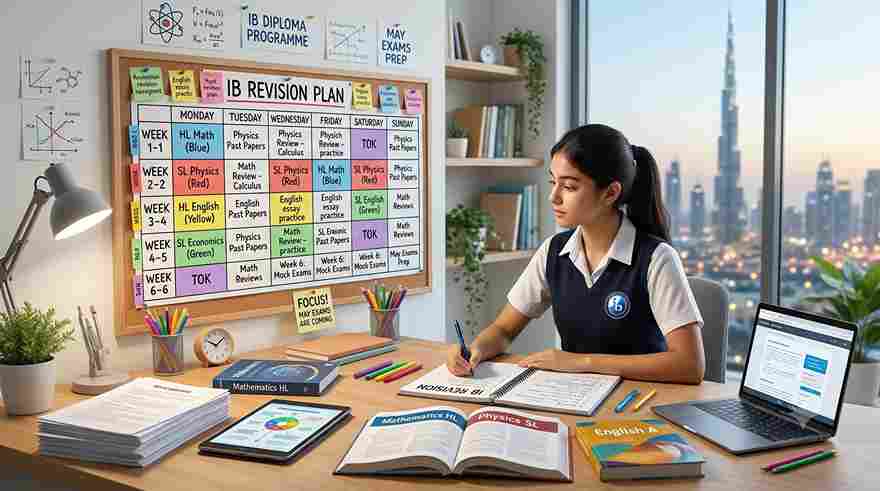
When IB exams are approaching, many students feel that there is too much to cover and too little time to do it. Subjects pile up, past papers wait on the desk and the evenings slip away. A clear timetable will not make the workload smaller, but it does make it manageable. This guide walks UAE parents and students through a six-week plan for May exams, with practical steps you can adapt to your child's subjects and school calendar.
Why a timetable helps more than a long list
A to-do list tells a student what needs doing. A timetable tells them when. That difference matters. When revision lives only in a list, students tend to start with the subject they like most, spend too long on one topic and leave the harder subjects for the final days. A timetable spreads the effort across the weeks, so every subject gets attention before the exams begin.
A timetable also makes progress visible. When a student can see that Week 3 is complete and Week 4 has three clear blocks, they can tell whether they are on track. That sense of control reduces stress, which many students find as useful as the revision itself.
Step one: list the subjects and the key dates
Start by writing down every subject your child sits, the exam date for each paper and any school deadlines, such as internal assessments or coursework submissions. Exam dates change from year to year, so check the official provider's current dates and your child's school timetable rather than relying on last year's schedule.
Next, mark the number of weeks you have. For this plan, we use six weeks, which gives a clear run-up without starting too early. If your child has more time, you can extend the plan. If they have less, keep the same structure and shorten each stage.
Step two: sort subjects by confidence and weight
Not every subject needs the same amount of time. Ask your child to rate each subject from one to five for confidence. Then consider how many papers each subject has and how heavily it is weighted in the final mark. A subject with a low confidence score and several papers should get more weekly blocks, even if your child likes it less.
It can help to talk this through together. Students often have a clear sense of which topics they find difficult, and naming them gives you a starting point for the first weeks of the plan.
Step three: build a weekly template
Use a simple weekly template rather than a different plan for each day. A workable pattern is four to five study blocks on weekdays and one or two longer blocks at the weekend. Each block should last between 45 and 60 minutes, with a short break between blocks. Keep the same subjects in the same slots each week, so the routine becomes familiar.
Within each block, give the student a clear task. Instead of writing "Chemistry", write "Chemistry: redox reactions, notes and five questions". Specific tasks are easier to start and easier to finish, and they show your child exactly what success looks like.
Step four: schedule past papers in a steady rhythm
Past papers are one of the most useful revision tools for IB students, because they show how questions are asked and how time is managed. Check the official IB materials for the current years available, and ask your child's teachers which papers they recommend.
Build past papers into the timetable from Week 2 onwards. Early in the plan, a student might attempt one paper section and mark it with the mark scheme. In the middle weeks, they might complete a full timed paper each week. In the final two weeks, a rhythm of two papers a week, with careful review, usually works well. Always leave time after a past paper to review the mistakes, because the review is where much of the learning happens.
Step five: protect rest and sleep
A revision timetable that leaves no time for rest is not a good plan. Sleep, exercise, meals and time with friends all help memory and focus. Schedule at least one fully free half-day each week, and keep the last evening before an exam light. Students who arrive at an exam rested usually perform more calmly than those who stayed up late revising.
If a week goes badly, do not abandon the plan. Move the missed block to the next free slot, and keep going. Consistency matters far more than perfection.
Balancing revision with school work
Revision rarely happens in an empty week. Students still have classes, homework, internal assessments and activities to fit in. A timetable that ignores these commitments will fail quickly. Before you fill the blocks, mark the school deadlines and any regular commitments, such as sports or music, on the same calendar. Then build the revision around them.
If a school assignment is due in Week 3, for example, reduce the revision load that week and move one or two blocks into the following week. This is not falling behind. It is protecting the parts of the plan that matter most. Students usually feel calmer when they can see that the timetable has room for real life.
When a week goes badly
Some weeks will not go to plan. A child may be unwell, a family event may take over an evening or a topic may prove much harder than expected. The most important rule is not to give up on the timetable. Instead, look at what was missed, move those blocks into the next free slots and keep going.
If the same subject is missed repeatedly, that is useful information. It may mean the subject needs fewer tasks, a clearer goal or extra support on a particular topic. Adjust the plan rather than blaming your child. A tutor or teacher can help identify where the difficulty lies, so the next week's blocks are more effective.
A practical checklist for parents
- Confirm exam dates and school deadlines with official sources and the school
- List every subject and rate your child's confidence in each
- Build a weekly template with specific tasks in each block
- Schedule past papers from Week 2, with time for review after every paper
- Keep one free half-day each week and a light evening before each exam
- Review the timetable together every Sunday and adjust for the coming week
- Ask the tutor or teacher which resources they use for each subject
How EdFlik can help
EdFlik offers live, one-to-one online classes for students aged 3 to 18. A class lasts about one hour, which is long enough to work through a difficult topic, mark a past paper together and set the goals for the week ahead. Classes start from AED 45 per class, and you can book a free trial class before you decide on a package.
If your child needs support with one subject in the timetable, ask whether the tutor teaches that IB course before you book. Many parents start with a trial class in their weakest subject, then add others once they see how the sessions help. You can also ask which resources the tutor uses for past papers and mark schemes. To book a free trial class, visit www.edflik.com, or email support@edflik.com with your questions.
Conclusion
A six-week IB revision timetable turns a crowded calendar into a series of small, clear steps. Start with the dates, sort subjects by confidence, use a simple weekly pattern and build in past papers and rest. Review the plan together each week, and adjust it when life gets in the way. With a steady routine and calm support, your child can approach the May exams with confidence.
Frequently Asked Questions
When should IB revision start for May exams?
Many students begin structured revision about six weeks before their first exam, but the right start depends on the subjects, the school calendar and how much revision was done earlier. Check the official exam dates and talk to your child's teachers about their recommended start point.
How many hours a week should IB students revise?
There is no single right number. Most plans use weekday blocks of 45 to 60 minutes and one or two longer weekend blocks. The best amount is the one your child can keep up with consistently, while still getting enough sleep and rest.
How do you split revision across several IB subjects?
Sort subjects by confidence and by the number of papers, then give more blocks to the weaker or heavier subjects. Keep the same subjects in the same slots each week so the routine feels familiar. Rotate subjects within the week to avoid long stretches of one topic.
Where do past papers fit in the timetable?
Start past papers in the second week, with short sections at first and full timed papers later. Always schedule review time after each paper. Use the official materials and mark schemes for the years available, and ask teachers which papers they recommend.
How can a parent check the timetable is working?
Look at it together each week. Ask which blocks were completed, which topics feel clearer and where your child is still struggling. If a subject keeps slipping, adjust the blocks rather than adding more hours. Small weekly reviews are more useful than a single check at the end.
More on IB
- The IB in the UAE: A Complete Guide to PYP, MYP and the Diploma Programme
- UAE Spring Break Revision Plan 2027 for IGCSE, A-Level and IB Students
- How to Prepare for IB Exams UAE 2026 — Complete IB Diploma Revision Guide for Grades 11 and 12
- How to Ace the IB MYP eAssessment: Top Revision Tips for Sciences and Mathematics
- All IB articles