How to Improve IGCSE Grades UAE 2026 — From Grade C to A and A* with Targeted Preparation
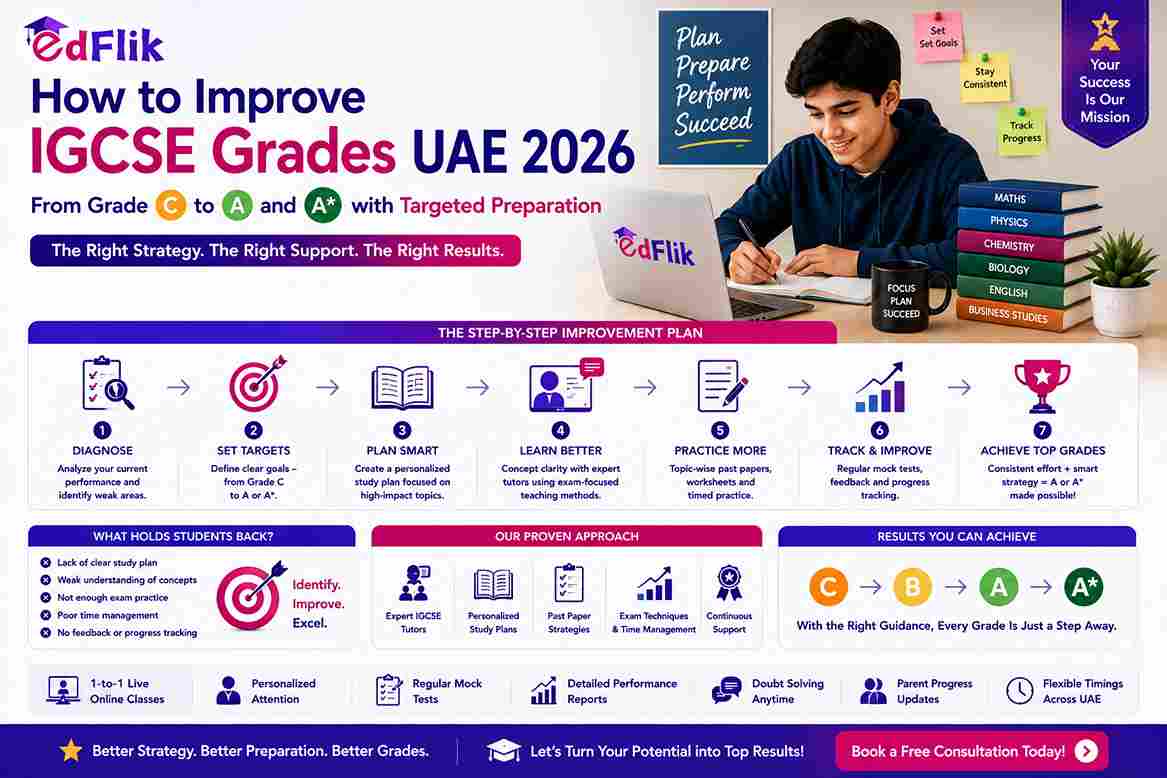
Improving an IGCSE grade from C to A is one of the most reliably achievable academic improvements in the UAE school system — and one of the most commonly sought by families following November mock results, June Cambridge results, and Year 10 end-of-year reports. The reason this improvement is more achievable than it sounds: Grade C students typically have the content knowledge to earn Grade A. The gap is almost always technique, not knowledge. This guide explains why, and exactly how to close that gap.
Why Grade C Students Have A-Grade Knowledge
Cambridge IGCSE Grade C boundaries typically fall at approximately 50-60% of total marks. This means a Grade C student answered roughly half of all marks correctly. A Grade A boundary typically falls at approximately 75-80% of marks. The difference — approximately 20-30% of total marks — is almost always recoverable, because:
• Grade C students know enough content to answer most questions correctly — they lose marks not because they lack knowledge but because they present correct knowledge in ways Cambridge mark schemes do not reward
• Method marks (marks for showing correct working even when the final answer is wrong) are regularly missed by students who do not know mark-scheme conventions
• Mark-scheme language — specific terminology that Cambridge examiners require — is a learnable skill that has nothing to do with intelligence or subject ability
• Time management — the specific issue of spending too long on low-mark questions and not enough on high-mark questions — is correctable through timed practice
|
The grade C
to grade A improvement does NOT require learning new content. It requires
developing the four technique skills: (1) mark-scheme language, (2) method
mark presentation, (3) question type recognition, (4) time management. All
four are explicitly trainable through past paper work with mark-scheme
correction. This is precisely what effective IGCSE tutoring delivers. |
The Four Technique Gaps that Separate Grade C from Grade A
|
Technique Gap |
What It Looks
Like in Grade C |
What Grade A
Looks Like |
How to Fix It |
|
Mark-scheme
language |
Correct
understanding expressed in everyday language: "the rate goes up because
there's more energy" |
Correct
understanding in mark-scheme language: "higher temperature increases
average kinetic energy of particles, increasing frequency of successful
collisions with activation energy" |
30-minute
daily mark-scheme review — read the mark scheme answer for every question
marked wrong; copy the specific phrases; test recall in next tutoring session |
|
Method mark
presentation |
Writes only
the final numerical answer without showing working steps |
Shows each
step: writes the formula, substitutes values, shows intermediate calculation,
states the answer with units |
Past paper
solutions written step-by-step even for "obvious" calculations;
tutor marks specifically for method mark compliance |
|
Question type
recognition |
Spends equal
time on all questions regardless of marks available |
Immediately
identifies mark value and question type; allocates time accordingly; writes
the correct depth of answer for 1-mark vs 6-mark questions |
Past paper
training specifically on identifying question type from first reading;
explicit rule: marks available = sentences required (approximately) |
|
Time
management |
Runs out of
time on the final section of each paper |
Finishes with
5-10 minutes to check answers |
Timed section
practice — practise Paper 2 Section A and Section B separately under timed
conditions before combining into full paper practice |
Subject-Specific Grade C to A Strategies
IGCSE Mathematics (0580)
Method marks are the most recoverable improvement in IGCSE Maths. Show the formula before substituting. Show intermediate steps even when the algebra is obvious. Write the units in all numerical answers. These three habits alone recover 5-10 marks per paper in most Grade C scripts — converting C to B or B to A.
IGCSE Sciences (Physics, Chemistry, Biology)
Mark-scheme language is the primary improvement lever. For each of the 10 most commonly tested IGCSE Science topics, learn the exact phrasing Cambridge mark schemes use — not the textbook explanation but the mark-scheme point. Practise writing answers to past paper questions then comparing word-for-word with the mark scheme.
IGCSE Business Studies and Economics
The evaluation essay structure — define, apply, two-sided analysis, justified conclusion — produces immediate grade improvement once internalised. Grade C essays provide one side of an argument. Grade A essays provide both sides and justify a conclusion. This structural shift is learnable in 3-5 sessions.
|
EdFlik IGCSE
grade improvement tutoring begins with a diagnostic that identifies the
specific technique gaps causing marks to be lost — not general content
revision. Past paper focused from Session 1. From AED 55 per session. Free
diagnostic. Book at www.edflik.com or WhatsApp +91 88788 96600. |
Frequently Asked Questions
Q: Is it realistic to go from Grade C to Grade A in IGCSE?
Yes — one of the most reliably achievable improvements with targeted preparation. C to A typically takes 4-6 months. C to A* takes 7-9 months. Grade C students usually have sufficient content knowledge — the gap is technique, not knowledge.
Q: What is the difference between a Grade C and Grade A IGCSE answer?
Mark-scheme alignment. Grade C students know the content but express it in language Cambridge mark schemes do not award. Grade A students have learned the specific mark-scheme terminology. The underlying knowledge is often identical — the language is different.
Q: What is the most efficient way to improve IGCSE grades in 6 months?
Month 1: diagnostic. Month 2: targeted gap closure on the 3-5 highest-mark-loss question types. Months 3-4: one timed past paper every two weeks with mark scheme review. Month 5: mark-scheme language consolidation. Month 6: full exam simulation.
Q: Which IGCSE subjects are easiest to improve quickly?
Mathematics Extended (method marks), Business Studies (evaluation essay formula), Economics (same), and Chemistry (systematic mark-scheme language patterns) all show reliable rapid improvement with past paper technique training.
Q: Should a UAE student who received Grade C in IGCSE retake the exam?
If the subject is a prerequisite for A-Level or IB (Chemistry C when intending A-Level Chemistry), or if the grade affects Sixth Form entry conditions: yes, retake in October/November with targeted preparation. If neither applies and the C meets the minimum requirement: retaking is optional.