IGCSE Computer Science Tutor UAE | EdFlik
IGCSE Computer Science Tutoring in the UAE: Theory, Programming, and How to Score High
Cambridge IGCSE Computer Science (0478) is one of the fastest-growing subject choices among international school students in the UAE, driven by growing interest in technology careers and by the subject's reputation as intellectually demanding and genuinely useful. Unlike purely descriptive IGCSE subjects, Computer Science requires students to think algorithmically — to decompose problems, design solutions, and write programmes that work. This guide explains what the qualification covers, where students struggle, and how specialist tutoring helps UAE students score well.
What Cambridge IGCSE Computer Science (0478) Tests
The qualification is assessed through two papers:
· Paper 1 — Theory, 1 hour 45 minutes, 75 marks (75% of final grade). Multiple-choice, short-answer, and extended-response questions covering all theory topics including data representation, hardware and software, networks, databases, logic gates, and ethics.
· Paper 2 — Problem-Solving and Programming, 1 hour 45 minutes, 50 marks (50% of final grade). Requires students to trace algorithms, correct pseudocode, design flowcharts, and write programmes in pseudocode or a high-level language.
Why Students Struggle With IGCSE Computer Science
Paper 1: Theory Volume and Precision
Paper 1 covers a broad range of computer science theory. The challenge is not just learning the content — it is answering questions with the precision that Cambridge mark schemes require. A student who writes that an operating system 'manages the computer' scores fewer marks than one who writes that it 'manages hardware resources, provides a user interface, and controls access to memory and the processor.' Mark schemes at IGCSE level reward specificity, and Computer Science is no exception.
Paper 2: Programming Under Examination Conditions
Most students encounter programming for the first time in their Computer Science classroom and do not practise writing code without IDE support, autocomplete, or the ability to run and test their output. Examination conditions remove all of these. Students must write syntactically close-to-correct pseudocode or Python from memory, trace through an existing algorithm, and debug code by reading — not by running. These are distinct skills from programming in a normal development environment, and they must be specifically practised.
Key Topics and How to Approach Them
Data Representation
Binary and hexadecimal conversion, binary arithmetic, two's complement for negative numbers, ASCII encoding, and the representation of sound and images are all Paper 1 topics that respond very well to practice. These are mathematical — not just conceptual — and students who practise conversions regularly can earn these marks reliably.
Logic Gates
Logic gate questions test students on AND, OR, NOT, NAND, NOR, and XOR gates. Students must draw truth tables, write Boolean expressions, and construct logic circuits from Boolean expressions or truth tables. This topic is learnable and marks-dense — a student who masters all six gate types earns logic gate marks consistently across every paper that tests them.
Algorithms and Pseudocode
Algorithmic thinking is the core skill of Paper 2. Students must understand sequence, selection, and iteration; be able to write loops, conditional structures, and procedures in pseudocode; and trace through existing algorithms step by step to find outputs or bugs. The most effective preparation is writing pseudocode from scratch to solve problems — not reading or copying it.
How EdFlik Tutors Support IGCSE Computer Science in the UAE
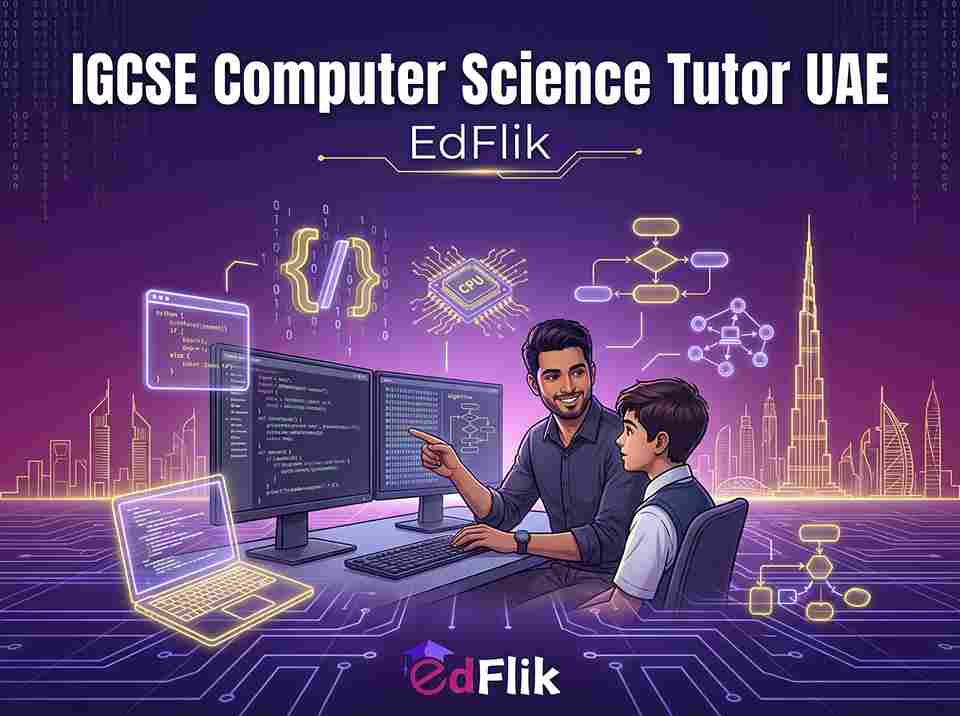
EdFlik's IGCSE Computer Science tutors are qualified teachers with direct experience in Cambridge 0478. They work through Paper 1 theory topics using mark-scheme-level explanation, and through Paper 2 using hands-on pseudocode and Python programming practice. Sessions are live and one-to-one, available from AED 45 per session, with a free trial class.
Frequently Asked Questions
What programming language is used in IGCSE Computer Science (0478)?
Cambridge IGCSE Computer Science (0478) does not mandate a specific programming language for the examination. Paper 2 (Problem-Solving and Programming) requires candidates to write pseudocode and to read, trace, and write programs in either pseudocode or a high-level language of their choice. In practice, Python is the most widely used language by teachers and candidates, because its syntax is close to Cambridge pseudocode and it is accessible for beginners. Some schools use Visual Basic or Java. EdFlik tutors work in pseudocode and Python and can accommodate other languages.
How hard is IGCSE Computer Science compared to IGCSE Maths?
IGCSE Computer Science is generally considered moderately challenging. Paper 1 (Theory) requires students to learn a substantial body of content covering hardware, software, networking, data representation, and security — this is content-heavy but largely factual. Paper 2 (Problem-Solving and Programming) is where most students find the greatest difficulty, because it requires writing and debugging code or pseudocode under timed examination conditions, which rewards students who have practised programming regularly. Students who are mathematically comfortable typically adapt well to the algorithmic thinking required.
What topics are in IGCSE Computer Science Paper 1?
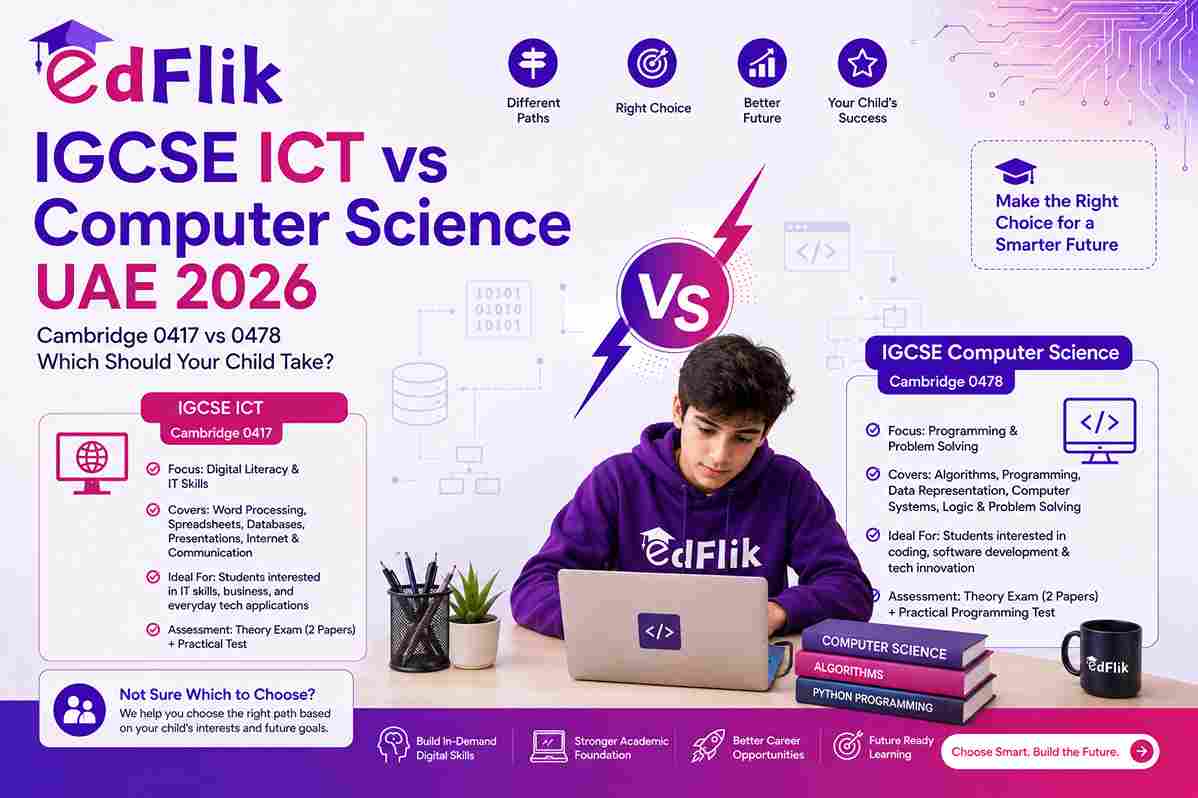
Cambridge IGCSE Computer Science 0478 Paper 1 covers: data representation (binary, hexadecimal, ASCII, sound and image digitisation), hardware and software (CPU architecture, memory, input/output devices, operating systems), networks (network topologies, protocols, security), logic gates and truth tables, ethics and cyber security, and databases. These topics are tested through short-answer and extended-response questions. The logic gates section is particularly amenable to targeted practice and carries reliable marks for students who have learned all common gate types and their Boolean expressions.
Is IGCSE Computer Science a good choice for UAE students who want to study technology at university?
Yes. IGCSE Computer Science is an excellent foundation for students intending to study Computer Science, Software Engineering, Artificial Intelligence, Data Science, or any technology-related field at university. It establishes understanding of the fundamental principles — hardware, software, networks, and basic programming — that underpin all subsequent study. For UAE students aiming at technology degrees at universities in the UK, UAE, or US, taking IGCSE Computer Science is a strong signal of interest and preparation. It does not directly replace A-Level Computer Science or IB Computer Science for selective admissions, but provides a solid base for those subsequent qualifications.
Book a Free IGCSE Computer Science Trial Class
EdFlik provides IGCSE Computer Science tutoring for students across the UAE. Qualified teachers, live 1-to-1 sessions, from AED 45. Free trial at edflik.com.