How to Master IGCSE English Language Paper 1: Reading Non-Fiction and Transactional Analysis
Last Updated: October 2026 | By EdFlik Education Team
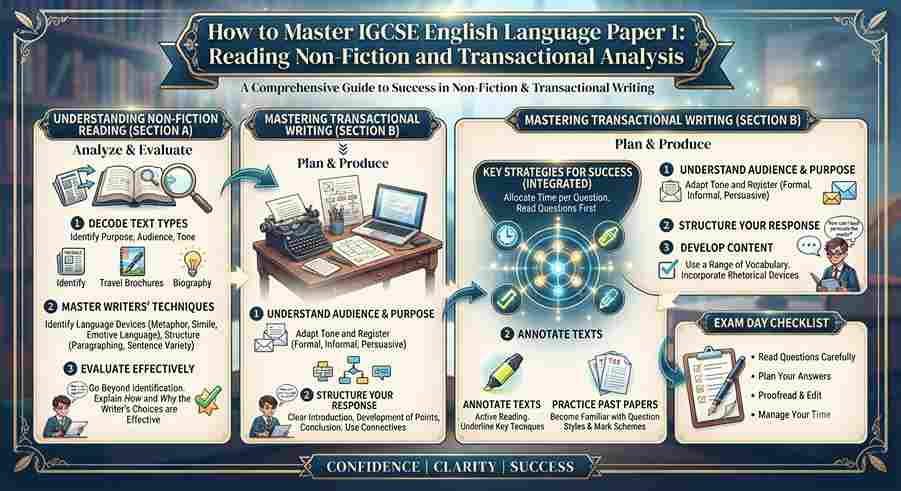
For students studying Pearson Edexcel IGCSE English Language (Specification A - 4EA1) or Cambridge IGCSE First Language English (0500/0990), Paper 1 represents the cornerstone of secondary language assessment. Entitled Reading Non-Fiction and Transactional Writing, this high-stakes examination tests your ability to deconstruct 19th-, 20th-, and 21st-century unseen texts, analyze authorial craft, and craft compelling transactional pieces such as letters, articles, speeches, and reports.
Many students lose marks on Paper 1 not because they lack reading comprehension skills, but because they treat exam passages like casual magazine articles rather than meticulously crafted rhetorical artifacts. Examiners look for precise textual evidence, deep exploration of implicit meanings, and absolute control over register and form.
In this comprehensive, exam-focused masterclass guide, our expert IGCSE English educators break down the official paper structure, unpack the secrets of top-band reading analysis, and provide a foolproof blueprint for transactional writing success.
Part 1: Deconstructing the Paper 1 Exam Structure
To manage your time effectively during the 2-hour-and-15-minute examination, you must master the two core sections of the paper:
Section A: Reading (Unseen Non-Fiction Texts)
- The Texts: You will be given an anthology extract or unseen non-fiction texts (often spanning historical and modern contexts, such as autobiographies, travel writing, journalism, or essays).
- The Questions: Moving from low-tariff retrieval and summary questions up to high-tariff analytical questions (worth 12 to 15 marks), culminating in a comparative evaluation of writer's craft and viewpoint.
Section B: Transactional Writing (Directed Writing)
- The Task: You must produce a single, extended piece of transactional writing (approx. 400–600 words) responding to a prompt and audience brief (e.g., writing a formal speech arguing for environmental policy reform or a persuasive article for a broadsheet newspaper).
- The Assessment Focus: Evaluated across two equally weighted domains: AO2 (Communication and Organization - 20 marks) and AO3 (Range of Vocabulary and Sentence Structures - 20 marks), totaling 40 marks.
Part 2: Section A — Mastering Non-Fiction Reading Analysis
When reading the unseen texts, you must adopt the mindset of an analytical critic. Follow this 3-step reading framework during your first 15 minutes of exam time:
1. Contextualize Before You Read
Always read the source metadata at the top of the extract (who wrote it, when it was published, and what genre it belongs to). Understanding whether a text was written in Victorian London or modern-day Dubai instantly frames its tone, formality, and rhetorical purpose.
2. Annotate Writer's Choices (The "PET" Method)
When answering language and structure questions, avoid vague statements like "The writer uses good adjectives." Instead, use the PET framework:
- Point: Identify the specific effect or tone created in the paragraph.
- Evidence: Embed a short, precise quotation directly into your analytical sentence.
- Terminology & Technique: Name the exact linguistic device (e.g., sibilance, dynamic verbs, juxtaposition, tripartite list, direct address, or high-modality syntax) and explain its psychological impact on the reader.
3. Track Structural Shifts
For structure questions, examiners award top marks to students who track how a text evolves from beginning to end. Look for shifts in focus:
- Does the text open with a broad panoramic description before zooming into an intimate personal anecdote?
- Does the mood shift from nostalgic reflection to urgent alarm?
Part 3: Section B — The Transactional Writing Blueprint
Section B carries massive weight in your overall grade. To score in the top band (Level 5), your writing must be engaging, purposefully structured, and linguistically ambitious.
1. Nail the Form and Register Immediately
Examiners check your adherence to form right away. If the prompt asks for a formal letter, include standard address blocks and a formal sign-off ("Yours sincerely" or "Yours faithfully"). If it asks for an opinion article, include a catchy headline and a journalistic byline.
- Audience Awareness: Adapt your tone. A speech to teenage peers requires energetic rhetoric and direct address, whereas a report to a local government official requires authoritative, objective, and persuasive gravitas.
2. The 5-Paragraph Transactional Structure
- Paragraph 1 (The Hook & Thesis): Introduce the topic with a rhetorical hook, establish your viewpoint clearly, and outline your core arguments.
- Paragraph 2 (Argument 1 - Pathos): Appeal to the reader's emotions through vivid anecdotes, powerful imagery, and sensory language.
- Paragraph 3 (Argument 2 - Logos): Inject intellectual weight using statistical assertions, expert framing, or logical counterargument refutation.
- Paragraph 4 (The Counterargument Pivot): Acknowledge the opposing view briefly before dismantling it sharply to reinforce your own authority.
- Paragraph 5 (The Call to Action Conclusion): Summarize your core thesis and leave the reader with a memorable, resounding final sentence (e.g., using a cyclical callback to your opening hook).
3. Elevate Your Sentence Architecture
To secure top marks under AO3, avoid writing repetitive, simple sentences. Vary your syntax intentionally across the piece:
- Use minor sentences for dramatic punch ("Silence.").
- Employ tripartite lists for rhythm ("We must act with courage, with conviction, and without delay.").
- Incorporate fronted adverbials and embedded clauses to demonstrate advanced grammatical control.
Part 4: Top 4 Exam Traps That Cost Students Paper 1 Marks
- Over-Quoting in Reading Answers: Copying out massive 3-line blocks of text instead of selecting tight, 2-to-4-word embedded quotations. Examiners want to see laser-focused word analysis.
- Ignoring the Bullet Points in Writing Prompts: In Section B, the prompt often provides bulleted guidance points (e.g., "Write about your personal experiences, what authorities should do, and your vision for the future"). Failing to cover all bullet points caps your organizational score.
- Mixing Up Tone and Register: Writing an informal, chatty blog post when the prompt explicitly asks for a formal, persuasive speech to school governors.
- Running Out of Time: Spending 50 minutes on Section A reading questions and leaving yourself only 25 minutes to write a rushed, unproofread 400-word essay. Practice strict time allocation during mock exams.
Struggling with IGCSE English Language Paper 1 reading analysis, transactional writing, or past-paper mark schemes? EdFlik connects international school students globally with expert, 1-to-1 online English tutors, helping you master textual deconstruction and secure top $A^$ grades.*Book a Free Demo Class Today!
Frequently Asked Questions (FAQs)
Q1: How long should my Section B transactional writing piece be?
Ans: While quality always trumps quantity, top-scoring responses typically range between 450 and 650 words. This provides enough space to develop three robust arguments without rambling or repeating points.
Q2: Do I need to memorize literary terms for IGCSE English Language?
Ans: Yes! Having a strong toolkit of linguistic and structural terminology—such as lexical field, juxtaposition, anaphora, hyperbole, syntactical parallelism, and shifting focus—allows you to articulate precise analysis under examination conditions.
Q3: Can I write in the first person ("I") for transactional writing?
Ans: Absolutely. Unless the prompt asks you to write strictly from an objective third-person standpoint (such as an informational report), using personal voice, anecdotes, and "I" or "we" is highly effective for persuasive speeches, letters, and opinion articles.
Q4: How does EdFlik support IGCSE English students?
Ans: EdFlik connects international school students worldwide with vetted, expert 1-to-1 online English tutors specializing in Pearson Edexcel and Cambridge IGCSE curricula. Our personalized sessions focus on rigorous reading comprehension, essay planning, vocabulary enhancement, and timed exam practice.