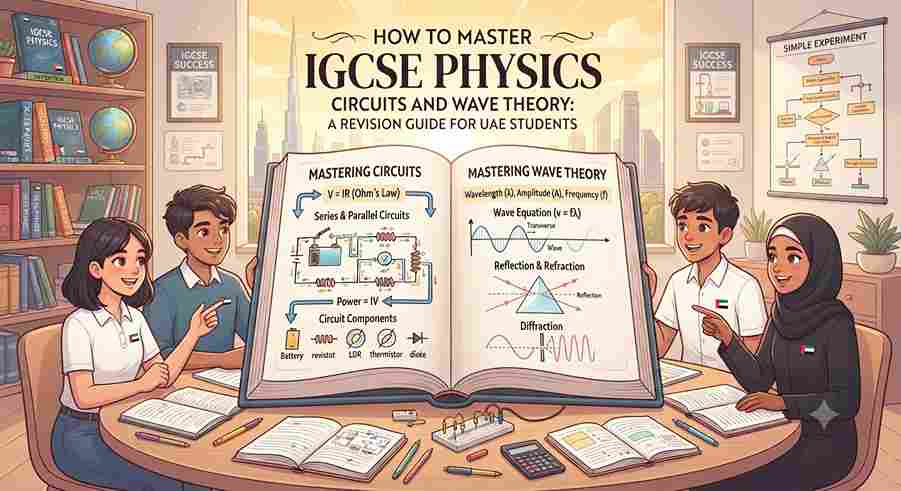
How to Master IGCSE Physics Circuits and Wave Theory: A Revision Guide for UAE Students
Last Updated: September 2026 | By EdFlik Education Team
For students studying Cambridge IGCSE or Pearson Edexcel IGCSE Physics, certain topics consistently stand out as high-tariff grade deciders. Among these, Electricity (Circuits) and Wave Theory (Waves) generate some of the highest point losses on exam papers if approached through passive memorization rather than conceptual understanding.
Examiners don't just want you to memorize Ohm's Law or recite definitions of frequency; they want to see your ability to analyze complex circuit diagrams, solve multi-step resistance problems, and apply wave properties to real-world scenarios.
In this comprehensive guide, our expert IGCSE Physics tutors break down the core principles, common student traps, and proven strategies needed to master Circuits and Waves for your upcoming exams.
Part 1: Electricity and Circuits — Connecting the Dots
Circuit electricity is a favorite testing ground for examiners because it requires both quantitative calculation and qualitative reasoning.
1. The Big Three Equations You Must Master Cold
You cannot survive an IGCSE Physics paper without instant, fluid recall of fundamental electrical relationships:
- Ohm’s Law: $V = I \times R$ (Voltage = Current $\times$ Resistance)
- Electrical Power: $P = I \times V$ and $P = I^2 \times R$
- Energy Transfer: $E = P \times t = I \times V \times t$
2. Series vs. Parallel Circuits: The Golden Rules
Students frequently mix up how current, voltage, and resistance behave in different circuit types. Memorize these absolute rules:
- Series Circuits:
- Current ($I$) is the same at all points in the circuit.
- Voltage ($V$) is shared across the components ($V_{\text{total}} = V_1 + V_2 + \dots$).
- Total resistance is simply the sum: $R_{\text{total}} = R_1 + R_2 + \dots$.
- Parallel Circuits:
- Voltage ($V$) across each parallel branch is equal to the source voltage.
- Current ($I$) is shared/split between the branches ($I_{\text{total}} = I_1 + I_2 + \dots$).
- Total resistance decreases as more resistors are added in parallel because you provide more pathways for charge to flow.
3. Component Characteristics (LDRs and Thermistors)
Expect a 4-mark question asking how a Light Dependent Resistor (LDR) or a thermistor behaves in a potential divider circuit when light levels or temperatures change.
- LDR: As light intensity increases, resistance decreases (LID: Light Increases, Resistance Down).
- Thermistor: As temperature increases, resistance decreases (TURD: Temperature Up, Resistance Down).
- Exam Tip: When answering these, always structure your answer in three clear steps: 1. State what happens to the component's resistance. 2. State how this affects the total resistance and current in the circuit. 3. Explain how the potential difference (voltage) splits across the resistors.
Part 2: Wave Theory — Energy Transfer Without Matter Transfer
Waves are everywhere—from light and sound to Wi-Fi signals in your classroom. IGCSE wave questions test your grasp of wave properties, wave phenomena, and the electromagnetic spectrum.
1. The Universal Wave Equation
The master equation for all wave motion is tested in almost every exam paper:
$$v = f \times \lambda$$
(Where $v$ = wave speed in $\text{ms}^{-1}$, $f$ = frequency in Hertz [Hz], and $\lambda$ = wavelength in meters [m]).
- Crucial Exam Trap: When a wave travels from one medium to another (e.g., light passing from air into glass), its frequency ($f$) remains constant because it is determined by the source. However, its speed ($v$) and wavelength ($\lambda$) change.
2. Transverse vs. Longitudinal Waves
- Transverse Waves: Oscillations are perpendicular to the direction of energy transfer (e.g., water ripples, all electromagnetic waves, secondary seismic waves).
- Longitudinal Waves: Oscillations are parallel to the direction of energy transfer, featuring compressions and rarefactions (e.g., sound waves, ultrasound, primary seismic waves).
3. Reflection, Refraction, and Diffraction
- Reflection: The angle of incidence equals the angle of reflection ($i = r$). Always measure angles relative to the normal line (perpendicular to the surface), not the surface itself!
- Refraction: Bending of waves when entering a medium of different density due to a change in speed. Remember: Faster speed = bending away from the normal; slower speed = bending towards the normal.
- Diffraction: The spreading out of waves when they pass through a gap or around an obstacle. Diffraction is maximum when the wavelength is roughly similar in size to the width of the gap.
Part 3: Top 4 Strategies to Score an A* in IGCSE Physics
- Never Drop Your Units: In calculation questions, marks are frequently awarded for correct units ($\text{A}, \text{V}, \Omega, \text{Hz}, \text{m/s}$). Make it a habit to write units at every step of your working out.
- Practice Circuit Diagram Redrawing: Exam boards often draw complex, messy circuit diagrams to confuse you. Practice redrawing them neatly on scrap paper to clearly identify series and parallel branches before attempting calculations.
- Master Ray Diagrams: For optics and wave reflection/refraction questions, use a sharp pencil and a ruler. Examiners strictly penalize inaccurate ray tracing where lines do not intersect at correct focal points or boundaries.
- Drill Past Paper Command Terms: Know the difference between state, describe, explain, and calculate. When asked to "explain" diffraction, a simple definition won't earn full marks; you must explain the relationship between wavelength and gap size.
Struggling to solve complex circuit calculations or wrap your head around wave refraction? EdFlik offers expert, 1-to-1 online tutoring customized specifically for Cambridge and Edexcel IGCSE Physics, helping you build analytical confidence and ace your exams.Book a Free Demo Class Today!
Frequently Asked Questions (FAQs)
Q1: Why does adding resistors in parallel decrease total resistance?
Ans: Because adding parallel branches provides alternative pathways for electric current to flow. Since more electrons can flow simultaneously for the same applied voltage, the overall opposition (resistance) of the circuit decreases.
Q2: Does frequency change when a wave refracts?
Ans: No. Frequency is strictly determined by the source generating the wave and never changes when crossing a boundary between different media. Only speed and wavelength change during refraction.
Q3: What is the difference between IGCSE Physics Paper 2 (Core) and Paper 4 (Extended)?
Ans: Paper 4 (Extended) covers the entire syllabus in greater depth, featuring rigorous multi-step calculations, complex circuit analysis, and advanced qualitative explanations, whereas Paper 2 tests foundational core concepts.
Q4: How can EdFlik help my child improve their IGCSE Physics grade?
Ans: EdFlik connects students with experienced, certified 1-to-1 online tutors who specialize in IGCSE Physics. Our tutors break down difficult formulas, demystify tricky circuit diagrams, and guide students through targeted past paper practice.