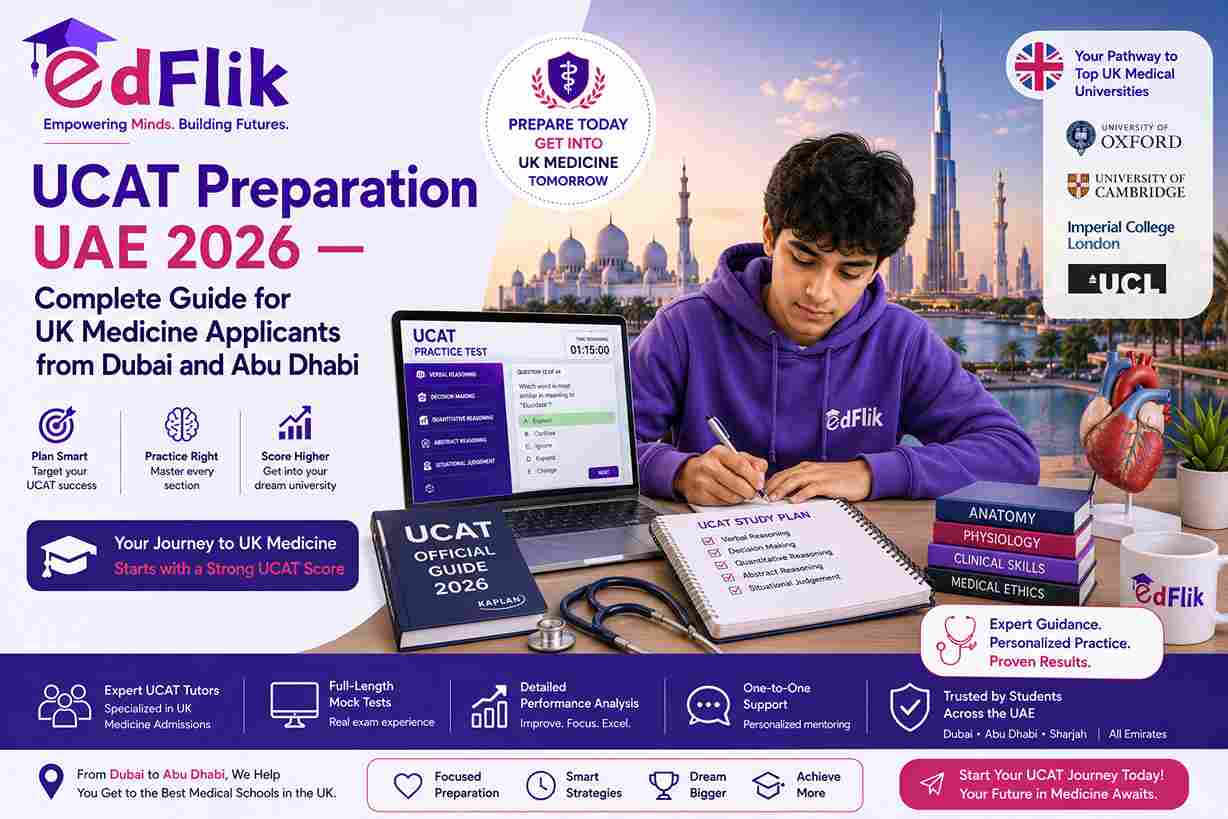
How to Prepare for the UCAT: Medical School Admissions Guide for UAE High Schoolers
Last Updated: October 2026 | By EdFlik Education Team
For ambitious high school students across the United Arab Emirates—whether studying in premier British, International Baccalaureate (IB), or American curriculum schools in Dubai, Abu Dhabi, or Sharjah—securing a spot in a top-tier medical school is a monumental aspiration.
For years, prospective medical applicants faced a confusing choice between two major admissions tests: the UCAT and the BMAT. However, a vital update has reshaped the landscape: The BioMedical Admissions Test (BMAT) was officially discontinued. Today, the University Clinical Aptitude Test (UCAT) stands as the universal standard required across virtually all UK medical and dental schools—including former BMAT strongholds like the University of Oxford and the University of Cambridge.
In this comprehensive, masterclass guide, our expert medical admissions educators break down the current UCAT structure, provide a winning preparation roadmap, and reveal how UAE high schoolers can secure competitive scores.
Part 1: The New Admissions Landscape — UCAT as the Universal Standard
If you are consulting older prep books or legacy advice online, you will likely see references to preparing for both the UCAT and the BMAT. It is critical to note that the BMAT is no longer in use.
- What this means for you: You do not need to study advanced physics, chemistry, or curriculum-heavy biology essay formats for admissions tests. Instead, your entire standardized testing focus can be channeled entirely into mastering the UCAT.
- What the UCAT measures: Unlike school examinations that test your retention of biology or chemistry syllabi, the UCAT is a computer-based cognitive aptitude test designed to assess the mental capacities, logic, problem-solving skills, and professional behaviors deemed essential for future doctors and dentists.
Part 2: Deconstructing the UCAT Subtests
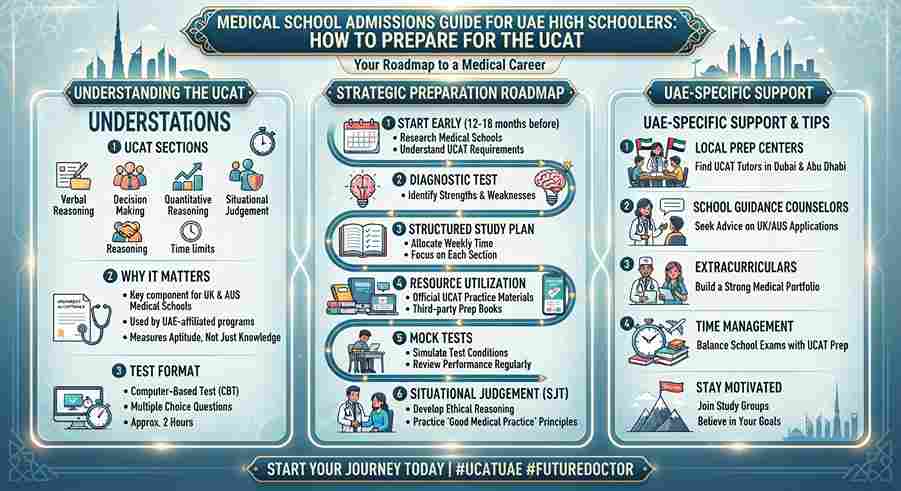
The UCAT is a rigorous, tightly timed 2-hour computer-based exam divided into five distinct subtests. Each cognitive section is scored on a scale from 300 to 900, while the Situational Judgment Test is categorized into distinct bands (Band 1 being the highest).
1. Verbal Reasoning (VR)
- Format: 44 passages with 11 questions (total 44 questions in 21 minutes).
- What it tests: Your ability to read, critically analyze, and evaluate information extracted from extended text passages, determining whether statements are true, false, or impossible to tell based only on the text.
- Top Tip: Do not rely on your general knowledge. If the passage states something that contradicts real-world facts, trust the passage exclusively.
2. Decision Making (DM)
- Format: 29 questions in 31 minutes.
- What it tests: Your ability to make sound decisions and draw conclusions under pressure using logic, evaluating arguments, interpreting probabilities, and analyzing diagrams.
- Top Tip: Master syllogisms and Venn diagrams early. Logic rules must be applied rigidly without personal bias.
3. Quantitative Reasoning (QR)
- Format: 36 questions in 24 minutes.
- What it tests: Your ability to use numerical skills to critically evaluate information presented in tables, charts, and graphs.
- Top Tip: Speed is everything here. You will have an on-screen calculator, but practicing mental estimation will save you vital seconds on multi-step data sets.
4. Abstract Reasoning (AR)
- Format: 55 questions in 13 minutes.
- What it tests: Your ability to identify hidden patterns, shapes, and structural rules in sets of abstract figures under extreme time pressure.
- Top Tip: Create a checklist of common pattern rules (e.g., number of sides, color distributions, intersections, rotational symmetry, or the "SCANS" mnemonic: Shape, Color, Arrangement, Number, Size).
5. Situational Judgment Test (SJT)
- Format: 69 questions across 26 scenarios in 26 minutes.
- What it tests: Your capacity to understand real-world medical ethics, professional integrity, empathy, team involvement, and appropriate responses to workplace dilemmas.
- Top Tip: Familiarize yourself fully with the General Medical Council (GMC) guidelines on medical ethics, patient confidentiality, and safety.
Part 3: The Ultimate UAE Student Timeline (Year 12 & 13)
Balancing your school mock exams or IB predicted grades while prepping for the UCAT requires strategic time management. Here is the ideal timeline for UAE high schoolers:
- January – March (Year 12 / Grade 11): Focus on baseline academic performance. Research target medical universities and note their minimum UCAT score cut-offs.
- April – May: Register for a UCAT account and begin light preparation. Take a diagnostic baseline test to identify your weakest subtests.
- June – July: Intensive preparation phase. Dedicate 1 to 2 hours daily to targeted subtest practice, question bank drills, and timed mini-mocks.
- August: Peak test-readiness. Sit full-length computer-based mock exams under strict simulation conditions.
- September: Test Window. Sit your UCAT exam at an authorized Pearson VUE testing center in Dubai or Abu Dhabi.
- October – January: Submit your UCAS or international applications armed with your verified UCAT score.
Part 4: Top 5 Strategies for Maximizing Your UCAT Score
- Embrace the "Guess, Flag, and Pass" Strategy: The UCAT is so fast that lingering on a single difficult question will ruin your entire section timing. If you are stuck for more than 30 seconds, make an educated guess, flag the question, and move on immediately.
- Simulate Real Test Conditions: Do not practice exclusively on paper or unproctored tablet apps. Use official online question banks that replicate the exact Pearson VUE calculator interface, font sizes, and keyboard shortcuts.
- Build Stamina Through Full Mocks: Sitting for 2 hours straight with zero breaks requires high mental endurance. Work your way up to completing at least 5 to 8 full-length timed mock exams before test day.
- Analyze Your Mistakes Systematically: Simply doing questions is not enough. Maintain an error log to categorize why you missed questions—was it a calculation error, a misread sentence, or a lack of time?
- Cultivate Ethical Reasoning for SJT: For the Situational Judgment section, practice weighing patient safety, team collaboration, and professional honesty above all else.
Preparing for medical school admissions across the UK or internationally? EdFlik connects international school students globally with expert, 1-to-1 online mentors and UCAT coaches, helping you master high-speed logic, bridge knowledge gaps, and secure competitive medical school offers.Book a Free Demo Class Today!
Frequently Asked Questions (FAQs)
Q1: What happened to the BMAT exam?
Ans: The BioMedical Admissions Test (BMAT) was officially discontinued by Cambridge Assessment Admissions Testing after its final sitting in October 2023. All universities that previously required the BMAT now use the UCAT or alternative internal processes.
Q2: Can UAE students take the UCAT locally?
Ans: Yes! The UCAT is delivered globally via Pearson VUE test centers. There are authorized testing centers located in Dubai, Abu Dhabi, and other major UAE hubs where you can book and sit your exam.
Q3: Does the UCAT require advanced mathematics or science knowledge?
Ans: No. The Quantitative Reasoning subtest only requires basic mathematical operations (percentages, ratios, fractions, and elementary arithmetic) up to GCSE / IGCSE or equivalent standard. It tests speed and data interpretation, not advanced calculus.
Q4: How does EdFlik support medical school applicants?
Ans: EdFlik connects international school students worldwide with vetted, expert 1-to-1 online tutors specializing in UCAT preparation, personal statement structuring, and medical interview (MMI/Panel) coaching. Our personalized sessions focus on speed, tactical strategy, and confidence-building.