How to Reconcile Bank Statements and Control Accounts in IGCSE Accounting
Last Updated: October 2026 | By EdFlik Education Team
For high school students completing the Cambridge IGCSE Accounting (0452) or Pearson Edexcel IGCSE Accounting (4AC1) qualifications, bookkeeping and financial control represent two of the most critical examinable pillars. Featured prominently in Paper 1 (Structured Questions) and Paper 2 (Structured and Extended Problems), tasks involving Bank Reconciliation Statements and Control Accounts (Trade Receivables and Trade Payables) regularly account for high-tariff, multi-step calculation and ledger-balancing items.
Every exam session, students lose valuable marks not because they don't understand basic double-entry bookkeeping, but because of common procedural errors: confusing items that belong in the updated cash book versus the bank reconciliation statement, misplacing debit and credit balances in control accounts, or mishandling contra entries and irrecoverable debts.
In this comprehensive, exam-focused masterclass guide, our expert IGCSE accounting educators break down the mechanics of bank reconciliations, demystify control account ledgers, explore common examiner traps, and provide a structured problem-solving framework to help you secure an $A^*$ grade.
Part 1: The Anatomy of Bank Reconciliations
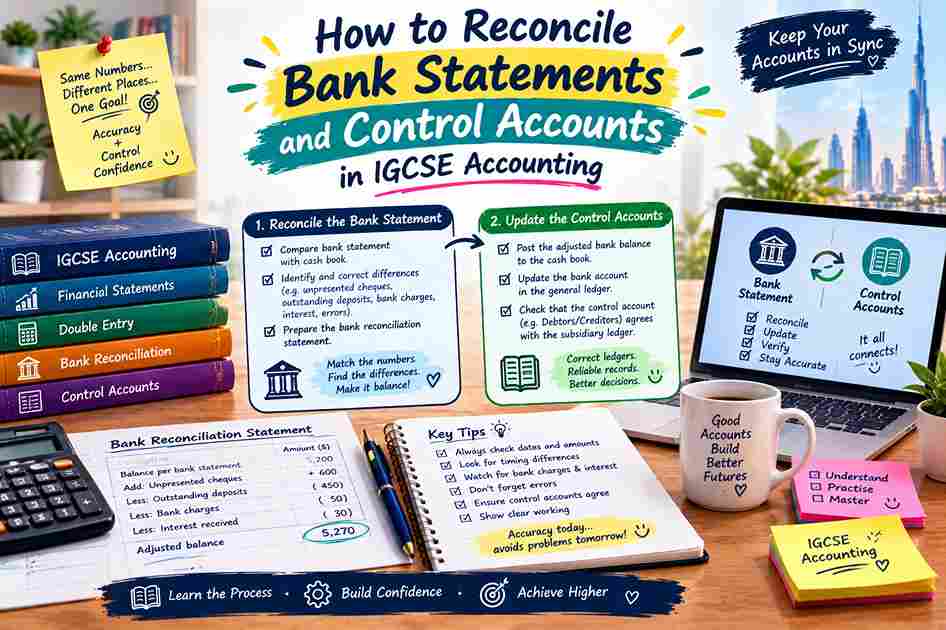
A Bank Reconciliation Statement is a financial schedule prepared by a business to explain the differences between the balance shown in its own Cash Book (Bank Column) and the balance shown on the official Bank Statement provided by the commercial bank as of a specific date.
Students often wonder why these two figures do not match automatically. The discrepancy arises due to timing differences and omissions.
                        WHY CASH BOOK & BANK STATEMENT DIFFER
                                          |
        +---------------------------------+---------------------------------+
        |                                                                   |
TIMING DIFFERENCES (BRS ITEMS)                                      OMISSIONS / UPDATES (CASH BOOK ITEMS)
• Unpresented cheques (Issued, not yet presented)                   • Bank charges and bank interest
• Amounts not yet credited (Deposited, not cleared)                 • Standing orders and direct debits
• Bank or Cash Book entry errors                                    • Dishonoured cheques / Credit transfers
1. Items That Require an Update to the Cash Book First
Before preparing the Bank Reconciliation Statement, any item recorded on the bank statement that has not yet been entered in the business's cash book must be adjusted directly in the cash book:
- Bank Charges & Bank Interest: Fees charged by the bank or interest earned/charged on overdrafts.
- Standing Orders & Direct Debits: Automated regular payments (e.g., rent, insurance, utility bills) or collections processed directly by the bank.
- Credit Transfers (Direct Credits): Payments made directly by customers into the business bank account (e.g., electronic funds transfers).
- Dishonoured Cheques: Cheques received from customers and previously recorded in the cash book that the bank subsequently refuses to pay due to insufficient funds (NSF).
- Cash Book Recording Errors: Omissions or transposition errors made by the bookkeeper in the cash book itself.
2. Items That Belong Solely on the Bank Reconciliation Statement (BRS)
These are timing differences where the business and the bank are aware of the transaction, but one party has recorded it while the other has not yet processed it:
- Unpresented Cheques: Cheques issued by the business to trade payables and recorded in the cash book as a credit (payment), but not yet presented to the bank for payment by the payee as of the statement date. (Effect: Reduces Cash Book balance; not yet reflected on Bank Statement).
- Amounts Not Yet Credited (Uncredited Deposits / Lodgements): Cheques or cash received from customers, recorded in the cash book as a debit (receipt), but not yet cleared or processed by the bank on the statement date. (Effect: Increases Cash Book balance; not yet reflected on Bank Statement).
- Bank Statement Errors: Mistakes made by the bank teller or automated clearing system (e.g., a cheque credited to the wrong account).
Part 2: Step-by-Step Bank Reconciliation Workflow
When an exam question asks you to update the cash book and prepare a bank reconciliation statement, follow this 4-step workflow:
                  THE 4-STEP BANK RECONCILIATION PROTOCOL
                                   |
  Step 1: Compare & Tick Off   ---> Cross-reference Cash Book bank column with Bank Statement items.
  Step 2: Update the Cash Book ---> Enter omitted bank charges, standing orders, and dishonoured cheques.
  Step 3: Extract New Balance  ---> Calculate the new adjusted cash book balance (Debit or Overdraft).
  Step 4: Prepare BRS Schedule ---> Reconcile adjusted cash book balance with Bank Statement using
                                     unpresented cheques and uncredited deposits.
Worked BRS Calculation Framework:
- Adjusted Cash Book Balance: $\$X$ (Debit balance or Overdraft)
- Add: Unpresented Cheques (Cheques issued but not yet cleared) $\rightarrow \$+\text{amount}$
- Less: Uncredited Deposits (Lodgements not yet cleared by bank) $\rightarrow \$-( \text{amount} )$
- Equals: Balance as per Bank Statement $\rightarrow \$Y$
Part 3: Understanding Control Accounts
A Control Account is a summary ledger account maintained in the general ledger that controls a subsidiary ledger (such as the Sales Ledger for Trade Receivables or the Purchases Ledger for Trade Payables).
Control accounts serve two primary functions:
- Internal Check: They provide a quick total of trade receivables and trade payables without extracting balances from hundreds of individual customer and supplier accounts.
- Error Detection: They help locate bookkeeping errors when a trial balance fails to agree.
                    CONTROL ACCOUNT LEDGER STRUCTURE
                                   |
        +--------------------------+--------------------------+
        |                                                     |
TRADE RECEIVABLES CONTROL ACCOUNT (SALES LEDGER)       TRADE PAYABLES CONTROL ACCOUNT (PURCHASES LEDGER)
• Opening Debit Balance (Asset / Owed to us)           • Opening Credit Balance (Liability / We owe them)
• Increases: Credit Sales, Dishonoured Cheques         • Increases: Credit Purchases, Interest Charged
• Decreases: Receipts, Discounts Allowed, Returns      • Decreases: Payments, Discounts Received, Returns
1. Comprehensive Breakdown of Control Account Entries
A. Trade Receivables Control Account (Sales Ledger Control)
- Debit Side (Increases what customers owe us):
- Opening debit balance (Balance b/d)
- Credit sales (Total sales day book)
- Interest charged on overdue accounts
- Dishonoured cheques (returned by bank)
- Refunds paid to customers (overpayments returned)
- Opening credit balances transferred from payables (rare contra)
- Credit Side (Decreases what customers owe us):
- Opening credit balance (customer overpayments / prepayments b/d)
- Bank / Cash received from trade receivables (settlements)
- Discounts allowed (cash discounts granted for prompt payment)
- Sales returns (Returns inwards / Credit notes issued)
- Irrecoverable debts written off (Bad debts)
- Contra entries (Set-offs against purchases ledger)
B. Trade Payables Control Account (Purchases Ledger Control)
- Credit Side (Increases what we owe suppliers):
- Opening credit balance (Balance b/d)
- Credit purchases (Total purchases day book)
- Interest charged by suppliers on overdue accounts
- Refunds received from suppliers
- Debit Side (Decreases what we owe suppliers):
- Opening debit balance (amounts overpaid to suppliers b/d)
- Bank / Cash paid to trade payables (settlements)
- Discounts received (cash discounts received from suppliers)
- Purchases returns (Returns outwards / Debit notes received)
- Contra entries (Set-offs against sales ledger)
2. Understanding Contra Entries (Set-Offs)
A contra entry occurs when a business is both a customer and a supplier to the same entity (i.e., we sell goods to them on credit, and we buy goods from them on credit).
- Instead of making two separate bank payments, the two accounts are offset against each other up to the smaller balance.
- Double Entry for Contra:
- Debit Trade Payables Control Account
- Credit Trade Receivables Control Account
Part 4: Top 4 Traps That Cost Students Marks in IGCSE Accounting
- Putting BRS Items into the Cash Book: Entering unpresented cheques or uncredited deposits into the updated cash book. Unpresented cheques and uncredited deposits belong only on the Bank Reconciliation Statement, never in the cash book!
- Confusing Debit and Credit Balances in Control Accounts: Placing customer overpayments (credit balances in the sales ledger) on the debit side of the control account, or supplier prepayments (debit balances in the purchases ledger) on the credit side.
- Omitting Contra Entries From Both Control Accounts: Recording a contra entry in the receivables control account but forgetting to enter it in the payables control account (or vice versa). A contra must appear on the debit side of payables and the credit side of receivables.
- Mixing Up Discounts Allowed vs. Discounts Received: Entering discounts allowed in the payables control account or discounts received in the receivables control account. Remember: Allowed relates to customers (receivables), while Received relates to suppliers (payables).
Preparing for Cambridge (0452) or Edexcel (4AC1) IGCSE Accounting exams and aiming for an $A^$ grade? EdFlik connects international school students globally with expert, 1-to-1 online IGCSE accounting tutors, helping you master bank reconciliations, control account ledgers, trial balance corrections, and past-paper exam strategies. *Book a Free Demo Class Today!
Frequently Asked Questions (FAQs)
Q1: What is the difference between a cash book debit balance and a bank overdraft?
Ans: A debit balance in the cash book bank column represents a positive asset (money the business has in the bank). An overdraft represents a credit balance in the cash book (money borrowed from the bank that the business must repay). On a Bank Reconciliation Statement, an overdraft starts as a credit balance in the cash book.
Q2: Why might a customer have a credit balance in the Trade Receivables Control Account?
Ans: A credit balance in the sales ledger occurs when a customer has overpaid their account, made an advance payment (prepayment) for future goods, or received a credit note for returned goods after their invoice had already been fully paid.
Q3: Do cash sales and cash purchases appear in control accounts?
Ans: No! Control accounts record transactions relating to credit customers (trade receivables) and credit suppliers (trade payables). Cash sales and cash purchases are settled immediately via the cash book and do not affect trade receivables or trade payables ledgers.
Q4: How does EdFlik support IGCSE Accounting students?
Ans: EdFlik connects international school students worldwide with vetted, expert 1-to-1 online tutors specializing in Cambridge (0452) and Pearson Edexcel (4AC1) IGCSE Accounting. Our personalized coaching focuses on clarifying double-entry principles, mastering ledger control accounts, solving bank reconciliation problems, and building exam confidence under timed conditions.