How to Solve Hess's Law and Enthalpy Cycle Problems in IB Chemistry DP1
Last Updated: October 2026 | By EdFlik Education Team
For students beginning their International Baccalaureate (IB) Diploma Programme in Chemistry (DP1), Topic 5: Energetics / Thermochemistry introduces some of the most fundamental quantitative principles in physical chemistry. Among these, Hess's Law and enthalpy cycle calculations frequently serve as a major stumbling block during unit assessments and final exams.
Whether you are studying Standard Level (SL) or Higher Level (HL), the core idea of Hess's Law is remarkably powerful: enthalpy change is independent of the reaction pathway. However, manipulating chemical equations, reversing signs, multiplying coefficients, and constructing accurate Born-Haber or thermochemical cycles requires absolute precision.
In this comprehensive, masterclass guide, our expert IB Chemistry educators break down the foundational rules of Hess's Law, unpack step-by-step problem-solving frameworks, and share essential tips to conquer enthalpy cycle questions without losing marks.
Part 1: The Core Principle — What is Hess's Law?
1. The Official Definition
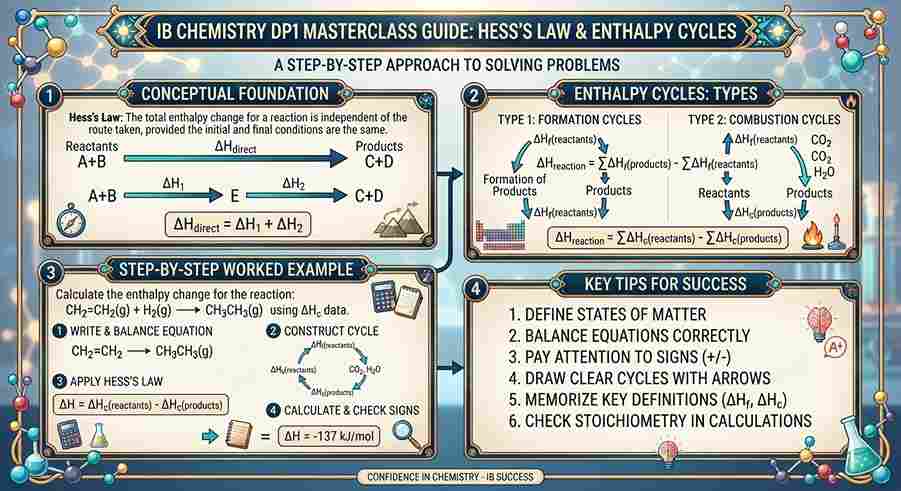
Hess's Law states that the total enthalpy change for a chemical reaction is independent of the route by which the chemical reaction takes place, provided the initial and final conditions are the same.
- The Key Insight: Energy is a state function. It does not matter whether a chemical reaction occurs in a single explosive step or through five slow intermediate stages; the net enthalpy change ($\Delta H_{\text{total}}$) remains identical.
- Why It Matters: Many chemical reactions cannot be measured directly in a laboratory (for example, the direct formation of carbon monoxide from carbon and oxygen always produces a mixture of carbon dioxide). Hess's Law allows chemists to calculate unknown enthalpy changes algebraically using known experimental data.
Part 2: The Three Golden Rules of Equation Manipulation
When solving Hess's Law algebraic puzzle problems, you will be given a target equation and several helper equations with known enthalpy values ($\Delta H$). To make them fit together, you must follow three strict rules:
Rule 1: Reversing an Equation Flips the Sign
If you reverse a chemical equation (swapping reactants and products), the magnitude of $\Delta H$ stays exactly the same, but its sign must be inverted (from positive to negative, or negative to positive).
- Example:
- $A \rightarrow B \quad (\Delta H = -100\text{ kJ mol}^{-1})$
- $B \rightarrow A \quad (\Delta H = +100\text{ kJ mol}^{-1})$
Rule 2: Multiplying Coefficients Multiplies $\Delta H$
If you multiply or divide a chemical equation by a constant coefficient (e.g., $2$, $3$, or $0.5$), you must multiply or divide the $\Delta H$ value by that exact same constant.
- Example:
- $A \rightarrow B \quad (\Delta H = -100\text{ kJ mol}^{-1})$
- $2A \rightarrow 2B \quad (\Delta H = -200\text{ kJ mol}^{-1})$
Rule 3: Adding Equations Adds Their Enthalpies
Once your helper equations are aligned so that intermediate species (intermediates) cancel out on opposite sides of the arrow, you simply add the equations together and sum their corresponding enthalpy values.
Part 3: Step-by-Step Problem-Solving Framework
Let’s look at how to tackle a classic IB Chemistry paper-style Hess's Law algebraic problem using a systematic 4-step workflow.
Target Equation:
Calculate the standard enthalpy of formation of methane ($\Delta H^\circ_f$):
$$C(\text{s, graphite}) + 2H_2(\text{g}) \rightarrow CH_4(\text{g})$$
Helper Equations Provided:
- $C(\text{s, graphite}) + O_2(\text{g}) \rightarrow CO_2(\text{g}) \quad \Delta H_1 = -393.5\text{ kJ mol}^{-1}$
- $H_2(\text{g}) + 0.5O_2(\text{g}) \rightarrow H_2O(\text{l}) \quad \Delta H_2 = -285.8\text{ kJ mol}^{-1}$
- $CH_4(\text{g}) + 2O_2(\text{g}) \rightarrow CO_2(\text{g}) + 2H_2O(\text{l}) \quad \Delta H_3 = -890.3\text{ kJ mol}^{-1}$
Step 1: Locate Target Species in Helper Equations
- Target has $1\text{ mole of } C(\text{s, graphite})$ on the reactants side. Equation 1 already has $1\text{ mole of } C(\text{s, graphite})$ on the reactants side. Keep Equation 1 as is.
- Target has $2\text{ moles of } H_2(\text{g})$ on the reactants side. Equation 2 has only $1\text{ mole of } H_2(\text{g})$. Multiply Equation 2 by 2.
- Target has $1\text{ mole of } CH_4(\text{g})$ on the products side. Equation 3 has $CH_4(\text{g})$ on the reactants side. Reverse Equation 3.
Step 2: Apply Rules and Adjust Enthalpies
- Eq 1 (Unchanged): $\Delta H_1 = -393.5\text{ kJ mol}^{-1}$
- Eq 2 ($\times 2$): $\Delta H_2 = 2 \times (-285.8) = -571.6\text{ kJ mol}^{-1}$
- Eq 3 (Reversed): $\Delta H_3 = +890.3\text{ kJ mol}^{-1}$
Step 3: Add Adjusted Equations and Cancel Intermediates
Summing the modified equations eliminates $CO_2$ and $H_2O$, leaving precisely the target equation.
Step 4: Sum the Enthalpy Values
$$\Delta H^\circ_f = (-393.5) + (-571.6) + (+890.3) = -74.8\text{ kJ mol}^{-1}$$
Part 4: Enthalpy Cycles ($\Delta H_f$ and $\Delta H_c$)
In addition to algebraic manipulation, IB Chemistry loves testing enthalpy cycles based on enthalpies of formation ($\Delta H^\circ_f$) and enthalpies of combustion ($\Delta H^\circ_c$).
1. Using Enthalpies of Formation ($\Delta H^\circ_f$)
When constructing a cycle where elements are at the bottom:
$$\Delta H_{\text{reaction}} = \sum \Delta H^\circ_f(\text{products}) - \sum \Delta H^\circ_f(\text{reactants})$$
Memory Trick: P - R (Products minus Reactants). Always multiply each formation value by its stoichiometric coefficient from the balanced equation.
2. Using Enthalpies of Combustion ($\Delta H^\circ_c$)
When constructing a cycle where combustion products ($CO_2$ and $H_2O$) are at the bottom:
$$\Delta H_{\text{reaction}} = \sum \Delta H^\circ_c(\text{reactants}) - \sum \Delta H^\circ_c(\text{products})$$
Memory Trick: R - P (Reactants minus Products). Notice that combustion cycles invert the subtraction order compared to formation cycles!
Part 5: Top 4 Traps That Cost Students Marks
- Sign Inversion Errors: Forgetting to flip the positive/negative sign when reversing an equation or forgetting the negative sign during enthalpy calculations.
- Ignoring State Symbols: Failing to check state symbols ($\text{s, l, g, aq}$) in helper equations. Enthalpy values change depending on whether water is produced as a liquid ($\text{H}_2\text{O(l)}$) or a gas ($\text{H}_2\text{O(g)}$).
- Coefficient Scaling Omission: Multiplying a chemical species by 2 to balance an equation but forgetting to multiply its corresponding $\Delta H$ value by 2.
- Mixing Up P-R and R-P in Cycles: Using Products minus Reactants for combustion data instead of Reactants minus Products. Always sketch out the full triangular energy cycle diagram if you are unsure!
Struggling with IB Chemistry DP1 thermochemistry, enthalpy cycles, or stoichiometry? EdFlik connects international school students globally with expert, 1-to-1 online chemistry tutors, helping you master problem-solving frameworks and secure top grade 7s.Book a Free Demo Class Today!
Frequently Asked Questions (FAQs)
Q1: What is standard state conditions in IB Chemistry?
Ans: Standard conditions refer to a pressure of $100\text{ kPa}$, a temperature of $298\text{ K}$ ($25^\circ\text{C}$), and solutions at a concentration of $1\text{ mol dm}^{-3}$, denoted by the superscript circle ($\Delta H^\circ$).
Q2: Why is the enthalpy of formation of an element in its standard state zero?
Ans: By definition, elements in their most stable standard state (such as $O_2(\text{g})$, $C(\text{s, graphite})$, or $H_2(\text{g})$) require no energy to form from themselves, so their standard enthalpy of formation is defined as exactly zero.
Q3: How do I know whether to use a formation cycle or a combustion cycle?
Ans: Look at the data provided in the question table. If the table gives values of $\Delta H^\circ_f$, use the Products minus Reactants formula. If the table provides values of $\Delta H^\circ_c$, use the Reactants minus Products formula.
Q4: How does EdFlik support IB Chemistry DP1 students?
Ans: EdFlik connects international school students worldwide with vetted, expert 1-to-1 online tutors specializing in IB Chemistry SL and HL. Our personalized coaching focuses on clarifying complex physical chemistry calculations, stoichiometry, and rigorous past-paper problem-solving.