IGCSE Chemistry Past Papers 0620 UAE 2026 — Cambridge Guide with Technique Tips
IGCSE Chemistry 0620 is one of the most technique-sensitive IGCSE subjects — and the one where students most consistently lose marks not because their chemistry is wrong, but because their observation language is imprecise, their ionic equations are missing state symbols, or their alternative to practical answers describe procedures without identifying the correct variables. This guide provides UAE students with the resources they need and the specific mark-scheme language that Cambridge examiners actually reward.
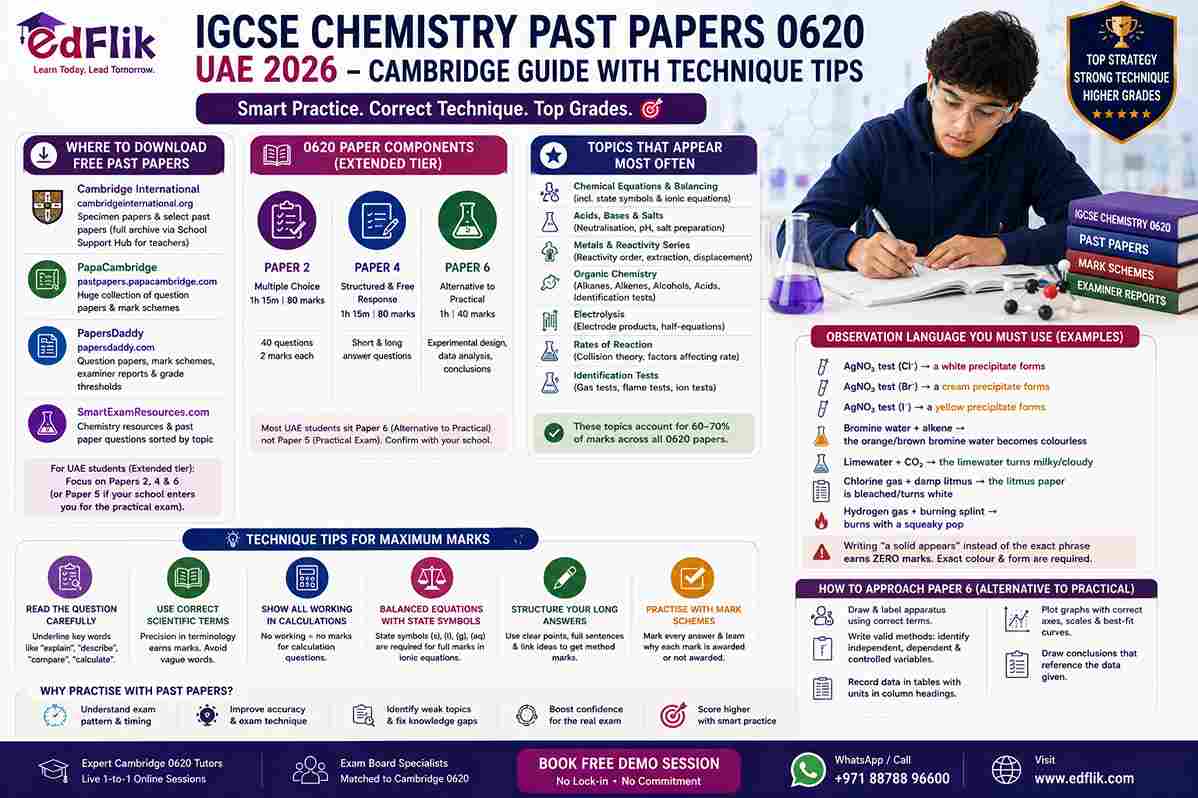
Cambridge IGCSE Chemistry 0620 — Paper Structure
|
Paper |
Duration |
Marks |
Content |
UAE Entry
(most schools) |
|
Paper 2 — Multiple Choice Extended |
1 hr 15 min |
80 |
Full Extended syllabus — 40 MCQ, 2 marks each |
Yes — Extended tier |
|
Paper 4 — Structured Questions Extended |
1 hr 15 min |
80 |
Full Extended syllabus — structured and free-response |
Yes — Extended tier |
|
Paper 6 — Alternative to Practical |
1 hour |
40 |
Experimental design, data analysis, conclusions |
Yes — most UAE schools (not laboratory-based) |
|
Paper 5 — Practical Test |
1 hour 15 min |
40 |
Actual laboratory practical (at school) |
Only schools with lab examination facilities |
Where to Download 0620 Past Papers Free
|
Source |
URL |
What's
Available |
|
Cambridge International (official) |
cambridgeinternational.org |
Specimen papers, syllabus, some past papers (full archive needs
School Support Hub) |
|
PapaCambridge |
pastpapers.papacambridge.com |
Full free archive — Papers 2, 4, 5, 6 by year and session with
mark schemes |
|
PapersDaddy |
papersdaddy.com |
Question papers, mark schemes, examiner reports, grade thresholds |
|
SmartExamResources |
smartexamresources.com |
Chemistry-specific resources including topic-sorted questions |
|
Physics and Maths Tutor |
physicsandmathstutor.com |
Past papers and some worked Chemistry solutions |
The Observation Language Table — Learn These Exact Phrases
The single most important preparation step for IGCSE Chemistry 0620 Paper 4 is memorising the exact observation language that Cambridge mark schemes require. The following phrases must be learned verbatim — approximations earn zero marks:
|
Test |
Substance
Being Tested |
Correct
Mark-Scheme Language |
|
Silver nitrate solution |
Chloride ions (Cl⁻) |
A white precipitate forms (soluble in dilute ammonia) |
|
Silver nitrate solution |
Bromide ions (Br⁻) |
A cream precipitate forms (partially soluble in dilute ammonia) |
|
Silver nitrate solution |
Iodide ions (I⁻) |
A yellow precipitate forms (insoluble in dilute ammonia) |
|
Bromine water |
Alkene (C=C double bond) |
The orange/brown bromine water becomes colourless |
|
Limewater |
Carbon dioxide (CO₂) |
The limewater turns milky/cloudy |
|
Damp litmus paper |
Chlorine gas (Cl₂) |
The litmus paper is bleached/turns white |
|
Burning splint |
Hydrogen gas (H₂) |
Burns with a squeaky pop |
|
Glowing splint |
Oxygen gas (O₂) |
The glowing splint relights |
|
Flame test (Na) |
Sodium compounds |
Yellow/golden yellow flame |
|
Flame test (Cu) |
Copper compounds |
Green/blue-green flame |
|
Flame test (K) |
Potassium compounds |
Lilac/purple flame |
|
Acidified potassium dichromate |
Alcohol (oxidation test) |
Turns from orange to green |
|
Universal indicator |
Any acid or alkali |
State the colour AND the approximate pH |
|
Barium chloride (acidified) |
Sulfate ions (SO₄²⁻) |
A white precipitate forms |
Ionic Equations — The State Symbol Requirement
Cambridge IGCSE Chemistry 0620 requires ionic equations for reactions in solution. The most common mark loss on ionic equation questions: writing the net ionic equation correctly but omitting state symbols. State symbols (aq), (s), (l), and (g) are mandatory in ionic equations — missing any one loses the mark for that equation regardless of whether the ionic equation itself is correct.
The method for writing ionic equations: (1) write the full symbol equation with state symbols; (2) separate all soluble ionic compounds into their constituent ions; (3) identify spectator ions (appear on both sides unchanged); (4) cancel spectator ions; (5) write the net ionic equation.
Example — precipitation of lead(II) iodide from lead(II) nitrate and potassium iodide solutions: Full equation: Pb(NO₃)₂(aq) + 2KI(aq) → PbI₂(s) + 2KNO₃(aq). Ionic equation: Pb²⁺(aq) + 2I⁻(aq) → PbI₂(s). The NO₃⁻ and K⁺ ions are spectator ions — they do not change and are cancelled. State symbols are mandatory in the ionic equation.
High-Frequency Topics — Where to Focus Past Paper Practice
|
Topic |
Mark
Proportion |
Most Common
Question Types |
Specific
Technique Required |
|
Chemical equations and balancing |
10 to 15% |
Balance symbol equations; state symbols; ionic equations |
State symbols in every equation; ionic equation method |
|
Organic chemistry |
12 to 15% |
Identify functional groups; name homologous series; describe
reactions |
Learn addition vs substitution; bromine water test; ethanol
oxidation |
|
Acids, bases, and salts |
10 to 12% |
Salt preparation methods; neutralisation reactions; pH |
Know all three salt preparation methods (neutralisation, direct
combination, displacement) |
|
Metals and reactivity series |
8 to 10% |
Reactivity order; displacement; extraction methods |
Reactivity order from potassium to gold — must be memorised |
|
Electrolysis |
8 to 10% |
Electrode products; half-equations at anode and cathode |
Anode = oxidation; cathode = reduction; know electrode products
for different solutions |
|
Rates of reaction |
6 to 8% |
Collision theory language; graph interpretation |
Use exact collision theory phrases: 'more frequent effective
collisions' |
|
Identification tests |
8 to 10% |
Gas tests; ion tests; flame tests |
Exact observation language from the table above — no
approximations |
Alternative to Practical (Paper 6) — What UAE Students Must Master
Paper 6 is the 40-mark practical paper that most UAE IGCSE Chemistry students sit. It is consistently the paper where UAE students lose the most marks relative to their knowledge, because the skills it tests — experimental design, variable identification, data recording, graph plotting — are different from the content recall and equation-writing tested in Papers 2 and 4. Specific skills to practise from past Paper 6 questions:
• Apparatus diagrams: draw standard Chemistry apparatus — beaker, conical flask, burette, gas syringe, Liebig condenser, test tube — using correct scientific conventions. Labels must be precise: 'conical flask' not 'flask'; 'burette' not 'measuring cylinder'.
• Variable identification: for every experiment, state the independent variable (what you change), the dependent variable (what you measure), and at least two controlled variables (what you keep the same and why). 'Temperature' alone is insufficient — 'kept constant using a water bath at 25°C' is the mark-scheme level answer.
• Data tables: column headings must include the quantity AND the unit in the heading row. Units do not belong in data cells. Heading format: 'Time / min', not 'Time (min)' and not 'Time in minutes'.
• Graph plotting: x-axis for the independent variable, y-axis for the dependent variable. Scale must use more than half the grid. All points plotted accurately to within half a small square. Best-fit smooth curve or straight line (not dot-to-dot). Anomalous points circled but included in the data table, excluded from the line.
Frequently Asked Questions — IGCSE Chemistry Past Papers 0620 UAE
Q: Where can I download Cambridge IGCSE Chemistry 0620 past papers for free?
A: PapaCambridge (pastpapers.papacambridge.com), PapersDaddy (papersdaddy.com), and the official Cambridge International website. For UAE students: confirm which papers you sit (Extended tier: Papers 2, 4, and 6 for most UAE schools; or Paper 5 if your school runs the laboratory practical examination).
Q: What paper components make up Cambridge IGCSE Chemistry 0620?
A: Extended tier: Paper 2 (40 MCQ, 80 marks, 1 hr 15 min); Paper 4 (structured questions, 80 marks, 1 hr 15 min); Paper 6 Alternative to Practical (40 marks, 1 hr) — most UAE schools enter Paper 6 rather than Paper 5 (the actual laboratory test).
Q: What observation language does the 0620 mark scheme require?
A: Exact phrases are required — approximations earn zero. Key examples: silver nitrate on chloride = 'a white precipitate forms'; bromine water with alkene = 'orange/brown bromine water becomes colourless'; limewater with CO₂ = 'turns milky/cloudy'; chlorine on damp litmus = 'bleached/turns white'; hydrogen with burning splint = 'squeaky pop'. Learn these verbatim.
Q: What topics appear most frequently in 0620 past papers?
A: Chemical equations and balancing (10–15%); organic chemistry (12–15%); acids, bases, and salts (10–12%); identification tests (8–10%); metals and reactivity (8–10%); electrolysis (8–10%); rates of reaction (6–8%). These account for approximately 65% of marks across all 0620 papers.
Q: What must UAE students know for the Alternative to Practical Paper 6?
A: Apparatus diagram conventions; variable identification (independent, dependent, controlled with specific values); data table format (quantity and unit in heading, not in cells); graph plotting (independent variable on x-axis; correct scale; points accurate to half a small square; smooth best-fit line; anomalous points circled but not connected).
How EdFlik Supports IGCSE Chemistry 0620 Students Across UAE
EdFlik IGCSE Chemistry tutors are matched to Cambridge CAIE 0620. Every session uses official past papers from Papers 2, 4, and 6 with mark-scheme correction. Observation language, ionic equations, and Paper 6 experimental technique are core session components. Sessions from AED 60 per class. Free demo. Book at www.edflik.com.