
How to Study for IGCSE Exams UAE 2026 — Evidence-Based Revision Strategy Guide
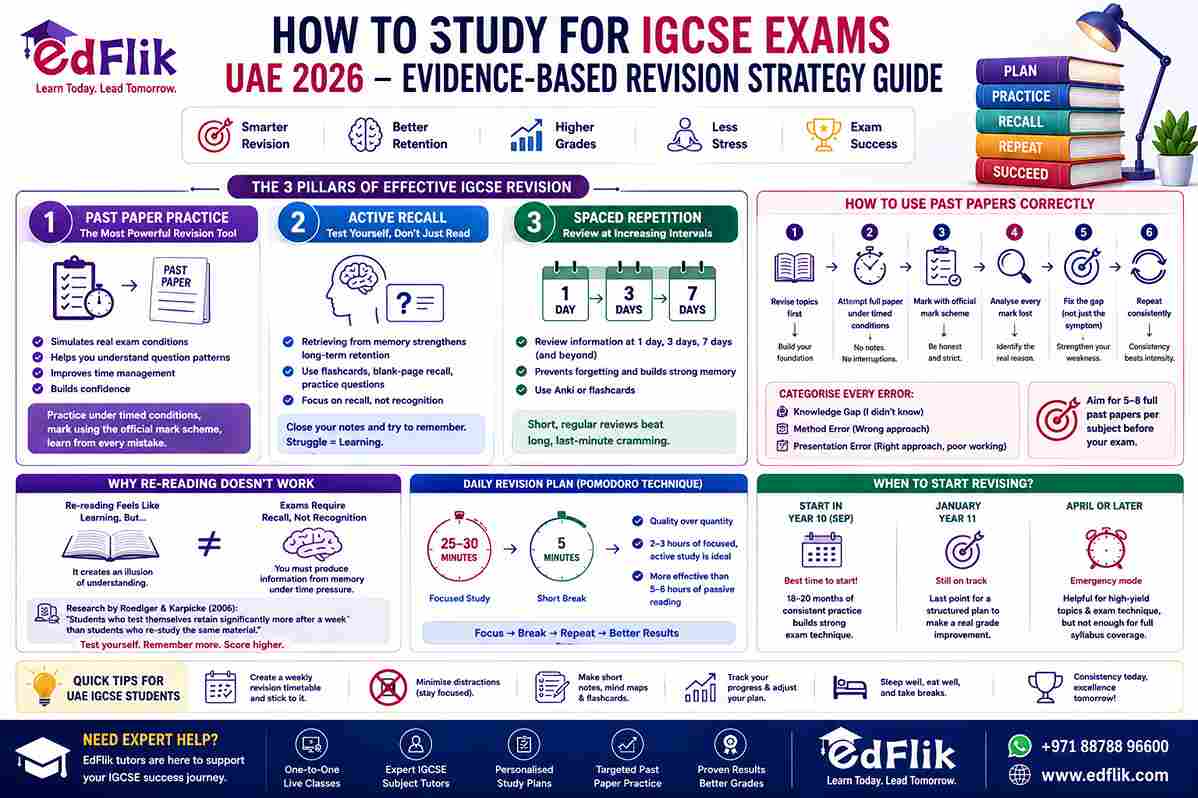
Most UAE students preparing for IGCSE examinations spend the majority of their revision time doing one of three things: re-reading textbook notes, highlighting key facts, or copying out information into summaries. Educational research is unequivocal: these are among the least effective revision methods available. Students who use them consistently feel productive during revision, then perform below their potential in examinations. This guide explains why, and what UAE students should do instead.
Why Most IGCSE Revision Does Not Work — The Recognition Problem
When you re-read your Chemistry notes for the third time and everything looks familiar, your brain produces a feeling of understanding. This feeling is not evidence of learning. It is evidence of recognition — your brain has processed the information before and recognises it when it sees it again. But in a Cambridge IGCSE examination, you need recall: the ability to produce information from memory without the notes in front of you, under time pressure, in response to a question phrased differently from any question you have seen before.
Recognition and recall are genuinely different cognitive skills. The research on this has been consistent since at least the 1970s. A landmark study by Roediger and Karpicke (2006) showed that students who tested themselves on material after studying it remembered significantly more one week later than students who re-studied the same material for the same total time. The testing effect is real, robust, and directly applicable to IGCSE examination preparation.
The Three Evidence-Based Techniques That Actually Work
Technique 1: Active Recall
Active recall means testing yourself from memory rather than reading. Every time you force your brain to retrieve information — without the source in front of you — you strengthen the memory trace for that information. The effort of retrieval is not a sign that you have not studied enough. It is the mechanism through which learning actually occurs.
Practical active recall methods for UAE IGCSE students:
1. Blank-page recall: close your notes, take a blank sheet, write a topic title at the top, and write everything you can remember about that topic in 5 minutes without looking at anything. Then check your notes to find what you missed. The gaps you find are genuine learning gaps — not familiarity gaps.
2. Flashcards: one concept, definition, formula, or diagram element per card. Cover the answer and try to produce it before checking. Separate cards into 'confident,' 'uncertain,' and 'forgotten' piles. Only confident cards go to the back of the review queue.
3. Past paper questions without notes: attempt 5 to 10 questions from a specific topic without looking at your notes or mark scheme. Then check both against the mark scheme. This simulates examination conditions at a topic level.
4. The Feynman technique: explain a IGCSE Chemistry or Physics concept aloud, as if you were teaching it to a student who knows nothing about it. If you cannot explain it simply and completely without checking your notes, you do not fully understand it. The gaps in your explanation are your learning priorities.
Technique 2: Spaced Repetition
Spaced repetition exploits the spacing effect — the well-established finding that distributing practice over time produces stronger long-term memory than concentrating the same amount of practice in a single session. The principle for UAE IGCSE students:
|
Day |
Repetition |
Expected
Result |
|
Day 1 |
Study the topic for the first time |
Familiar but not yet retained |
|
Day 2 |
Active recall — test yourself without notes |
~70% retention; fill the gaps |
|
Day 5 |
Active recall again |
~80% retention if Day 2 was completed |
|
Day 12 |
Active recall again |
~85 to 90% retention if previous reviews were completed |
|
Day 26 |
Active recall again |
Approaching long-term retention — move to less frequent review |
|
If forgotten |
Return to Day 2 interval and restart |
Forgetting is not failure — it is information about which topics
need more work |
For managing spaced repetition across 8 to 10 IGCSE subjects, the free app Anki automates the scheduling — it tracks which flashcards you found easy or difficult and schedules the next review at the optimal interval. A UAE student who builds Anki decks from their IGCSE syllabus content from September of Year 10 and reviews daily for 20 minutes will enter the May/June examination with stronger long-term retention across all subjects than any other single revision method can produce.
Technique 3: Past Paper Practice Under Timed Examination Conditions
Past papers are the closest simulation of the actual IGCSE examination available. They develop four skills simultaneously: familiarity with the specific question types and formats Cambridge uses for each subject; time management under genuine time pressure; mark-scheme language awareness (what Cambridge actually rewards); and identification of your specific topic gaps under examination conditions. The correct protocol:
5. Complete the full paper from start to finish under timed conditions. Paper 4 in 2 hours 30 minutes. Paper 2 in 1 hour 30 minutes. No pausing. No looking at notes.
6. Mark immediately after completion using the official Cambridge mark scheme from the Cambridge International website or PapaCambridge.
7. For every mark lost, categorise the error: (a) knowledge gap — you did not know the topic; (b) method error — you knew the topic but used the wrong approach; (c) presentation error — correct approach but working not shown clearly enough to earn method marks.
8. Address knowledge gaps before the next paper. Presentation errors — not showing working — require no new knowledge. They are the highest-yield immediate fix for any UAE IGCSE Maths or Science student.
9. Complete the next paper at least one week later. Do not rush through papers without thorough review.
Subject-Specific Revision Priorities for UAE IGCSE Students
|
Subject |
Most Common
Reason for Underperformance |
Highest-Yield
Revision Action |
|
Maths 0580 |
Not showing working — losing M marks even when answers are
correct |
Every calculation: write formula, substitute, show steps, circle
answer. Non-negotiable. |
|
Chemistry 0620 |
Imprecise observation language — losing marks on reactions and
identification tests |
Memorise the exact phrase for every identification test (white
precipitate, squeaky pop, etc.) |
|
Physics 0625 |
Short causal chains — explaining phenomena without the full
mechanism |
For every 'explain' question: write a cause → mechanism → effect
chain. Every step = one mark. |
|
Biology 0610 |
Approximate biological language on description questions |
Learn the exact Cambridge phrasing for osmosis, enzyme
denaturation, active transport, etc. |
|
English Language 0500 |
Not answering the specific question asked — describing instead of
inferring |
For comprehension: quote the exact word or phrase; for writing:
use deliberate structural techniques |
|
Economics 0455 |
One-sided evaluation and unlabelled diagrams |
Every diagram: labelled axes, labelled curves, labelled
equilibrium. Evaluate both sides in essays. |
A Practical Weekly Revision Schedule for UAE IGCSE Students
This schedule is designed for a UAE student in Year 11 revising 8 to 10 IGCSE subjects from January to May/June. It builds from topic-based revision in January through to full past paper practice in April and final consolidation in May:
|
Phase |
Timing |
Daily Focus |
Weekly Goal |
|
Content and active recall |
January to February |
1 hour per subject: 20 min topic notes → 20 min blank-page recall
→ 20 min flashcard review |
Complete all syllabus topics with active recall checks; build
flashcard decks |
|
Topic-specific past paper questions |
February to March |
1.5 hours per subject: attempt topic questions from past papers;
mark against mark scheme |
Identify which specific topics need more work; fix errors before
moving on |
|
Full timed past papers |
March to April |
Full Paper 2 + Paper 4 pair for one subject per day (rotating
through subjects) |
Complete 2 to 3 full paper pairs per subject; achieve improvement
from paper to paper |
|
Consolidation and weak-area focus |
April to May |
30 min high-frequency topic flashcards; 30 min past paper
questions on weak topics only |
Do not attempt new topics; consolidate and reinforce what is
already understood |
Frequently Asked Questions — How to Study for IGCSE UAE
Q: What is the most effective way to study for IGCSE exams in UAE?
A: Three evidence-based techniques: (1) Past paper practice under timed conditions with mark-scheme review — the single most effective IGCSE revision tool. (2) Active recall — testing yourself from memory rather than re-reading notes. (3) Spaced repetition — reviewing information at 1-3-7-day increasing intervals. These three techniques consistently outperform re-reading, highlighting, and note-copying for IGCSE examination performance.
Q: Why do re-reading and highlighting not work for IGCSE revision?
A: They produce recognition, not recall. IGCSE examinations require recall — producing information from memory without notes under time pressure. Roediger and Karpicke (2006) and subsequent research consistently show that students who test themselves after studying remember significantly more than those who re-study the same material. Every hour of self-testing is more valuable than every hour of re-reading.
Q: How should UAE students use IGCSE past papers?
A: Complete the full paper timed, no notes. Mark immediately using the official Cambridge mark scheme. Categorise every lost mark: knowledge gap, method error, or presentation error. Fix presentation errors first — they are the highest-yield correction. Aim for 5 to 8 full paper pairs per subject before examinations.
Q: What is spaced repetition and how should UAE students use it?
A: Reviewing information at increasing intervals: Day 2, Day 5, Day 12, Day 26. Each successful retrieval extends the next review interval. The free app Anki automates this scheduling. A student who builds Anki decks from Year 10 and reviews daily for 20 minutes will enter the examination with stronger long-term retention than any passive revision method can produce.
Q: How long should UAE students revise each day for IGCSE?
A: 25 to 30-minute focused blocks (Pomodoro technique) with 5-minute breaks. 3 to 4 blocks (1.5 to 2 hours of genuine focus) per subject is the sustainable daily maximum before diminishing returns. Quality of attention matters more than total hours logged. Active study for 2 hours outperforms passive re-reading for 6.
Q: When should UAE students start revising for IGCSE exams?
A: September of Year 10 is optimal — practising past paper topic questions as each unit is taught builds 18 months of examination technique. January of Year 11 is the latest for a comprehensive programme. Starting in April is emergency preparation — useful for technique review and high-frequency topics but insufficient for systematic full-subject coverage.
How EdFlik Supports IGCSE Students Across UAE
EdFlik IGCSE tutors use past papers and active recall techniques in every session. Sessions are built around the student's specific gaps identified through past paper review — not generic topic-by-topic coverage. Sessions from AED 60. Free demo. Book at www.edflik.com.