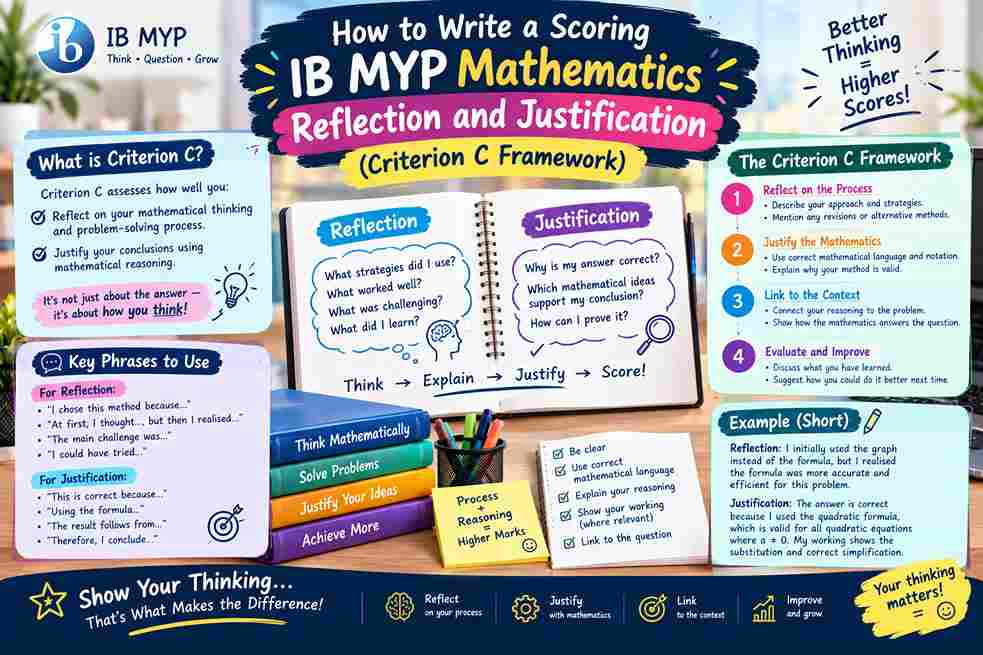
How to Write a Scoring IB MYP Mathematics Reflection and Justification (Criterion C Framework)
Last Updated: October 2026 | By EdFlik Education Team
For students navigating the International Baccalaureate (IB) Middle Years Programme (MYP) mathematics framework, achieving a top score (Level 7) requires much more than arriving at the correct final numerical answer. While Criterion A evaluates computational knowledge and Criterion D tests real-life application, Criterion C (Communicating) and the accompanying mathematical reflections and justifications frequently determine whether a student secures an elite grade.
Across international schools worldwide, students often lose crucial marks not because their calculations are wrong, but because they fail to communicate how they arrived at their conclusions, justify their mathematical choices, or critically reflect on the limitations of their models.
In this comprehensive, exam-focused masterclass guide, our expert IB mathematics educators break down the official Criterion C rubric, demystify what examiners mean by "justification" and "reflection," and provide a foolproof 5-step framework to help you write scoring MYP math reflections.
Part 1: Deconstructing the IB MYP Criterion C Rubric (Communicating)
Criterion C assesses your ability to use mathematical language to express ideas, arguments, and findings both orally and in writing. To score in the top Level 7–8 band, your work must demonstrate clarity, coherence, rigorous logical structure, and sophisticated reflection.
                  THE IB MYP CRITERION C PERFORMANCE BANDS
                                     |
      +------------------------------+------------------------------+
      |                                                             |
LEVEL 1–2: BASIC COMMUNICATION                               LEVEL 3–4: ADEQUATE COMMUNICATION
• Uses basic mathematical notation.                          • Uses appropriate notation and terminology.
• Lines of reasoning are difficult to follow.                 • Presents some logical working steps.
      |                                                             |
      +------------------------------+------------------------------+
                                     |
      +------------------------------+------------------------------+
      |                                                             |
LEVEL 5–6: SUBSTANTIAL COMMUNICATION                         LEVEL 7–8: CRITICAL & SOPHISTICATED
• Clear, coherent lines of reasoning.                        • Rigorous logical structure throughout.
• Uses appropriate forms of mathematical                     • Precise mathematical language, precise
  representation (tables, graphs, symbols).                    representation, and deep reflection/justification.
What Examiners Look For in the Top Band:
- Coherent Lines of Reasoning: Your working out must flow logically from premise to conclusion like a well-argued essay.
- Appropriate Mathematical Language: Using correct vocabulary (e.g., quadratic function, asymptote, gradient, correlation coefficient, domain and range) rather than vague everyday terms ("the line goes up").
- Precise Representation: Seamlessly integrating well-labeled tables, clear algebraic notation, correctly scaled graphs, and geometric diagrams.
Part 2: The Anatomy of a Scoring Mathematical Reflection
Many students misunderstand what an MYP math reflection entails. Writing "I enjoyed this task and found it easy" or "I made a calculation mistake on question 3 but fixed it" will not earn reflection marks.
A high-scoring mathematical reflection evaluates three core dimensions:
                  THE THREE PILLARS OF MATHEMATICAL REFLECTION
                                         |
        +--------------------------------+--------------------------------+
        |                                |                                |
 1. REASONABLENESS OF RESULTS            2. METHODOLOGICAL LIMITATIONS    3. ALTERNATIVE APPROACHES
 • Do your final answers make logical    • What assumptions were made?    • Could this problem be solved
   sense in the context of the problem?    Where does your model break down?  differently (e.g., graphically vs.
                                                                              algebraically)?
1. Evaluating Reasonableness
Instead of simply stating numbers, analyze whether your numerical findings align with reality.
- Example: "When calculating the vertex of the profit quadratic model, the maximum profit was found at $x = 42.5$ units. Since production items must be whole integers, rounding to $43$ units gives a practical maximum profit of $\$12,450$, which aligns logically with our initial cost constraints."
2. Identifying Limitations
Every mathematical model simplifies reality. A top-tier reflection acknowledges these simplifications:
- Example: "Our exponential population growth model assumes unlimited resources and zero migration. In reality, carrying capacity limits and economic shifts in the UAE would cause the growth curve to plateau into a logistic curve over a 10-year period."
Part 3: The 5-Step Framework for Structuring Justifications
When an MYP task asks you to "justify your choice" or "explain why," you must provide mathematical evidence supporting your decision. Follow this 5-step framework:
                  THE 5-STEP JUSTIFICATION PROTOCOL
                                   |
  Step 1: State the Claim       ---> Clearly declare your chosen strategy or model
  Step 2: Provide Mathematical Proof---> Show calculations, formulas, or algebraic properties supporting it
  Step 3: Compare Alternatives  ---> Explain why alternative methods were rejected
  Step 4: Contextualize Results ---> Link the mathematical outcome back to the real-world scenario
  Step 5: Conclude Rigorously   ---> Summarize how the justification validates your final answer
Part 4: Top 4 Traps That Cost Students Marks in Criterion C
- Using Vague Everyday Language: Writing phrases like "the numbers got bigger so I multiplied" instead of precise mathematical terminology like "as the independent variable $x$ increased exponentially, the dependent variable scaled by a common ratio of $r = 1.5$."
- Omitting Intermediate Working Steps: Jumping straight from an initial equation to a final answer without showing the intermediate algebraic manipulation. If an examiner cannot follow your steps, your communication mark drops.
- Ignoring Units and Context: Presenting raw numbers without units (e.g., writing $14.2$ instead of $14.2\text{ cm}^2$ or $\$14,200$). In applied MYP tasks, units are mandatory for full communication marks.
- Writing Superficial Reflections: Submitting a 2-sentence reflection at the very end of an investigation. Reflection should be woven throughout your report and supported by detailed analytical commentary.
Preparing for your IB MYP Mathematics investigations and aiming for a Level 7? EdFlik connects international school students globally with expert, 1-to-1 online IB math tutors, helping you master mathematical communication, structured justifications, reflection frameworks, and past-paper strategies. Book A Free Demo Class Today!
Frequently Asked Questions (FAQs)
Q1: How long should an MYP mathematics reflection be?
Ans: There is no strict word-count limit, but quality matters far more than quantity. A thorough, analytical reflection spanning 1 to 2 well-structured paragraphs—addressing assumptions, model limitations, and reasonableness—is far more effective than a page of vague statements.
Q2: Can I use bullet points in my Criterion C communication?
Ans: Yes! Bullet points, numbered steps, clear subheadings, and well-organized data tables enhance readability and demonstrate structured logical thinking, which directly supports Criterion C communication standards.
Q3: What is the difference between an explanation and a justification?
Ans: An explanation tells what you did and how you did it. A justification goes a step further by proving why that specific method was the most appropriate and mathematically valid choice among available alternatives.
Q4: How does EdFlik support IB MYP Mathematics students?
Ans: EdFlik connects international school students worldwide with vetted, expert 1-to-1 online tutors specializing in IB MYP and DP Mathematics. Our personalized coaching focuses on mastering mathematical investigations, structuring rigorous justifications, improving written communication, and building academic confidence.