How to Write a Standout Personal Statement for UK Computing and Software Engineering Degrees
Last Updated: October 29, 2026 | By EdFlik Team
Securing an offer for Computer Science or Software Engineering at top UK universities—such as Imperial College London, Cambridge, Oxford, UCL, Edinburgh, or Manchester—is increasingly competitive. With thousands of applicants predicting top grades ($A^*A^*A$ at A-Level or $40+$ points in the IB Diploma), your UCAS personal statement serves as a critical differentiator for admissions tutors.
A common mistake made by applicants is listing technical buzzwords, summarizing online courses, or writing generic stories about building their first PC. Admissions tutors want to see super-curricular engagement, technical curiosity, and a clear understanding of computational theory beyond high school syllabi.
This masterclass guide breaks down the structural breakdown, super-curricular topics, technical project frameworks, top applicant traps, and supplies a 100% copy-paste JSON-LD schema markup script.
Part 1: The Core Philosophy of UK Computing Personal Statements
Unlike US college essays—which prioritize personal narratives, leadership anecdotes, and character growth—UK university personal statements are strictly academic self-portraits.
Admissions teams at top Russell Group universities evaluate applicants against three primary criteria:
                    THE 80/20 RULE FOR UK PERSONAL STATEMENTS
                                       |
        +------------------------------+------------------------------+
        |                                                             |
1. ACADEMIC & SUPER-CURRICULAR (80%)                         2. EXTRA-CURRICULAR (20%)
• Deep engagement with computer science theory.               • Relevant leadership, teamwork, or soft skills.
• Independent programming projects & algorithmic thinking.  • Kept strictly brief and linked back to academic
• Mathematical foundation & reading beyond school syllabi.     discipline/focus.
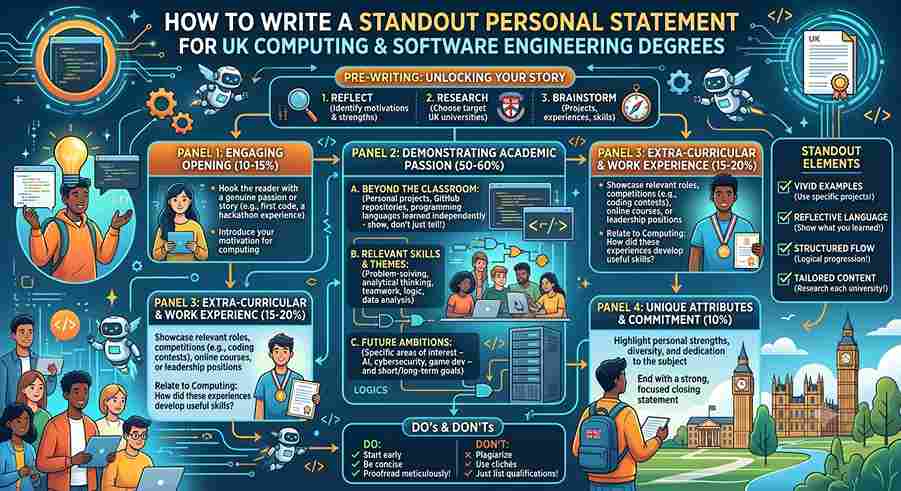
Part 2: Step-by-Step Structural Framework
To keep your personal statement clear, cohesive, and easy to read within the 4,000-character / 47-line UCAS limit, follow this 5-paragraph structure:
                 THE 5-PARAGRAPH PERSONAL STATEMENT PROTOCOL
                                      |
  Paragraph 1: Academic Hook         ---> Define your specific theoretical interest (e.g., algorithms, compiler design, AI ethics).
  Paragraph 2: Technical Project      ---> Detail an independent project (GitHub, app, or algorithm) using the ABC framework.
  Paragraph 3: Mathematics & Theory   ---> Connect mathematical concepts (calculus, graph theory, discrete math) to computing.
  Paragraph 4: Super-Curricular Reading---> Analyze a textbook, research paper, or lecture beyond your school curriculum.
  Paragraph 5: Concise Conclusion    ---> Summarize career ambitions and readiness for undergraduate rigor.
Part 3: The ABC Project Framework for Technical Projects
When describing a coding project, app, or open-source contribution, avoid simply stating "I built a pathfinding visualizer in Python." Instead, use the ABC Framework (Action, Benefit, Connection):
- Action: What specific engineering problem did you tackle, and what stack/tools did you use?
- Benefit: What technical obstacle did you overcome, or what algorithmic insight did you gain?
- Connection: How does this prepare you for university-level computer science?
Example Comparison:
| Approach | Sample Text |
| Weak (Descriptive): | "In my spare time, I built a web scraper using Python and BeautifulSoup to collect price data, which taught me a lot about coding." |
| Strong (Analytical - ABC): | "To explore time-complexity trade-offs, I implemented Dijkstra's algorithm and $\text{A}^$ search in C++ to model urban transit routing. Benchmarking execution times against dense graphs revealed how heuristic choices directly impact memory overhead, reinforcing the practical necessity of asymptotic analysis."* |
Part 4: High-Impact Super-Curricular Ideas for Computing Applicants
To demonstrate engagement beyond A-Level or IB syllabi, explore topics that bridge mathematics, logic, and software construction:
- Theoretical Computer Science & Algorithms:
- Exploring $P \text{ vs. } NP$ problems and time complexity ($\mathcal{O}(n \log n)$ vs $\mathcal{O}(n^2)$).
- Graph theory applications in network architecture and data structures (trees, heaps, hash tables).
- Systems Architecture & Low-Level Computing:
- Building basic compilers or interpreters; understanding assembly language and memory management (C/C++ pointers).
- Logic gate design and Boolean algebra optimization.
- Applied Machine Learning & Mathematics:
- Understanding the linear algebra (matrix operations) and multivariable calculus underlying neural networks rather than using pre-built APIs.
- Cybersecurity principles, cryptography (RSA encryption math), and state machines.
Part 5: Top 4 Traps That Cost Applicants Offers
- Gimmicky Openings: Starting with cliches like "Ever since I built my first computer at age 10..." or "Technology is changing the world." Admissions tutors read hundreds of identical openings; start directly with a specific academic or theoretical concept that fascinates you.
- Listing Tools Without Depth: Creating a laundry list of languages (
Python, Java, HTML, CSS, C++, SQL, Rust) without explaining how you applied them or what computer science principles you learned. - Ignoring Mathematics: Computer Science at top UK universities is fundamentally a branch of mathematics. Omitting your passion for discrete math, calculus, or logic leaves your application incomplete for top-tier courses.
- Copying Code Snippets: Including raw syntax or code blocks in your statement. Tutors want to read about your problem-solving logic and architectural choices, not code syntax.
For expert 1-on-1 guidance on UCAS application strategies, personal statement reviews, and interview prep for UK universities, book a class on EdFlik.
Frequently Asked Questions (FAQs)
Q1: How important is GitHub in a UK Computer Science personal statement?
Ans: While you cannot embed active hyperlinks in UCAS personal statements, referencing an independent project host or open-source contribution demonstrates initiative. Describing the technical challenges faced during development carries significant weight.
Q2: Should I apply for Computer Science or Software Engineering?
Ans: Computer Science focuses heavily on theoretical foundations, mathematics, and computation limits, whereas Software Engineering emphasizes project management, architecture, and application lifecycle. Your personal statement should reflect the specific focus of the course title.
Q3: Does UCAS allow AI tools to write personal statements?
Ans: UCAS uses sophisticated plagiarism and similarity detection software. Personal statements generated by AI risk flag detection. Write your own authentic thoughts, reflections, and technical project analyses.