Solving Radioactive Decay Law and Nuclear Binding Energy Curve Problems in IB Physics
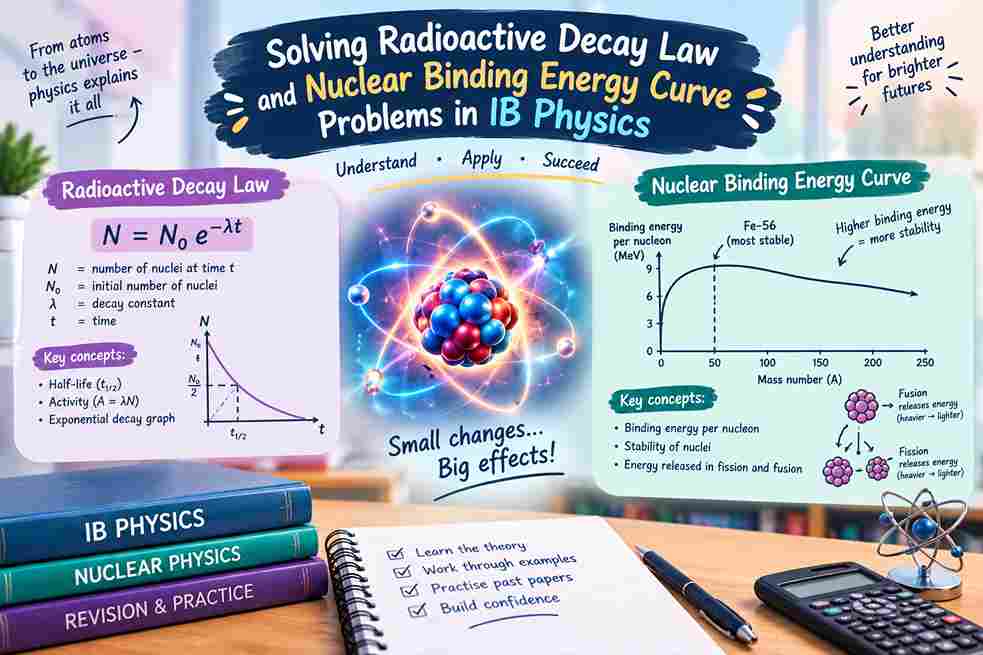
Last Updated: October 2026 | By EdFlik Education Team
For students completing the International Baccalaureate (IB) Diploma Programme (DP) Physics course—at both Standard Level (SL) and Higher Level (HL)—Topic 7 (Atomic, Nuclear, and Particle Physics) represents one of the most conceptually fascinating yet mathematically rigorous modules on Paper 2 (Structured Questions).
Among the various sub-topics tested, questions combining the Radioactive Decay Law (exponential decay, activity, and half-life) with Nuclear Binding Energy Curves and Mass Defect calculations consistently account for high-value, multi-part calculation items. Students frequently lose marks not because they misunderstand nuclear physics, but due to careless unit conversions (converting unified atomic mass units $u$ to kilograms or mega-electronvolts $\text{MeV}$ to Joules) or misinterpreting the binding energy per nucleon curve.
In this comprehensive, exam-focused masterclass guide, our expert IB Physics educators break down the core equations, provide step-by-step calculation workflows, expose common examiner traps, and supply a 100% copy-paste JSON-LD schema markup for your study resources.
Part 1: The Radioactive Decay Law & Half-Life Mechanics
Radioactive decay is a random and spontaneous process where unstable atomic nuclei stabilize by emitting ionizing radiation. Because it is statistical in nature, decay follows an exponential mathematical model.
                      EXPONENTIAL RADIOACTIVE DECAY
                                     |
        +----------------------------+----------------------------+
        |                                                         |
THE DECAY EQUATION                                        DECAY CONSTANT & HALF-LIFE
• $N = N_0 e^{-\lambda t}$ or $A = A_0 e^{-\lambda t}$    • Half-life: $T_{1/2} = \frac{\ln(2)}{\lambda} \approx \frac{0.693}{\lambda}$
• $N$: Remaining undecayed nuclei                         • $\lambda$: Probability of decay per unit time
• $A$: Activity (becquerels, $\text{Bq}$)                  • Unit of $\lambda$: $\text{s}^{-1}$ or $\text{year}^{-1}$
1. Key Mathematical Relationships
- Activity ($A$): The rate of decay of a radioactive source, measured in Becquerels ($\text{Bq}$), where $1 \text{ Bq} = 1 \text{ decay per second}$.$$A = \lambda N$$
- Half-Life ($T_{1/2}$): The time taken for the initial activity or number of undecayed nuclei to reduce to exactly half of its initial value.
Step-by-Step Worked Radioactive Decay Example:
Question: A radioactive isotope has a half-life of $12.5 \text{ hours}$. A sample initially has an activity of $4.80 \times 10^{6} \text{ Bq}$.Calculate the decay constant $\lambda$ in $\text{s}^{-1}$.Determine the activity of the sample after $30.0 \text{ hours}$.
Step 1: Calculate the Decay Constant ($\lambda$)
First, convert half-life from hours to seconds:
$$T_{1/2} = 12.5 \text{ hours} \times 3600 \text{ s/hour} = 45,000 \text{ s}$$
Using the half-life formula:
$$\lambda = \frac{\ln(2)}{T_{1/2}} = \frac{0.69315}{45,000 \text{ s}} = 1.540 \times 10^{-5} \text{ s}^{-1}$$
Step 2: Calculate Activity After $30.0 \text{ Hours}$
Convert total time $t$ to seconds:
$$t = 30.0 \text{ hours} \times 3600 \text{ s/hour} = 108,000 \text{ s}$$
Apply the exponential decay law for activity ($A = A_0 e^{-\lambda t}$):
$$A = (4.80 \times 10^6) \times e^{-(1.540 \times 10^{-5} \times 108,000)}$$$$A = (4.80 \times 10^6) \times e^{-1.6632} = (4.80 \times 10^6) \times 0.1894 = 9.09 \times 10^5 \text{ Bq}$$
Part 2: Nuclear Binding Energy and the Mass Defect
To understand why nuclear fission (splitting heavy nuclei) and nuclear fusion (combining light nuclei) release enormous amounts of energy, you must analyze the Binding Energy per Nucleon Curve.
                   MASS-ENERGY EQUIVALENCE & BINDING ENERGY
                                      |
        +-----------------------------+-----------------------------+
        |                                                           |
MASS DEFECT ($\Delta m$)                                     BINDING ENERGY ($E_b$)
• Difference between total mass of                          • Energy required to separate a nucleus
  individual nucleons and intact nucleus.                     into its constituent protons and neutrons.
• $\Delta m = (\sum m_{\text{protons}} + \sum m_{\text{neutrons}}) - m_{\text{nucleus}}$  • $E_b = \Delta m \cdot c^2$
1. Analyzing the Binding Energy per Nucleon Curve
- Peak of the Curve: Iron ($^{56}\text{Fe}$) has the highest binding energy per nucleon (~$8.8 \text{ MeV per nucleon}$), making it the most stable nuclide in the universe.
- Nuclear Fusion (Left Side of Curve): Light nuclei (like hydrogen isotopes) fuse to form heavier nuclei, moving up the curve toward iron. Because binding energy per nucleon increases, mass is lost and converted into energy.
- Nuclear Fission (Right Side of Curve): Heavy unstable nuclei (like Uranium-$235$) split into smaller fragments, moving up toward iron. This also results in an increase in binding energy per nucleon, releasing vast amounts of energy.
Part 3: Step-by-Step Calculation Protocol for Binding Energy
Examiners frequently ask you to calculate the binding energy per nucleon for a specific nuclide given isotopic masses.
                  BINDING ENERGY CALCULATION WORKFLOW
                                   |
  Step 1: Identify Nucleon Count  ---> Find proton number ($Z$), neutron number ($N = A - Z$)
  Step 2: Calculate Mass Defect   ---> Subtract nuclear mass from total constituent mass
  Step 3: Convert Mass to kg      ---> Multiply mass defect in $u$ by $1.661 \times 10^{-27} \text{ kg}$
  Step 4: Calculate Energy ($E_b$)---> Apply $E = \Delta m \cdot c^2$ (convert Joules to $\text{MeV}$)
Worked Binding Energy Example:
Question: Calculate the binding energy per nucleon for Carbon-12 ($^{12}_{\ 6}\text{C}$), given:Mass of a proton = $1.00728 \text{ u}$Mass of a neutron = $1.00867 \text{ u}$Mass of Carbon-12 nucleus = $11.99671 \text{ u}$$1 \text{ u} = 931.5 \text{ MeV/c}^2$
Step 1: Count Nucleons
- Protons ($Z$) = $6$
- Neutrons ($N$) = $12 - 6 = 6$
Step 2: Calculate Total Mass of Nucleons
$$\text{Mass} = (6 \times 1.00728 \text{ u}) + (6 \times 1.00867 \text{ u}) = 6.04368 + 6.05202 = 12.09570 \text{ u}$$
Step 3: Calculate Mass Defect ($\Delta m$)
$$\Delta m = 12.09570 \text{ u} - 11.99671 \text{ u} = 0.09899 \text{ u}$$
Step 4: Convert to Binding Energy in $\text{MeV}$
Using the conversion factor $1 \text{ u} = 931.5 \text{ MeV}$:
$$E_b = 0.09899 \text{ u} \times 931.5 \text{ MeV/u} = 92.20 \text{ MeV}$$
Step 5: Calculate Binding Energy per Nucleon
$$\text{Binding Energy per Nucleon} = \frac{92.20 \text{ MeV}}{12} = 7.68 \text{ MeV per nucleon}$$
Part 4: Top 4 Traps That Cost Students Marks in IB Physics Paper 2
- Forgetting Mass Units Conversion: Multiplying mass defect in unified atomic mass units ($u$) directly by $c^2$ without converting $u$ to kilograms ($1 \text{ u} = 1.661 \times 10^{-27} \text{ kg}$), resulting in off-by-scale errors.
- Confusing Mass of Atom vs. Mass of Nucleus: Using the mass of a neutral carbon atom instead of the bare nucleus in mass defect calculations without subtracting the mass of the orbital electrons.
- Misreading the Binding Energy Curve Axis: Assuming binding energy total is plotted on the Y-axis instead of binding energy per nucleon. Remember: higher on the curve means more stable per nucleon!
- Rounding Intermediate Exponential Values: Rounding decay constants ($\lambda$) to 1 significant figure midway through a half-life calculation, leading to compounding errors in final activity values.
Preparing for IB Physics SL or HL exams and aiming for a grade 7? EdFlik connects international school students globally with expert, 1-to-1 online IB Physics tutors, helping you master nuclear physics, exponential decay, binding energy curves, and past-paper Paper 2 strategies. Book a Free Demo Class Today!
Frequently Asked Questions (FAQs)
Q1: Why is iron ($^{56}\text{Fe}$) the most stable nucleus?
Ans: Iron-56 has one of the highest binding energy per nucleon values (~$8.8 \text{ MeV/nucleon}$). This means it requires the most energy per particle to dismantle its nucleus, occupying the lowest point on the potential energy well curve.
Q2: What is the difference between radioactive decay and nuclear fission?
Ans: Radioactive decay is a spontaneous, random process where an unstable single nucleus emits alpha, beta, or gamma radiation to reach a lower energy state. Nuclear fission is typically an induced process where a heavy nucleus absorbs a neutron and splits into two smaller daughter nuclei.
Q3: How do I convert Joules to Mega-electronvolts ($\text{MeV}$)?
Ans: Divide the energy in Joules by the elementary charge ($1.60 \times 10^{-19} \text{ J/eV}$) and then divide by $10^6$ to convert eV to MeV:
$$\text{Energy in MeV} = \frac{\text{Energy in Joules}}{1.60 \times 10^{-13}}$$
Q4: How does EdFlik support IB Physics students?
Ans: EdFlik connects international school students worldwide with vetted, expert 1-to-1 online tutors specializing in IB Physics SL and HL. Our personalized coaching focuses on clarifying complex nuclear mechanics, solving data-based Paper 2 calculations, and building exam confidence under timed conditions.