How UAE Sixth Formers Can Balance EPQ (Extended Project Qualification) with A-Levels
Last Updated: October 2026 | By EdFlik Education Team
For Sixth Form students studying in British curriculum international schools across the United Arab Emirates—whether in Dubai, Abu Dhabi, Sharjah, or the Northern Emirates—Year 12 and Year 13 represent the most intellectually demanding phase of high school. Alongside navigating rigorous Pearson Edexcel or Cambridge International Advanced Level (IAL) syllabi, many ambitious students choose to undertake the Extended Project Qualification (EPQ).
Often described by university admissions officers as the "gold standard" of independent sixth form study, the EPQ allows students to research a self-selected topic, produce a 5,000-word dissertation (or create an artifact/investigation), and deliver a formal presentation. Equivalent to half an A-Level (worth up to 28 UCAS points), the EPQ is a powerful differentiator for top university applications in the UK, UAE, and globally.
However, balancing the independent, self-directed demands of the EPQ with high-stakes A-Level subject revision can easily lead to time-management stress if not managed strategically.
In this comprehensive masterclass guide, our expert academic advisors and university admissions strategists break down the EPQ framework, explore how to synergize your project with your A-Level subjects, and provide a step-by-step time-management blueprint to help you excel without academic burnout.
Part 1: Why the EPQ Is a Game-Changer for UAE University Applicants
Before diving into time management, it is vital to understand why undertaking the EPQ is worth the effort for international students in the UAE:
                      THE STRATEGIC VALUE OF THE EPQ
                                    |
      +-----------------------------+-----------------------------+
      |                             |                             |
UCAS TARIFF BOOST                  PERSONAL STATEMENT ANCHOR      UNIVERSITY OFFER REDUCTIONS
• Worth up to 28 UCAS points       • Provides evidence of          • Many Russell Group universities
  (equivalent to an A grade).        independent wider reading     lower standard offers by one grade
                                     and academic curiosity.       if you achieve a grade A/A* in EPQ.
Part 2: The Core Challenge — Balancing EPQ and A-Levels
The primary friction point for Year 12 and Year 13 students in the UAE is the clash between structured, teacher-led A-Level content and independent, self-directed EPQ research.
- A-Level Study: Relies heavily on mastering past papers, memorizing mark schemes, and meeting weekly homework deadlines.
- EPQ Study: Requires long-term project management, academic journal searching, bibliography compilation, and independent critical reflection tracked via an official Production Log.
Without a structured schedule, students often neglect their EPQ until the weeks right before mocks or final exams, resulting in rushed writing and compromised A-Level preparation.
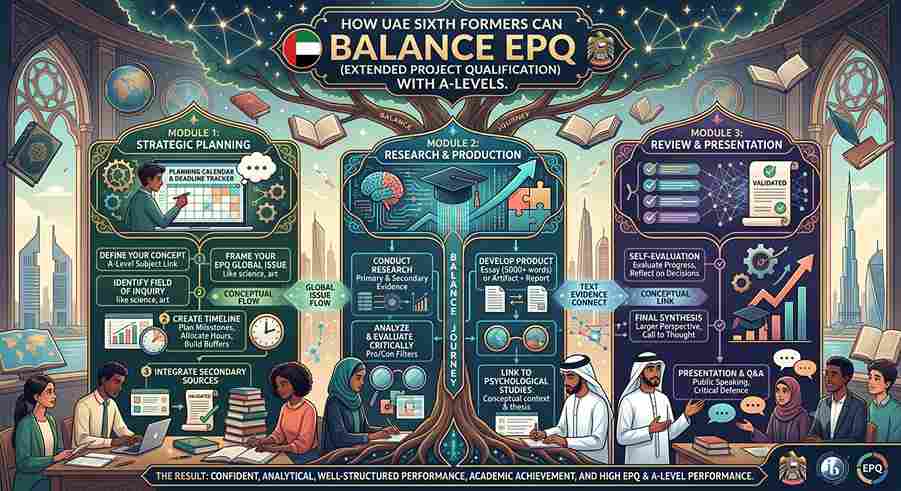
Part 3: The 4-Step EPQ & A-Level Balancing Framework
To successfully manage both commitments concurrently, execute this proven four-step operational framework:
                  THE 4-STEP EPQ & A-LEVEL BALANCING FRAMEWORK
                                     |
        +----------------------------+----------------------------+
        |                            |                            |
  1. SYNERGISTIC TOPIC SELECTION     2. THE MILESTONE TIMELINE    3. TIME-BOXED WEEKLY SLOTS   4. PRODUCTION LOG HABIT
  Choose an EPQ topic that           Map your project deadlines   Dedicate fixed micro-slots   Record reflections weekly
  directly connects to your A-       away from January/May A-     (e.g., 2 hours on Sunday)    rather than guessing
  Level subjects.                    Level exam windows.          exclusively for EPQ.         dates at the end.
1. Choose a Synergistic EPQ Topic
The single best way to reduce workload is to bridge your EPQ topic with your current A-Level studies.
- If you study A-Level Economics & Math: Research "To what extent can central bank digital currencies (CBDCs) stabilize emerging GCC economies?"
- If you study A-Level Biology & Chemistry: Research "Evaluating the efficacy of targeted nanotherapy in treating glioblastoma brain tumors."
- Why this works: Every academic journal article or book you read for your EPQ simultaneously deepens your critical understanding for your A-Level essay responses and synoptic papers!
2. Map Your Milestone Timeline Away from Exam Windows
Never schedule your heavy EPQ writing phase during January mock exams or May/June formal public examination periods.
- Ideal Timeline for UAE Sixth Formers:
- Term 3 (Year 12 / April–June): Topic approval, initial title formulation, and bibliography gathering.
- Summer Break (July–August): Primary research, essay drafting (aiming for 60% completion), and data collection.
- Term 1 (Year 13 / September–November): Finalizing the dissertation, formatting references, and preparing the presentation defense before December mocks.
3. Implement Time-Boxed Weekly Slots
Treat your EPQ like a regular timetabled subject. Dedicate a fixed 1.5 to 2-hour window every weekend (e.g., Sunday morning) strictly for EPQ research and drafting. Consistent, micro-progress prevents weekend panic and leaves your weekdays free for A-Level problem-solving.
4. Maintain the Production Log Weekly
Examiners award a massive portion of your EPQ marks (under AO1 and AO4) based on your Production Log and Project Record. Do not leave filling out this log until the end. Jot down quick reflective bullet points after every research session noting what challenges you faced, how you overcame them, and how your project direction evolved.
Part 4: Top 4 Traps That Derail UAE Sixth Formers
- Choosing an Overly Broad Title: Selecting an impossible title like "To what extent has artificial intelligence changed the world?" Narrow your focus to a specific, debatable question with clear regional or sectoral boundaries.
- Treating EPQ Like a Standard School Essay: Writing 5,000 words without referencing academic journals, analyzing conflicting viewpoints, or evaluating source reliability. The EPQ demands university-level independent research methodology.
- Neglecting the Presentation Defense: Forgetting that the 15-minute presentation and Q&A session with your school supervisor is a mandatory assessed component of the qualification. Practice your slide deck and anticipate challenging questions.
- Letting EPQ Steal Time from A-Levels: Allowing a passion for your EPQ research topic to derail your daily A-Level revision schedule. Remember: universities make their primary conditional offers based on your A-Level grades, not your EPQ!
Navigating Sixth Form in the UAE, balancing EPQ projects with A-Levels, and targeting top university admissions? EdFlik connects international school students globally with expert, 1-to-1 online A-Level tutors and university admissions mentors, helping you master independent research, optimize study schedules, and secure elite offers. Book a Free Demo Class Today!
Frequently Asked Questions (FAQs)
Q1: How many UCAS points is the EPQ worth?
Ans: The EPQ is awarded up to 28 UCAS tariff points for an $A^*$ grade, scaling down to 8 points for an $E$ grade. This is equivalent to half of a full A-Level (where an $A^*$ is worth 56 points).
Q2: Do all UK and UAE universities accept the EPQ?
Ans: Yes! Major UK institutions (including Oxford, Cambridge, Imperial, LSE, and UCL) and international branch campuses across the UAE actively welcome the EPQ. Many universities offer lower conditional entry requirements (such as dropping one grade requirement) if you achieve an $A$ or $A^*$ in your EPQ.
Q3: Can my EPQ be a practical artifact instead of a written dissertation?
Ans: Absolutely. While the majority of students write a 5,000-word dissertation, the EPQ permits you to create an artifact—such as building a functional software application, designing an architectural model, composing a musical score, or staging a theatrical performance—accompanied by a shorter 1,000-word written report and project log.
Q4: How does EdFlik support UAE Sixth Form students with A-Levels and EPQs?
Ans: EdFlik connects international school students across Dubai, Abu Dhabi, and the wider GCC with vetted, expert 1-to-1 online tutors specializing in Pearson Edexcel and Cambridge IAL subjects, university admissions strategies, and EPQ research structuring. Our personalized coaching helps students manage workloads efficiently and achieve top academic grades.