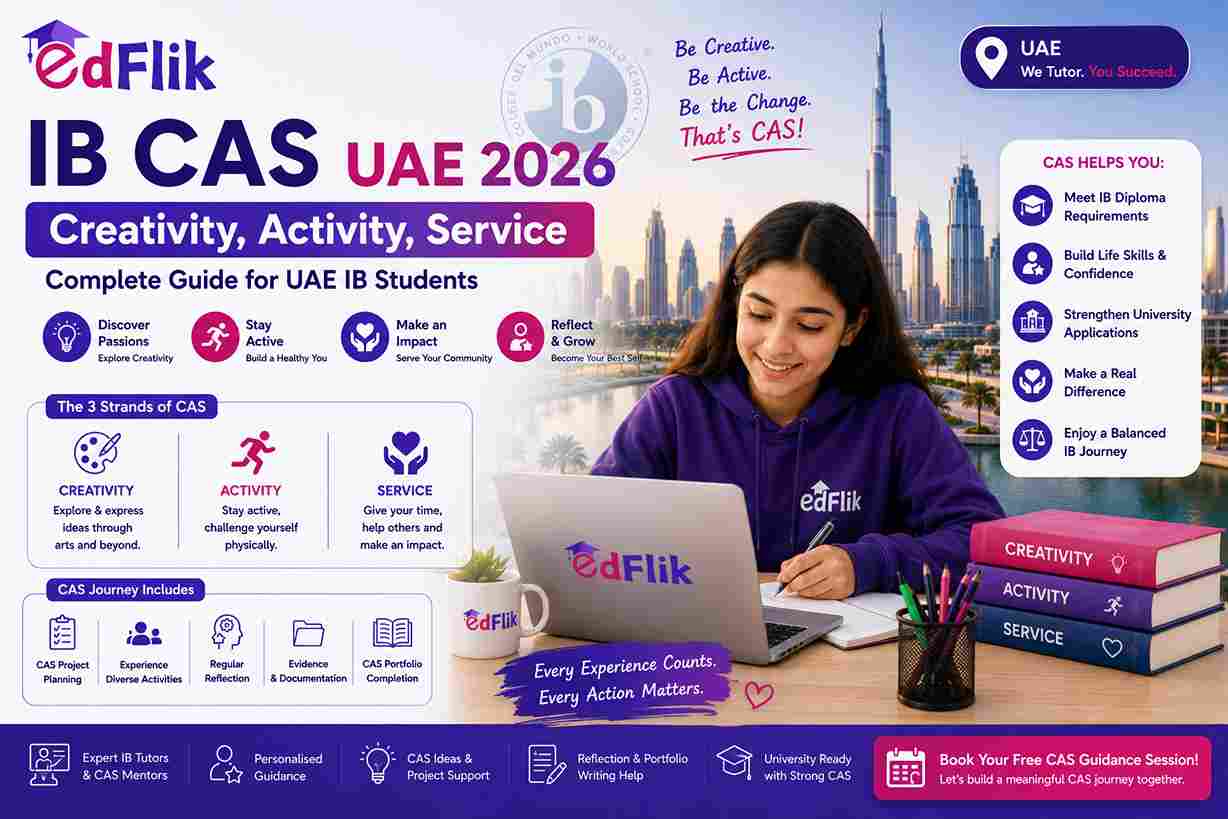
IB CAS UAE 2026 — Creativity, Activity, Service Complete Guide for UAE IB Students
CAS (Creativity, Activity, Service) is the IB Diploma core component that UAE students most consistently mismanage — not because it is difficult but because it requires ongoing documentation and reflection across two years, and the consequences of leaving it until Grade 12 are severe: a student who has not maintained their CAS portfolio cannot receive the IB Diploma regardless of how many 7s they earn in their subject examinations. This guide covers what CAS requires, what counts in UAE, the seven Learning Outcomes, and how to avoid the most common CAS failure patterns.
What CAS Actually Is — The Three Strands
|
Strand |
Definition |
UAE Examples |
Common
Misunderstanding |
|
Creativity |
Imaginative,
expressive, or creative engagement — arts, music, design, creative
exploration |
Learning to
play guitar, creating a short film, painting or drawing consistently,
photography project, set design for school play, creative writing, graphic
design |
Creativity
does not require professional-level output — a student who is learning a new
creative skill, documenting their progress and reflecting on it, is doing
valid Creativity CAS even if the output is not impressive to outsiders |
|
Activity |
Physical
activity — sport, fitness, movement, new physical challenges |
Joining a
football team, regular swimming training, learning a martial art, taking up
yoga, running programme, competitive rowing or sailing |
Any regular
physical activity qualifies — it does not need to be a school sport or
competitive. A student who walks 5km three times per week and documents their
progression meets the Activity requirement |
|
Service |
Voluntary
activity that benefits others — community service, social engagement, helping
others |
Volunteering
at a food bank, tutoring younger students in the community, environmental
clean-up projects, fundraising for charity, assisting at a community centre,
participating in a school-organised service trip |
Service
activities must be voluntary and must benefit others — they cannot benefit
the student financially or academically. Tutoring peers for payment does not
count as Service; tutoring peers voluntarily does |
The Seven CAS Learning Outcomes — What Each Means
Every CAS portfolio must demonstrate evidence of all seven Learning Outcomes across the two years of the Diploma:
• LO 1 — Identify own strengths and areas for growth: Reflection that goes beyond "I was good at this" — specifically identifying what you can do, what you cannot yet do, and what you learned about yourself through the activity
• LO 2 — Demonstrate that challenges have been undertaken: At least some CAS activities must involve genuine challenge — doing something difficult, encountering failure, learning from setbacks. A student who only does activities they are already skilled at may not demonstrate LO 2
• LO 3 — Initiate and plan a CAS experience: At least some CAS must be student-initiated — not just school-assigned activities. A student who designs and organises their own CAS project demonstrates LO 3
• LO 4 — Show commitment and perseverance: Sustained engagement over time rather than one-off activities. A student who attends a football team once does not demonstrate LO 4; a student who attends consistently over a term does
• LO 5 — Working collaboratively: CAS activities with others — the CAS Project specifically tests this outcome
• LO 6 — Issues of global significance: At least some CAS should connect to global challenges — environment, social justice, health, community. The reflection must explicitly discuss the global significance
• LO 7 — Ethics of choices and actions: Reflection on the ethical dimensions of the CAS activity — who benefits? who might be affected negatively? are there power dynamics to consider?
The CAS Portfolio — What UAE Students Must Document
CAS is assessed through the portfolio, not the activity itself. A student who does excellent CAS activities but fails to document them with reflections will not pass CAS. The portfolio must include for each activity:
• What I did: A description of the activity — not just the category but the specific engagement
• What I planned: How you prepared for and organised the activity
• What I felt: A reflective response that goes beyond description — what surprised you? what challenged you? what did you feel?
• What I learned: What the activity taught you about yourself, others, or the world — explicitly linked to the CAS Learning Outcomes
|
The most
common UAE CAS failure pattern: students complete good CAS activities but do
not write reflections at the time — planning to "write everything
up" in Grade 12 Term 2. By Grade 12 Term 2, the activities are 12-18
months in the past; the genuine emotional and developmental details are gone;
the reflections become vague summaries. CAS reflections must be written
immediately after each activity or experience. |
The CAS Project — The Compulsory Collaborative Component
Every IB Diploma student must complete a CAS Project — a sustained, collaborative project involving all three strands. Planning a CAS Project that genuinely covers all three strands requires creative thinking:
• Example: A school environmental campaign — students research an environmental issue (Creativity: research and communications design), run physical awareness walks or clean-up days (Activity: physical engagement with the environmental issue), and organise a community awareness campaign (Service: benefiting the broader school or local community)
• Example: A community sports event for younger children — students design activities and marketing (Creativity), run and participate in sports activities (Activity), and organise a fundraising or awareness element for a relevant charity (Service)
|
EdFlik does
not tutor CAS directly — CAS is an experiential and reflective programme, not
an academic subject. However, EdFlik tutors who work with UAE IB students
consistently help students understand the Learning Outcomes through the
academic lens of IB Diploma reflection practice, and can direct families to
their school's CAS Coordinator for programme-specific guidance. Free IB
Diploma consultation at www.edflik.com or WhatsApp +91 88788 96600. |
Frequently Asked Questions
Q: What is IB CAS and is it assessed with grades?
CAS (Creativity, Activity, Service) is a compulsory IB Diploma core requirement — pass/fail, no numerical grade. Students who do not complete CAS cannot receive the IB Diploma regardless of examination grades. Must cover all three strands across Grade 11 and 12.
Q: What counts as CAS for IB students in UAE?
Creativity: arts, music, design, film, creative writing. Activity: sport, fitness, new physical challenges. Service: volunteering, community service, tutoring others voluntarily, fundraising. All activities must be documented with reflections addressing the seven CAS Learning Outcomes.
Q: What are the CAS Learning Outcomes that IB students must demonstrate?
Seven LOs across the portfolio: identify strengths/areas for growth, demonstrate challenges undertaken, initiate and plan experiences, show commitment and perseverance, work collaboratively, engage with global issues, recognise ethics of choices and actions.
Q: What is a CAS project and is it compulsory?
Compulsory — a sustained collaborative project covering all three CAS strands simultaneously. Typically one month or more. Must be done with others. Assessed through the CAS portfolio as evidence of LO 5 (working collaboratively) and LO 3 (initiating and planning).
Q: When is the CAS portfolio submitted and what happens if it is incomplete?
Typically January-March of Grade 12 (internal school deadlines). Incomplete portfolios: school requires additional work; if still insufficient, IB may withhold the Diploma. CAS failure is completely avoidable with consistent documentation from Grade 11.