IB Extended Essay Guide UAE 2026 — How to Choose a Topic, Structure the EE and Score Band A
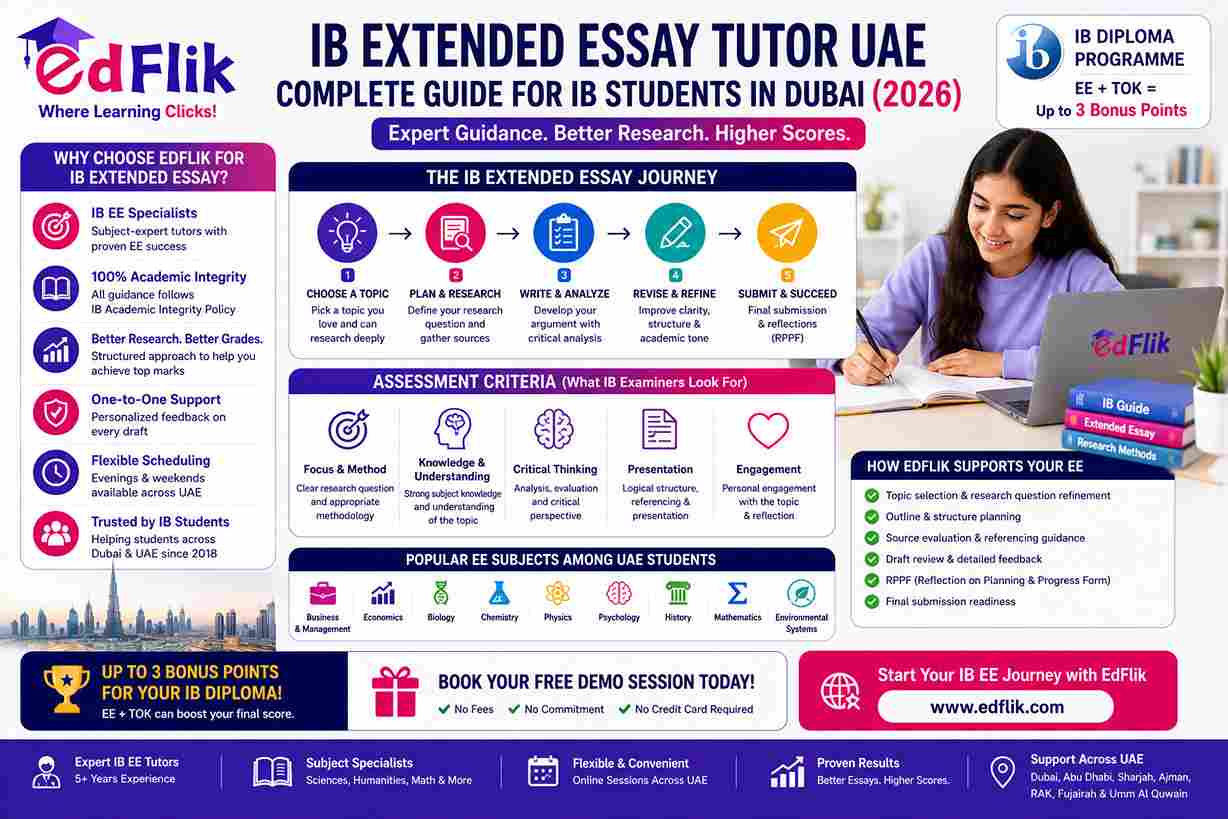
The IB Extended Essay is the most independently demanding component of the Diploma — a 4,000-word research essay on a focused question of the student's choice. It is also the component where UAE students most consistently lose bonus points through poor topic selection, vague research questions, or insufficient critical analysis. This guide covers topic selection, research question formulation, the five assessment criteria, and what Band A EEs actually contain.
Why the Extended Essay Matters — Bonus Points and University Signal
The EE and Theory of Knowledge together offer up to 3 bonus points toward the 45-point Diploma total:
|
EE Grade +
TOK Grade |
Bonus Points |
|
A + A |
3 points |
|
A + B or B + A |
3 points |
|
B + B or A + C
or C + A |
2 points |
|
B + C or C + B |
2 points |
|
C + C or B + D
or D + B |
1 point |
|
E or D
combinations |
0 points — but
EE Grade E causes Diploma failure regardless of total score |
|
EE Grade E is
one of three conditions that cause automatic Diploma failure regardless of
total score (alongside TOK Grade E and being found in breach of academic
integrity). An E grade requires a standard equivalent to what is described in
the criteria as "failing" — this is most often the result of: no
clear research question; almost entirely descriptive without analysis;
extremely poor presentation; or not engaging with the supervision process. |
The Research Question — The Most Critical EE Decision
The research question determines the entire EE. A poor research question makes a Band A essay essentially impossible — no amount of good writing can rescue a fundamentally misconceived investigation. Good research questions share five characteristics:
• Focused: Can be genuinely investigated within 4,000 words. "The causes of the 2008 financial crisis" is not focused. "To what extent did the failure of the regulatory framework in the USA contribute to the 2008 financial crisis compared to Europe?" is investigable.
• Arguable: Has a non-obvious answer that requires analysis and evaluation, not just information gathering. "What is photosynthesis?" is not arguable. "To what extent does light intensity independently regulate the rate of photosynthesis in Elodea canadensis?" requires genuine investigation.
• Accessible: Has sources the student can actually access and evaluate — not classified documents, interviews that cannot be arranged, or data that does not exist
• Subject-appropriate: Fits within the IB guidelines for the chosen EE subject — each subject has specific EE requirements; a topic that is really a Psychology question submitted under Biology will score poorly on Criterion A
• Genuinely interesting to the student: The EE takes approximately 40 hours over a year — sustained intellectual engagement requires genuine curiosity
The Five Assessment Criteria — What Examiners Award Marks For
|
Criterion |
Max Marks |
What It
Assesses |
Common
Weakness |
|
A — Focus and
Method |
10 |
Clarity and
appropriateness of the research question; methodology; theoretical framework |
Research
question too broad; no explanation of why the chosen method is appropriate
for the question |
|
B — Knowledge
and Understanding |
6 |
Subject-specific
knowledge; use of subject-specific terminology; engagement with relevant
theory or literature |
Superficial
knowledge of the topic; not engaging with key relevant theories or academic
sources in the field |
|
C — Critical
Thinking |
12 |
Analysis of
evidence; discussion of implications; evaluation of limitations; reaching a
justified conclusion |
Descriptive
without analysis — summarising sources rather than evaluating them; reaching
a conclusion not supported by the evidence presented |
|
D —
Presentation |
4 |
Formal
academic structure; referencing accuracy; bibliography; word count
compliance; table of contents; abstract |
Missing or
incorrect citations; no abstract; word count exceeded; poor bibliography
format |
|
E — Engagement |
6 |
Reflection on
the research process shown in the Reflections on Planning and Progress Form
(RPPF); intellectual engagement |
RPPF completed
superficially or only at the last minute; reflections that describe what was
done rather than what was learned |
Popular EE Subjects at UAE IB Schools and Key Considerations
|
EE Subject |
Key Strength
of This Choice |
Key Challenge |
UAE-Specific
Tip |
|
Economics |
Accessible
secondary data; economic theory provides analytical framework; clear marking
criteria |
Data must be
current and relevant; analysis must use economic models not just description |
Use UAE or GCC
economic data — local relevance makes sourcing easier and application more
specific |
|
Biology |
Allows
original laboratory investigation; IB values primary data highly |
Requires safe,
accessible experiments with sufficient data for statistical analysis |
UAE biological
contexts (desert ecology, coral reef deterioration in Gulf) offer unique
locally accessible research angles |
|
History |
Strong archive
sources available; clear analytical framework |
4,000 words
limits depth; must cover historiography (different historians'
interpretations) to score well on Criterion C |
Focus on 20th
century world history topics rather than UAE-specific history where
historiography is less developed |
|
English A |
Allows genuine
literary analysis of chosen texts; flexible source selection |
Must
demonstrate literary analysis skills beyond personal response |
Choose two or
three texts with genuine comparative potential — theme, form, or cultural
context connections |
|
Business
Management |
Real company
primary data accessible via interviews, reports; practical topic |
Risk of
description over analysis; must apply BM theory and tools to score on
Criterion C |
Dubai-based
companies or UAE market contexts offer accessible primary research through
informational interviews |
The UAE EE Timeline — What Schools Expect When
|
When |
Milestone |
Why It
Matters |
|
September–October,
Grade 11 |
Initial topic
and research question proposal submitted to EE supervisor |
Sets the
entire investigation direction — the earlier the RQ is fixed, the more time
for substantive research |
|
November–December,
Grade 11 |
First formal
supervision session; reading and initial source gathering |
Supervisor
feedback on RQ suitability can prevent a year of work on a misconceived
question |
|
February–March,
Grade 11 |
First draft
(typically Chapters 1-2 or approximately 2,000 words) submitted to supervisor |
Early draft
feedback is the most valuable — time to genuinely revise rather than just
edit |
|
June–August,
Grade 11 (summer) |
Near-complete
draft; all primary data collected |
Summer is the
most productive EE writing period — school is not in session |
|
September,
Grade 12 |
Final EE
submitted to school for teacher review and RPPF completion |
Schools
typically require final EE submission in early Grade 12 before the busy
examination revision period begins |
|
October–November,
Grade 12 |
EE submitted
to IB by the school |
IB external
examiner marks the EE — no further revision possible after submission |
|
EdFlik
provides IB Extended Essay guidance across all IB subjects, within IB
Academic Integrity Policy. All EE content is produced by the student — EdFlik
tutors guide research question development, criteria analysis, and draft
review. From AED 70 per session. Free consultation. Book at www.edflik.com or
WhatsApp +91 88788 96600. |
Frequently Asked Questions
Q: What is the IB Extended Essay?
A 4,000-word independently researched essay mandatory for the IB Diploma. Worth up to 3 bonus points combined with TOK. Graded A-E by an external IB examiner. Grade E causes automatic Diploma failure.
Q: How do you choose a good Extended Essay topic?
The research question must be focused (investigable in 4,000 words), arguable (non-obvious answer requiring analysis), accessible (sources available), subject-appropriate, and genuinely interesting to the student.
Q: What subjects can the IB Extended Essay be written in?
Any IB subject group. Popular at UAE schools: Economics, Biology, History, Business Management, Chemistry, English A, Psychology. World Studies EE allows interdisciplinary investigation.
Q: What is the IB EE grading criteria?
Five criteria: Focus and Method (10 marks), Knowledge and Understanding (6), Critical Thinking (12), Presentation (4), Engagement (6) — total 38 marks converted to A-E grade.
Q: When should UAE IB students start their Extended Essay?
September of Grade 11 — research question confirmed by October, first draft in February-March, near-complete by summer between Grade 11 and 12. Schools typically require final submission in September of Grade 12.