IB Chemistry Tutor in Dubai and the UAE: What It Takes to Score a 6 or 7
IB Chemistry is one of the most consequential subjects in the IB Diploma Programme. For UAE students aiming at medicine, biochemistry, pharmacy, or chemical engineering — at universities in the UK, US, or the UAE — IB Chemistry HL at grade 6 or 7 is typically a firm requirement. Yet Chemistry is also one of the subjects where the gap between understanding the content and performing well in examinations is widest. This guide explains what separates grade 5 Chemistry students from grade 7 students, and how specialist one-to-one tutoring closes that gap.
The IB Chemistry Assessment: What UAE Students Are Actually Marked On
IB Chemistry at SL is assessed through two papers; at HL through three:
· Paper 1 — multiple choice, 30 questions at SL / 40 at HL (45 minutes / 60 minutes). Tests breadth of content knowledge. Data booklet is provided. No working is required.
· Paper 2 — structured and extended response (1 hour 15 minutes SL / 2 hours 15 minutes HL). Short and medium-length questions in Section A (compulsory) and extended response questions in Section B (choice at SL; compulsory at HL). Tests depth of understanding and ability to apply chemistry to unfamiliar contexts.
· Paper 3 (HL only) — 1 hour 15 minutes. Section A: data-based question on an unfamiliar experimental context requiring analytical reasoning. Section B: structured questions on the optional theme studied in class.
The data booklet is available in all papers and contains electronegativity values, enthalpies, standard electrode potentials, and other data. Students must know which values to look up and how to use them — the booklet is a tool, not a substitute for understanding.
Where UAE Students Lose Most Marks in IB Chemistry
Paper 1: Speed and Precision on Ambiguous Questions
Multiple-choice questions in IB Chemistry Paper 1 are carefully constructed so that common misconceptions produce incorrect answers. A student who memorised that 'higher temperature increases reaction rate' without understanding why may choose the wrong answer to a question about equilibrium constants at different temperatures. Paper 1 requires genuine understanding, not surface familiarity. Time management is also critical — 30 (or 40) questions in 45 (or 60) minutes leaves approximately 90 seconds per question. Students who spend too long on early questions lose time on later ones.
Paper 2: Precision of Written Answers
IB Chemistry mark schemes at Paper 2 reward precision. Answers that describe a process generally but omit the specific mechanism, unit, or quantitative dimension required typically earn one mark where two are available. Training students to write answers that anticipate what the mark scheme is looking for — through consistent analysis of IB mark schemes alongside past papers — is one of the most reliable ways a tutor accelerates grade improvement.
Organic Chemistry Mechanisms: The HL Differentiator
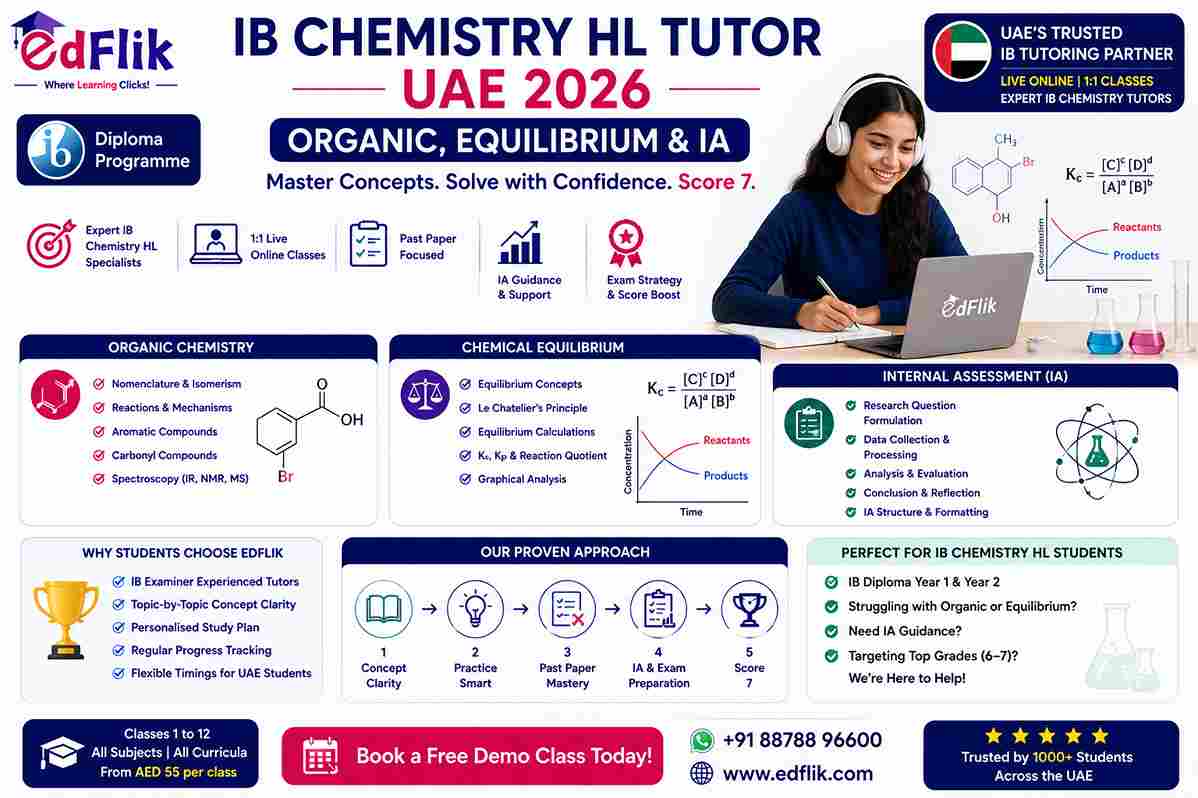
Organic mechanisms at HL — nucleophilic substitution (SN1 and SN2), electrophilic addition, electrophilic aromatic substitution, and condensation reactions — require drawing curly arrows accurately, identifying the type of reagent, and explaining why each step occurs. Students who have memorised reaction products without understanding the mechanism consistently earn partial marks on mechanism questions. A tutor who teaches mechanisms from first principles — not from memorisation — builds the transferable reasoning that earns full marks on unfamiliar mechanism questions.
How EdFlik Provides IB Chemistry Tutoring Across Dubai and the UAE
EdFlik provides one-to-one IB Chemistry tutoring for SL and HL students across Dubai, Abu Dhabi, Sharjah, and the wider UAE. Tutors are qualified, experienced Chemistry teachers with familiarity with the IB Chemistry guide (first assessment 2025) and the associated examination papers. Sessions combine content explanation, past paper analysis against IB mark schemes, mechanism practice, and calculation technique. Internal Assessment support is available for students at the planning, data analysis, and write-up stages.
Sessions start from AED 45 per session with a free trial class available. Book at \edflik.com.
Frequently Asked Questions
What are the hardest topics in IB Chemistry Higher Level?
The topics that most consistently cause grade loss in IB Chemistry HL are organic chemistry mechanisms and synthesis, electrochemistry (standard electrode potentials, cell notation, and electrolysis calculations), thermodynamics (entropy, Gibbs free energy, Born-Haber cycles), and the kinetics topics requiring detailed understanding of activation energy and reaction mechanisms. Physical chemistry at HL is more mathematically demanding than at SL, and students who are not comfortable with multi-step calculations under timed conditions lose marks across several paper sections simultaneously. The HL Paper 3 also includes an unfamiliar data analysis question in Section A that rewards scientific reasoning over content recall.
Is IB Chemistry SL much easier than IB Chemistry HL?
IB Chemistry SL covers the same core content as HL but omits the additional HL material and the HL-only option content. SL is assessed through Papers 1 and 2 only, while HL adds Paper 3. The conceptual difficulty at SL is genuine — the examination still requires understanding of atomic structure, bonding, energetics, kinetics, equilibrium, acid-base chemistry, redox, and organic chemistry — but the mathematical demands are lower and the depth of mechanistic understanding required is less than at HL. Students who achieve grade 6 or 7 at SL have demonstrated solid chemistry competence. Most medical, biochemistry, and chemistry degree programmes require HL, which makes SL adequate only for students not heading toward these fields.
What is the IB Chemistry Internal Assessment?
The IB Chemistry Internal Assessment is a scientific investigation carried out by the student, contributing 20% of the final Chemistry grade at both SL and HL. The investigation must be personally designed by the student around a specific research question, include appropriate controls, produce data that allows quantitative analysis, and be reported in approximately 2,000 words. It is assessed against five criteria: Personal Engagement, Exploration, Analysis, Evaluation, and Communication. Common weaknesses include insufficient independent design (using commercially available protocols too closely), superficial data analysis, and evaluation sections that identify errors without quantifying their likely impact on results.
How can a UAE student improve in IB Chemistry if they already understand the theory?
Understanding the theory and performing in IB Chemistry examinations are related but distinct skills. If a student understands content but underperforms in examinations, the most likely causes are: writing answers at a level of precision below what the IB mark scheme requires; losing marks in multi-step calculations through step-sequencing errors; not completing Paper 1 multiple-choice within the time limit, leading to rushed guessing; or underperforming in the data analysis section of Paper 3 (HL) by applying taught knowledge rather than reasoning from the unfamiliar data provided. A tutor who analyses past paper performance and identifies which of these patterns applies can target improvement directly and efficiently.
Book a Free IB Chemistry Trial Class
EdFlik's IB Chemistry tutors cover SL and HL across the UAE. Sessions from AED 45. Free trial at edflik.com.