IB Chemistry HL Tutor UAE 2026 — Organic, Equilibrium & IA
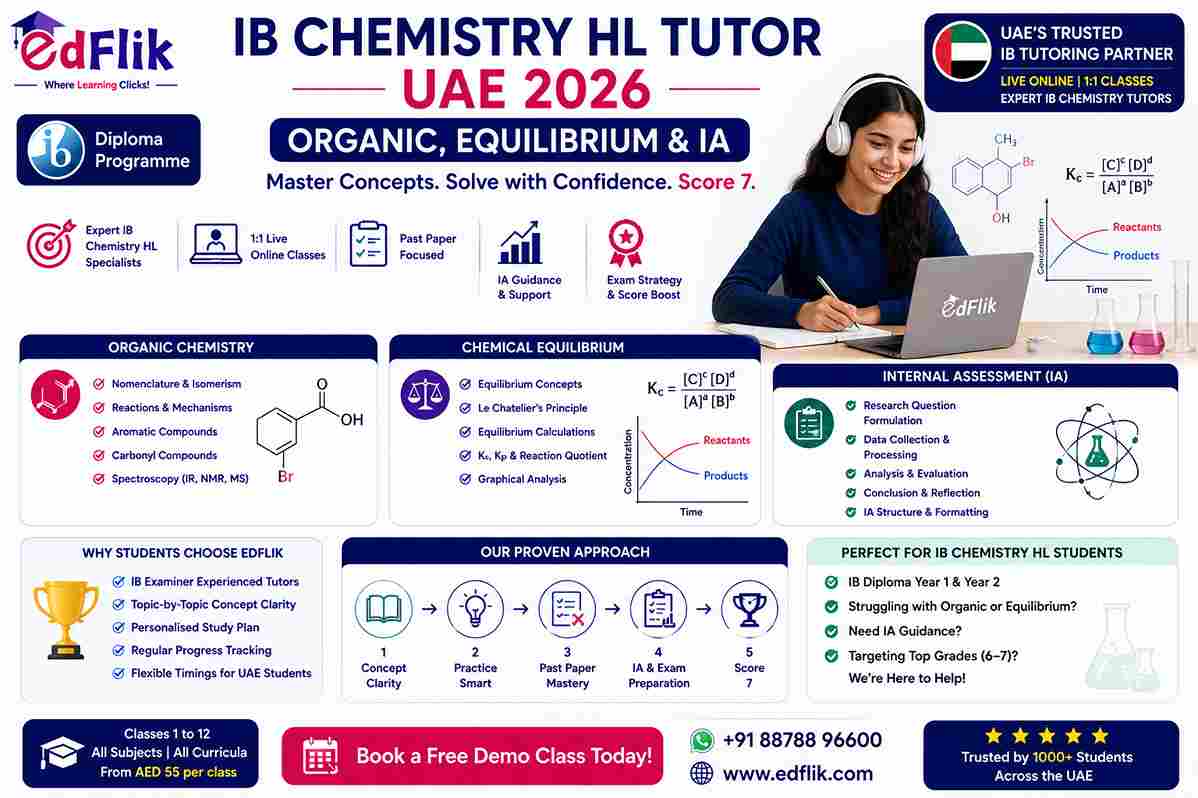
IB Chemistry HL is the most requested IB science subject for tutoring at EdFlik — and the one where the gap between classroom instruction and exam performance is widest. The reason is specific: HL Chemistry requires simultaneous mastery of organic reaction mechanisms, physical chemistry calculations, and experimental data analysis. Each demands a different type of thinking, and classroom teaching rarely gives students enough time in any one area.
This guide covers the full IB Chemistry HL structure, the five topic areas where UAE students consistently need support, the IA guide for maximising the 20% internal assessment mark, and the HL-versus-SL content differences that matter for university applications.
IB Chemistry HL — Full Paper Structure
|
Paper |
Format |
Duration |
Marks |
% of Grade |
|
Paper 1 (HL) |
40 MCQ — core
and AHL content |
1 hour |
40 |
20% |
|
Paper 2 (HL) |
Short answer
and extended response — data + theory |
2 hrs 15 mins |
95 |
36% |
|
Paper 3 (HL) |
Section A:
data-based + Section B: Options |
1 hr 15 mins |
45 |
24% |
|
Internal
Assessment (IA) |
Individual
scientific investigation |
Assessed over
Year 12 |
— |
20% |
|
HL-only
content (AHL) appears in Papers 1 and 2 and adds approximately 60 hours of
additional teaching above SL. AHL topics include reaction mechanisms,
spectroscopy, electrochemistry (Nernst), thermodynamics (Gibbs energy), and
the full Options topic in Paper 3. |
The 5 Hardest IB Chemistry HL Topics — By UAE Tutoring Demand
1. Organic Reaction Mechanisms
Organic chemistry is where most UAE IB Chemistry HL students lose the most marks. Paper 2 requires students to draw curly-arrow mechanisms for nucleophilic substitution (SN1 and SN2), electrophilic addition to alkenes, elimination reactions, and nucleophilic addition to carbonyls. Each mechanism has precise rules: the nucleophile attacks the electrophilic centre, the arrow begins at a lone pair or bond, and the leaving group departs with the electron pair. Any deviation from this — arrows starting at atoms rather than electron pairs, incorrect stereochemistry in SN1/SN2 — loses the mechanism marks.
The most common error: UAE students learn the overall transformation (reactants → products) without learning the mechanism. Examiners award marks specifically for the intermediate steps and curly arrows — not just the correct product.
2. Acid-Base Equilibrium and Buffer Calculations
The pH calculations in IB Chemistry HL extend well beyond SL. HL requires buffer calculations using the Henderson-Hasselbalch equation, Ka and Kb relationships, titration curve interpretation (including identifying equivalence points and buffer regions), and pH of salt solutions (hydrolysis). The mathematics is manageable but the conceptual framework — knowing which species is the acid and which is the base in any given situation — requires deliberate practice.
3. Electrochemistry — Cell Potential and the Nernst Equation
IB Chemistry HL electrochemistry (AHL topic) requires calculating standard cell potential from half-reaction potentials, predicting spontaneity (ΔG = -nFE), and applying the Nernst equation to non-standard conditions. Most UAE schools teach this topic in two or three lessons. EdFlik tutors spend four to six sessions on this topic alone, because exam questions require students to move fluently between E°, ΔG°, Keq, and pH — all in one multi-part question.
4. Spectroscopy — IR, Mass Spec, and NMR
Paper 2 and Paper 3 both include spectroscopy interpretation questions. IR spectroscopy requires identifying functional groups from wavenumber tables. Mass spectrometry requires interpreting fragmentation patterns and identifying molecular formula from M+ peak. ¹H NMR requires assigning chemical shift, integration, and splitting pattern to a proposed structure. The skill is not memorisation — it is systematic elimination: what does this spectrum rule out, and what remains?
5. Options — Paper 3 Section B
UAE students overwhelmingly choose Medicinal Chemistry (Option D) or Biochemistry (Option B) as their Options topic. Medicinal Chemistry covers pharmacokinetics, drug design, anaesthetics, antiviral drugs, and mind-altering drugs. Biochemistry covers amino acids, proteins, carbohydrates, lipids, and vitamins. Both require learning genuinely new content that is not covered in the core or AHL — and both are tested at HL depth in Paper 3 Section B.
IB Chemistry HL Internal Assessment — Guide to Scoring All 5 Criteria
The IA is worth 20% of the final grade and is assessed on five criteria. Understanding what each criterion actually rewards is the fastest route to a high IA mark.
|
Criterion |
Marks |
What
Examiners Reward |
|
Personal
Engagement |
2 |
Genuine
student interest — not just a "safe" topic. Evidence the student
chose the question themselves. |
|
Exploration |
6 |
Clear,
specific research question; identified variables; justified methodology;
relevant safety and ethics. |
|
Analysis |
6 |
Processed data
with correct uncertainties; graphs with error bars; appropriate statistical
treatment; trend identification. |
|
Evaluation |
6 |
Conclusion
directly answers the research question; specific weaknesses identified with
realistic improvements; comparison to literature value. |
|
Communication |
4 |
Structure,
focus, appropriate terminology, correct referencing, within 6–12 page limit. |
The single biggest IA mistake UAE students make: choosing a topic that is too broad or too obvious. "How does temperature affect enzyme activity?" is a fine school experiment — it is a weak IA because every examiner has seen it 200 times and it produces flat, uninformative results. A narrow, specific question with a genuine variable — "How does the concentration of ethanol affect the fluorescence intensity of quinine sulphate solution?" — produces data that can be analysed meaningfully and demonstrates genuine personal engagement.
IB Chemistry HL vs SL — What the Difference Means for Tutoring
|
Area |
SL Content |
HL Additional
Content |
|
Organic
Chemistry |
Functional
groups, reactions, naming |
Reaction
mechanisms (curly arrows), spectroscopy (NMR), stereoisomerism |
|
Physical
Chemistry |
Equilibrium,
pH basics, Hess's law |
Nernst
equation, Gibbs energy, Henderson-Hasselbalch, advanced titration |
|
Inorganic
Chemistry |
Periodicity,
Group 1/7 reactions |
Transition
metal chemistry, ligand field theory |
|
Paper 3 |
Data-based +
Options (SL depth) |
Data-based
(same) + Options (HL depth, 15 extra marks) |
|
Exam time |
2h 15m Papers
1+2, 1h Paper 3 |
3h 15m Papers
1+2, 1h 15m Paper 3 |
|
EdFlik IB
Chemistry tutors are matched by HL or SL level. HL and SL are different
courses requiring different teaching approaches. Sessions from AED 70 for IB
Chemistry HL. Free diagnostic trial. Book at www.edflik.com or WhatsApp +91
88788 96600. |
Frequently Asked Questions
Q: Is IB Chemistry HL hard?
IB Chemistry HL is one of the most demanding IB subjects. HL extends SL content with organic mechanisms, electrochemistry, and spectroscopy, plus an independent IA worth 20%. Most UAE students who take HL do so for Medicine, Engineering, or Biochemistry university requirements.
Q: What is the hardest topic in IB Chemistry HL?
By UAE tutoring demand: organic reaction mechanisms (SN1/SN2, curly arrows), acid-base equilibrium (buffer calculations), electrochemistry (Nernst equation), and spectroscopy (NMR interpretation) are consistently the most requested areas.
Q: How much does IB Chemistry HL tutoring cost in UAE?
EdFlik charges AED 70 per session for IB Chemistry HL — 1:1, live online, past-paper-based. First session is a free diagnostic trial.
Q: What does IB Chemistry HL Paper 3 test?
Section A: data-based questions using experimental results. Section B: one Options topic (Medicinal Chemistry, Biochemistry, Energy, or Materials) at HL depth.
Q: When should UAE students start IB Chemistry HL tutoring?
September of Year 12 for students who struggled in Year 11 SL content. October–November for students whose first Year 12 assessment reveals content gaps. IA support should begin October of Year 12 at the latest.