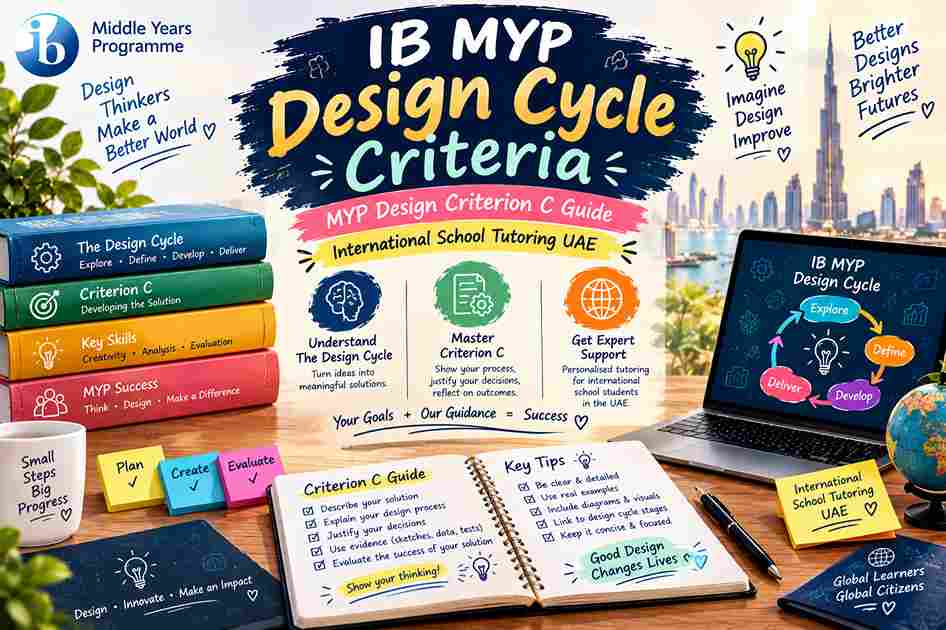
IB MYP design cycle criteria, MYP design criterion c guide, international school tutoring UAE
Last Updated: September 2026 | By EdFlik Education Team
For students and parents navigating international schools across the UAE—including Dubai, Abu Dhabi, and Sharjah—following the International Baccalaureate (IB) Middle Years Programme (MYP), design is a core pillar of holistic education. Whether your child is studying Product Design, Digital Design, or Food Technology in Years 7 through 9 (MYP 1–3) or preparing for their e-Portfolios in MYP 4 and 5, mastering the IB MYP Design Cycle is essential.
While students often enjoy brainstorming ideas (Criterion B) and evaluating finished prototypes (Criterion D), Criterion C: Creating the Solution is where many lose precious marks. Criterion C requires meticulous technical planning, precise execution, and rigorous documentation of developmental changes.
In this comprehensive guide, our expert MYP design and international school tutors break down the exact requirements of Criterion C, share step-by-step execution strategies, and explain how targeted academic support across the UAE can secure your target Grade 7.
Part 1: Deconstructing the IB MYP Design Cycle
The MYP Design cycle is an iterative, problem-solving framework consisting of four equally weighted criteria (each graded out of 8):
- Criterion A: Inquiring and Analyzing: Identifying a need, researching existing products, and developing a design brief.
- Criterion B: Developing Ideas: Generating detailed design proposals, considering feasibility, and selecting a final chosen design.
- Criterion C: Creating the Solution: Planning the construction/creation process and following the plan to make a prototype.
- Criterion D: Evaluating: Testing the product against the original design specification and evaluating its impact on the client/target audience.
Part 2: Deep Dive into Criterion C (Creating the Solution)
Criterion C is worth 8 marks and is divided into three distinct strands that test your practical skills, organization, and technical adaptability.
Strand 1: Constructing a Logical Plan (The Blueprint)
Before you touch a tool, write a line of code, or cut a piece of wood, you must construct a step-by-step manufacturing plan. Examiners do not want to see a vague list; they want a detailed operational blueprint.
- What to Include: A table containing chronological steps, estimated time allocations, tools and equipment required, safety precautions, and quality control checks.
- Why It Matters: A robust plan allows any skilled third party to recreate your product exactly as you intended.
Strand 2: Demonstrating Technical Skills (Execution)
This strand evaluates your ability to use tools, techniques, and technologies competently and safely.
- Evidence Required: High-resolution photographic evidence showing you actively engaged in the manufacturing or coding process (e.g., soldering circuit boards, operating laser cutters, sewing seams, or writing advanced software loops). Photos of only the final product will result in low marks here.
- Safety & Hygiene: Explicitly document how you adhered to workshop or laboratory safety rules.
Strand 3: Following the Plan and Making Changes (Adaptability)
In real-world design, things rarely go 100% according to plan. Materials might be out of stock, dimensions might need tweaking, or software bugs might arise.
- The Examiner's Expectation: Examiners love to see critical thinking and problem-solving. If your plan changes, do not hide it. Document why the change occurred, what modification you made to your original plan, and how it impacted the final outcome.
Part 3: Top 4 Strategies to Secure a Grade 7 in MYP Design
- Never Skip In-Process Documentation: Take photos at every major milestone of creation. A visual timeline proving how the product was built is mandatory for top-band marks in Criterion C.
- Make Your Timeline Realistic: If your manufacturing plan states "Build entire wooden cabinet in 10 minutes," examiners will know it is unrealistic. Break tasks down into sensible, timed blocks.
- Justify Every Modification: If you deviate from your initial design drawings during the creation phase, write a brief explanatory note detailing the justification (e.g., "Acrylic sheet cracked during laser cutting; switched to 3mm plywood for improved structural integrity").
- Reference Your Design Specification (Criterion B): Ensure your created solution strictly adheres to the dimensions, materials, and functional requirements you established in earlier criteria.
Part 4: The Advantage of Specialized International School Tutoring in the UAE
Balancing rigorous MYP design portfolios with Science, Humanities, and Mathematics coursework across fast-paced UAE international schools can lead to severe student burnout.
Partnering with an expert international school tutoring provider offers transformational advantages:
- Portfolio Guidance: Learning how to structure your design e-portfolio cleanly to meet strict IB formatting and evidence guidelines.
- Technical Troubleshooting: Receiving expert guidance on digital software (CAD, vector graphics, coding environments) or physical prototyping techniques.
- Confidence Building: Providing a supportive mentorship environment that replaces design anxiety with creative autonomy and academic success.
Struggling to structure your MYP design cycle portfolio, master Criterion C, or keep up with international school assessments across the UAE? EdFlik offers expert, 1-to-1 online tutoring customized specifically for MYP students, helping you build creative confidence and secure top Grade 7 results.Book a Free Demo Class Today!
Frequently Asked Questions (FAQs)
Q1: What is the difference between MYP Design for early years (MYP 1–3) and personal project/e-portfolios (MYP 4–5)?
Ans: In MYP 1–3, the design cycle introduces fundamental problem-solving and basic prototyping. In MYP 4–5, assessments become far more rigorous, culminating in external e-portfolio moderation or the MYP Personal Project, requiring sophisticated technical justification and detailed evaluation.
Q2: Can I use digital tools like CAD and 3D printing for my MYP Design solution?
Ans: Yes! Digital design (including 3D modeling, laser cutting, app development, and graphic design) is fully supported and encouraged alongside traditional resistant-materials or textiles approaches.
Q3: What happens if my prototype fails during the creation stage?
Ans: Do not panic. The IB values the process over perfection. If a prototype fails, documenting the failure, analyzing why it happened, and explaining how you modified your approach demonstrates high-level critical thinking and problem-solving.
Q4: How can EdFlik support MYP students in the UAE?
Ans: EdFlik connects students across Dubai, Abu Dhabi, Sharjah, and the UAE with vetted, experienced 1-to-1 online tutors specializing in IB MYP Design, Sciences, Mathematics, and Humanities. Our personalized sessions focus on clarifying portfolio criteria, mastering practical skills, and building academic confidence.