IELTS Preparation UAE 2026 — Complete Guide to Academic and General Training Scores and Preparation
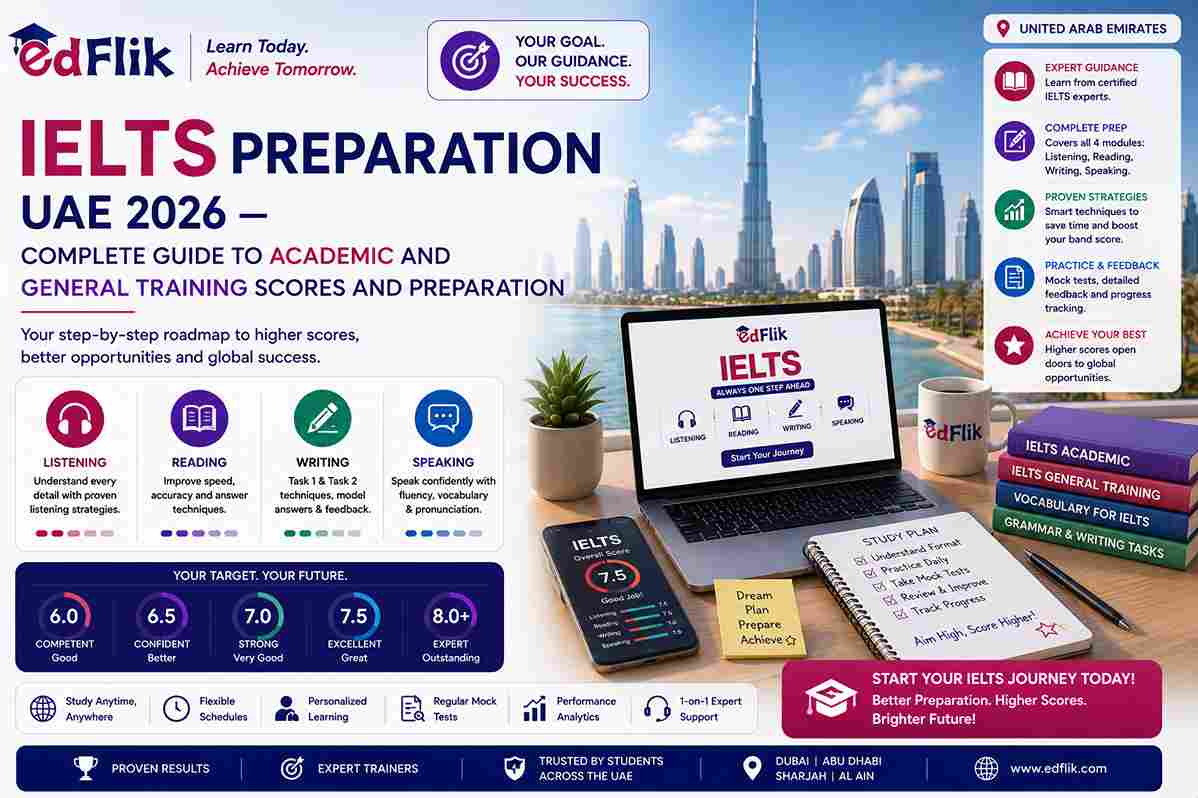
IELTS is one of the most important examinations UAE students will sit if they intend to study at UK, Australian, Canadian, or certain UAE universities — yet it is often prepared for last, with insufficient time, and with a preparation approach that focuses on the wrong components. This guide covers the complete IELTS landscape for UAE students: which version to take, what scores each university destination requires, how long preparation takes, and which components require the most focused attention.
IELTS Academic vs General Training — Which Do You Need?
|
Situation |
Take IELTS
Academic |
Take IELTS
General Training |
|
UK university
undergraduate degree application |
Yes — required
by virtually all UK universities for non-native English speakers |
No — General
Training not accepted for degree-level university admission |
|
UAE public
university application (UAEU, Khalifa, ZU) |
Yes (if using
IELTS rather than EmSAT English) |
No |
|
Australian or
Canadian university application |
Yes |
No |
|
UK visa or
immigration application (non-study) |
Sometimes
specified — check specific visa type |
Yes for most
non-study visa types |
|
UAE
professional registration (nursing, medicine, engineering) |
Yes for most
professional licensing bodies |
Sometimes —
check the specific licensing body requirements |
|
US university
application |
Yes if English
proficiency documentation is required |
No |
|
General
migration (Australia, Canada, UK points-based) |
Not required —
General Training is standard |
Yes — General
Training for immigration points systems |
IELTS Band Scores — What Each Level Means
|
Band Score |
Description |
University
Typical Access Level |
|
9.0 |
Expert user —
complete command of English |
Native-equivalent;
competitive for any university worldwide |
|
8.0-8.5 |
Very good user
— very few inaccuracies |
Strong
competitive profile for any UK, Australian, US university; above requirement
for most programmes |
|
7.0-7.5 |
Good user —
operational command with some inaccuracies |
UK competitive
programmes (Medicine, Law, LSE); Australian Medicine; required minimum at
many top UK universities |
|
6.5 |
Competent user
— generally effective command, some misunderstandings in complex situations |
Standard
minimum for most UK Russell Group undergraduate; most Australian
universities; competitive UAE universities |
|
6.0 |
Modest user —
partial command; can use familiar situations |
Minimum for
many UAE public universities; some UK post-92 universities; not sufficient
for most Russell Group or medicine |
|
5.5 |
Limited user —
partial understanding in familiar contexts |
Below
threshold for most UK and Australian university admission; some foundation
programme entry |
The Four IELTS Bands — Preparation Priority by Component
Listening (Band 1 of 4) — 30 minutes, 40 questions
IELTS Listening tests comprehension of recorded material — conversations, monologues, and lectures. Most UAE students find Listening the most accessible component because it uses standard spoken English at a moderate speed. Common errors: missing answers by spending too long on one question (move on if unsure), and not following the instruction on how to record answers (word count limits, capitalisation requirements).
Reading (Band 2 of 4) — 60 minutes, 40 questions (Academic: 3 long texts)
Academic Reading uses complex academic texts. Time management is the primary challenge — 60 minutes for 40 questions on long texts (800-1000 words each) requires fast, accurate skimming and scanning. The most time-consuming question type: True/False/Not Given — the distinction between False (the text contradicts the statement) and Not Given (the text does not mention it) is the most consistently answered incorrectly by UAE students.
Writing (Band 3 of 4) — 60 minutes: Task 1 (20 min) + Task 2 (40 min)
Writing is the most underestimated and most commonly band-limiting component:
• Task 1 Academic (graph/chart/diagram description, 150 words min): Requires a specific structure (overview of main trend + key details + comparison) using data-description language ("rose significantly to," "declined sharply from," "remained stable at"). UAE students who treat Task 1 as a simple description without overview or trend language rarely score above Band 5.
• Task 2 (essay, 250 words min, counts 2/3 of Writing marks): Requires a four-paragraph academic essay structure: introduction (paraphrase prompt + thesis), body 1 (first argument + evidence + explanation), body 2 (second argument or counterargument + rebuttal), conclusion. Coherence and cohesion (discourse markers: "Furthermore," "In contrast," "As a result") are assessed separately from vocabulary and grammatical range.
Speaking (Band 4 of 4) — 11-14 minutes, live face-to-face with examiner)
IELTS Speaking is a structured conversation: Part 1 (familiar topics, 4-5 minutes); Part 2 (prepared 2-minute talk on an unfamiliar topic from a cue card — the most commonly underprepared component); Part 3 (abstract discussion related to Part 2 theme). UAE students from Arabic, Hindi, or Tagalog-speaking home backgrounds often have strong vocabulary but pronunciation patterns and fluency hesitation that pull their Speaking band below their Reading and Listening level. Explicit Speaking practice with feedback is the most efficient intervention.
|
EdFlik
provides IELTS Academic preparation with tutors who are IELTS specialists —
Writing Task 1 structure training, Task 2 essay technique, Speaking Part 2
preparation, and Reading True/False/Not Given technique. Results-oriented
preparation with target band planning. From AED 60 per session. Free
diagnostic. Book at www.edflik.com or WhatsApp +91 88788 96600. |
Frequently Asked Questions
Q: What is IELTS and who needs to take it in UAE?
IELTS is a global English proficiency test accepted by 11,000+ organisations worldwide. UAE students need it for: UK university admission (non-native English speakers), UAE public universities (UAEU, Khalifa, ZU — as alternative to EmSAT English), Australian and Canadian universities, UAE professional licensing (medicine, nursing, engineering), and some UAE visa categories.
Q: What is the difference between IELTS Academic and IELTS General Training?
Shared: same Listening and Speaking tests. Different: Academic has complex academic Reading texts and a data-description Writing Task 1; General Training has shorter practical Reading texts and a letter-writing Task 1. UAE students applying to universities always need IELTS Academic.
Q: What IELTS score is needed for UAE and UK universities?
UK Russell Group (most programmes): 6.5 overall, no band below 6.0; competitive programmes (Medicine, LSE): 7.0+. UAE public universities: 6.0+ overall. Australian universities: 6.0-7.0. US universities: no universal requirement; 7.0+ is competitive. Always check the specific requirement at each target institution.
Q: How long does it take to prepare for IELTS in UAE?
From IELTS 5.5 targeting 6.5: 8-16 weeks. From 6.0-6.5 targeting 7.0: 6-10 weeks. Writing and Speaking are the most commonly band-limiting components — students who only prepare for Reading and Listening consistently find their Writing and Speaking pull the overall band down.
Q: Where can UAE students take the IELTS test?
British Council and IDP Australia centres across Dubai, Abu Dhabi, Sharjah, Al Ain, and Ras Al Khaimah. Book 6-8 weeks in advance for popular months. IELTS on Computer gives faster results (3-5 days vs 13 days paper-based) and is increasingly preferred.