IGCSE Biology Genetics: Alleles, Punnett Squares, Ratios and Family Trees
Last updated: November 2026 | By EdFlik Education Team
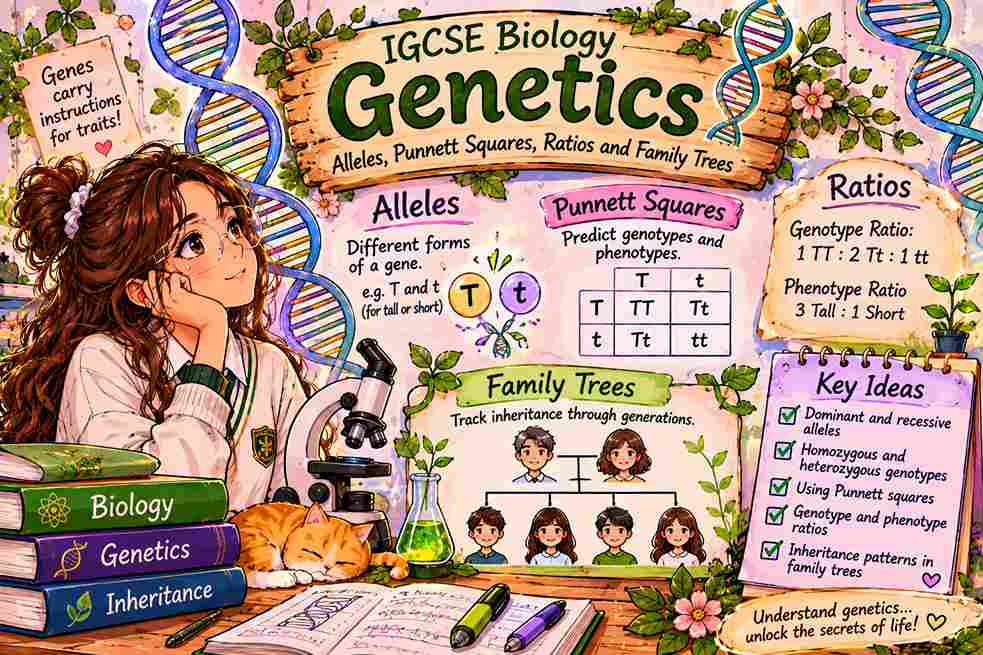
Genetics questions are predictable and high scoring. Students who set out a Punnett square clearly and state the ratio in words can gain full marks. This guide covers the vocabulary, the method and the question types.
Key terms
Term |
Meaning |
Gene |
A section of DNA that codes for a protein, which gives a characteristic |
Allele |
A different version of a gene |
Dominant allele |
Shows in the phenotype even if only one copy is present (capital letter, T) |
Recessive allele |
Shows only if two copies are present (lower case, t) |
Genotype |
The alleles an organism has (for example Tt) |
Phenotype |
The observable characteristic (for example tall) |
Homozygous |
Two identical alleles (TT or tt) |
Heterozygous |
Two different alleles (Tt) |
Method for a monohybrid cross
- Choose letters and state which allele is dominant.
- Write the parents' genotypes.
- Write the gametes each parent can make (each gamete has one allele).
- Draw the Punnett square and fill it in.
- Read off the genotypes, phenotypes and ratio.
Worked examples
Example 1: two heterozygous parents
Tall (T) is dominant to short (t). Cross Tt × Tt.
|
T |
t |
T |
TT |
Tt |
t |
Tt |
tt |
- Genotypes: 1 TT : 2 Tt : 1 tt.
- Phenotypes: 3 tall : 1 short.
- The probability of a short offspring is1/4 (25%).
Example 2: heterozygous with recessive
Cross Tt × tt. The gametes are T or t from one parent and only t from the other.
- Offspring: 1 Tt : 1 tt, so1 tall : 1 short, a 50% chance of each.
- This cross is a test cross: if any offspring show the recessive trait, the dominant-phenotype parent must be heterozygous.
Example 3: homozygous cross
TT × tt: every offspring is Tt, so all are tall.
Sex determination
Females are XX and males are XY. Each egg carries an X; each sperm carries an X or a Y. Crossing XX × XY gives 1 XX : 1 XY, so the probability of a girl (or boy) is50%, whatever the previous children were.
Family trees
- If two unaffected parents have an affected child, the condition must be recessive and both parents must be carriers(heterozygous).
- Each child of two carriers has a 1 in 4 chance of being affected.
- Cystic fibrosis is an example of a condition caused by a recessive allele.
Variation and mutation
- Variation can be caused by genes, the environment, or both.
- A mutation is a random change in DNA that can create a new allele; most are harmless or harmful but some can be beneficial.
- Ionising radiation and some chemicals increase the mutation rate.
Common mistakes
- Putting both alleles of a parent into one gamete.
- Writing a ratio such as 3 : 1 without saying which phenotype is which.
- Confusing genotype and phenotype.
- Thinking earlier children change the probability for the next child. Each birth is independent.
Practice questions
Question |
Answer |
1. What fraction of offspring from Tt × Tt are tt? |
1/4 |
2. What are the offspring of TT × tt? |
All Tt |
3. Two unaffected parents have an affected child. What do you know about the allele? |
It is recessive and both parents are carriers |
4. What is the probability that a child is a boy? |
1/2 |
Frequently asked questions
Q: What is the difference between genotype and phenotype?
Genotype is the combination of alleles; phenotype is the characteristic that results.
Q: What is a Punnett square?
A diagram that shows the possible combinations of alleles from two parents' gametes.
Q: What is a carrier?
Someone who has one copy of a recessive allele but does not show the condition.
Q: Is a 3 : 1 ratio guaranteed in a small family?
No. It is a probability; small families can differ from the expected ratio.
Try a free trial class with EdFlik. Live 1:1 IGCSE tutoring for Cambridge and Edexcel students in the UAE, matched to your child's board, subject and year group. Book at edflik.com or message us on WhatsApp. |
Related reading
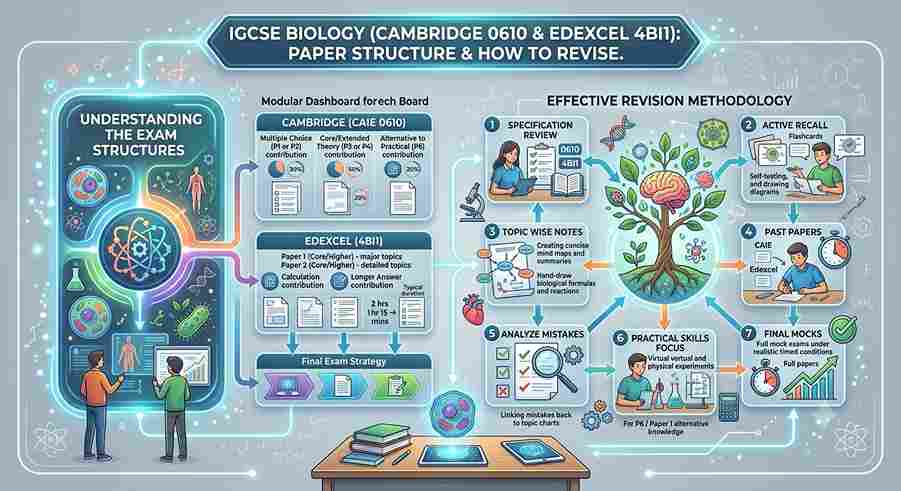
- IGCSE Biology (0610 / 4BI1) Guide
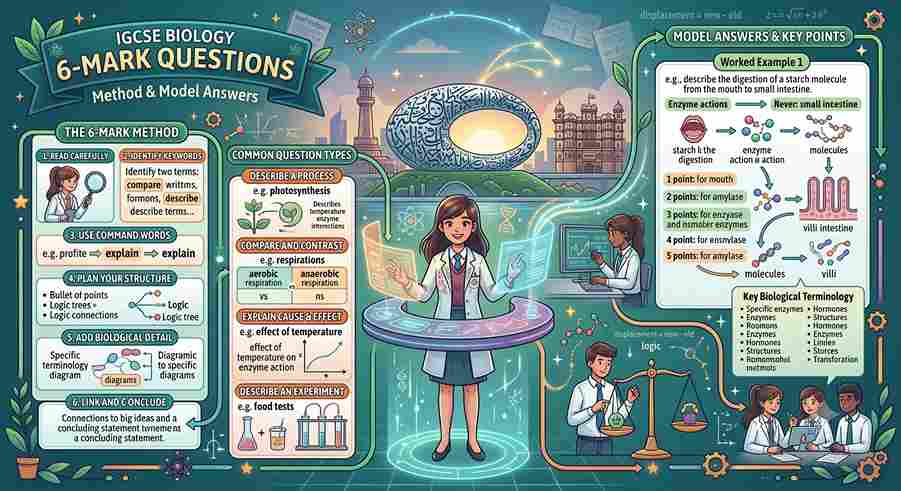
- IGCSE Biology 6-Mark Questions: Model Answers
- IGCSE Practical Skills: Planning and Evaluating Experiments
Sources
- Cambridge International IGCSE Biology 0610 syllabus 2026–2028
- Pearson Edexcel International GCSE Biology 4BI1 specification