IGCSE Biology 6-Mark Questions: Method and Model Answers
Last updated: November 2026 | By EdFlik Education Team
Longer written questions separate grades in Biology. They test recall, but also whether you can organise points clearly and use correct terms. This guide gives a method, two model answers with the marking points marked, and the mistakes that cost marks.
How these questions are marked
Mark schemes list marking points, and each valid, well-expressed point earns a mark. Longer-answer questions may also be level-marked, where the overall quality and logic of the answer decides the mark band. In both cases, a clear sequence of specific scientific statements earns more than a long vague paragraph.
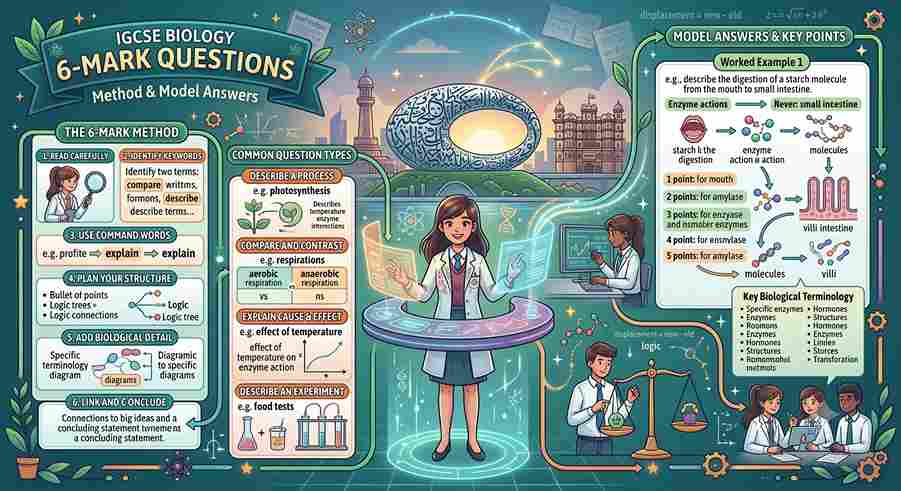
A five-step method
- Read the command word(describe, explain, compare, suggest) and underline the key terms.
- Jot down four to six points in the margin before writing.
- Order them so they follow a logical chain.
- Write one complete statement per point, using the exact scientific terms.
- Check the number of marks. Six marks usually needs at least six distinct, creditable points.
Model answer 1: adaptation
Question: Describe how the small intestine is adapted for the absorption of digested food. [6]
Marking point |
Written as |
1 |
The inside surface is folded into villi, which increases the surface area for absorption. |
2 |
Each villus has a thin wall, one cell thick, giving a short diffusion distance. |
3 |
Villi contain a network of capillaries to carry absorbed nutrients away quickly. |
4 |
Removing nutrients keeps a steep concentration gradient between the gut and the blood. |
5 |
Villi contain a lacteal that absorbs fatty acids and glycerol. |
6 |
Cells on the surface have microvilli, increasing surface area further. Muscular contractions (peristalsis) also mix food and keep the gradient. |
Model answer 2: explaining a graph
Question:The rate of an enzyme-catalysed reaction increases up to 40 °C, then falls to zero by 70 °C. Explain these results. [6]
- As temperature rises, molecules have more kinetic energy and move faster.
- So there are more frequent collisions between enzyme and substrate molecules.
- More successful collisions per second form enzyme–substrate complexes, so the rate increases.
- Above the optimum temperature (about 40 °C here), the enzyme's bonds break and the active site changes shape.
- The substrate no longer fits the active site: the enzyme isndenatured.
- Denaturation is permanent, so the rate falls to zero.
Mark scheme language to use
Say this |
Not this |
Increases surface area |
Makes it bigger |
Steep concentration gradient |
Helps it move faster |
Enzyme is denatured; the active site changes shape |
The enzyme dies |
Short diffusion distance |
Thin so things go through easily |
Specific term: osmosis, diffusion, active transport |
Moves in or out |
Common mistakes
- Repeating one point in different words.
- Writing everything you know about the topic instead of answering the question set.
- Using "it" without saying what it refers to.
- Saying enzymes are "killed" rather than denatured.
- Describing when asked to explain, or explaining when asked to describe.
How to practise
- Take a question, write your answer, and compare it point by point with the mark scheme.
- Highlight which marking points you missed and write them on a flash card.
- Re-attempt the same question a week later from memory.
Practise with your own board's papers: Cambridge and Edexcel word their longer questions differently. |
Frequently asked questions
Q: How many points do I need for a 6-mark question?
Aim for at least six distinct, correct and specific points. Some questions are level-marked, so quality and logic also matter.
Q: Should I write in paragraphs or bullet points?
Either is acceptable if the points are clear and linked. Complete sentences are safest.
Q: What if I do not know all the points?
Write the ones you know in a logical order. Partial answers still earn credit.
Q: Do I lose marks for spelling?
Scientific terms must be recognisable. Obvious mis-spellings may be accepted but ambiguous ones are not.
Try a free trial class with EdFlik. Live 1:1 IGCSE tutoring for Cambridge and Edexcel students in the UAE, matched to your child's board, subject and year group. Book at edflik.com or message us on WhatsApp. |
Related reading
- IGCSE Biology (0610 / 4BI1) Guide
- IGCSE Command Words Explained
- IGCSE Science Papers: Cambridge vs Edexcel
Sources
- Cambridge International IGCSE Biology 0610 syllabus 2026–2028
- Pearson Edexcel International GCSE Biology 4BI1 specification