IGCSE Biology Tutor UAE 2026 — Exam Technique, Required Practicals and Grade A* Guide
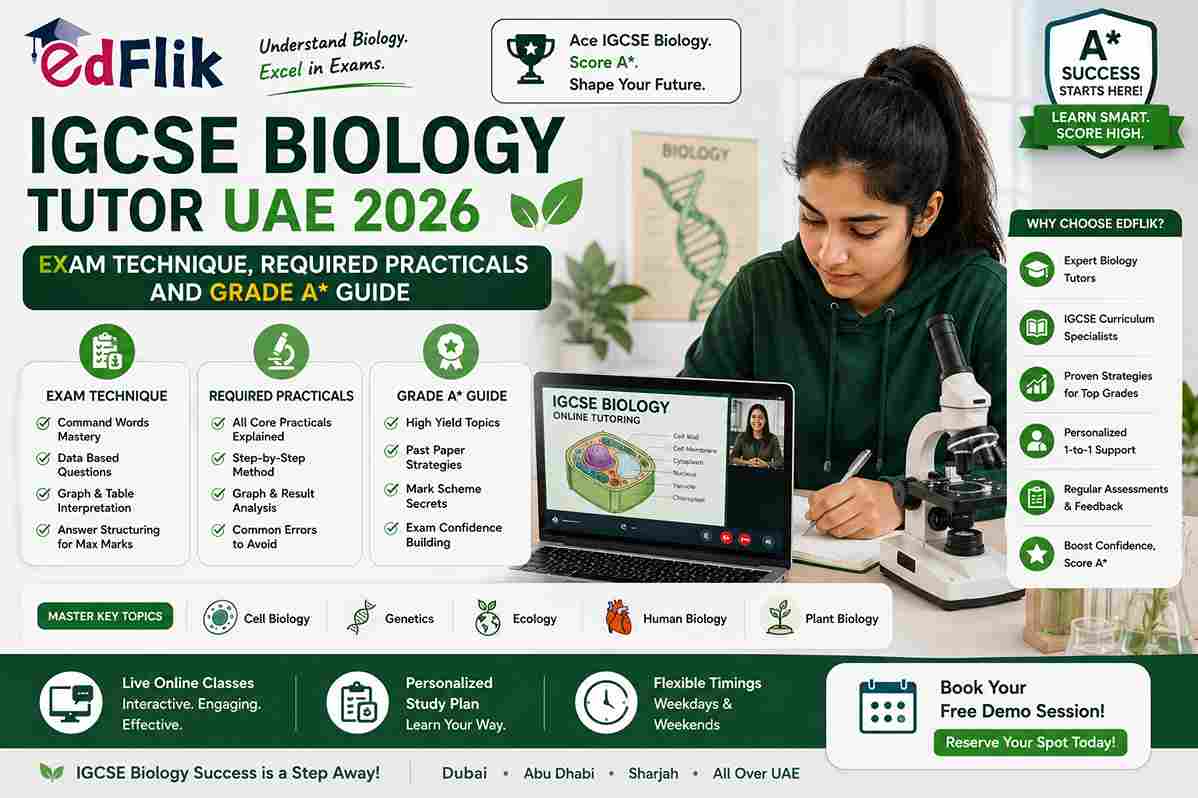
IGCSE Biology (Cambridge 0610) is the third most tutored IGCSE science subject in UAE and the one with the most specific exam technique requirements. Labelled diagrams, mark-scheme-compliant language, and required practical knowledge are the three areas where most UAE students lose marks they should be earning. This guide covers the full paper structure, highest-frequency topics, diagram technique, and required practical knowledge for Paper 6.
IGCSE Biology Paper Structure — Cambridge 0610
|
Paper |
Format |
Duration |
% of Grade |
|
Paper 1 |
40 MCQ — Core
and Extended content |
45 minutes |
30% |
|
Paper 2 |
Structured
questions — Extended content only |
1 hour 15
minutes |
50% |
|
Paper 6 |
Alternative to
Practical — written practical knowledge paper |
1 hour |
20% |
|
Most UAE
IGCSE Biology students sit Papers 1, 2, and 6. The A* grade boundary
typically requires approximately 90%+ across all papers. Paper 6 is the most
coachable paper — it rewards specific knowledge of practical techniques that
can be systematically learned. |
The 6 Most Consistently Tested IGCSE Biology Topics
1. Cell Biology — Structure and Transport
Transport questions require precise language: "net movement of water molecules from a region of higher water potential to lower water potential by osmosis" — not "water moves from dilute to concentrated." That exact phrasing earns marks. Approximations consistently lose them.
2. Enzymes — Activity, Temperature, and pH
Denaturation means the shape of the active site is changed so the substrate can no longer bind — not that the enzyme is "killed" or "destroyed." Temperature and pH graphs require correct shapes: bell curve for temperature (with a clear optimum and sharp decline after denaturation), bell curve for pH at the specific optimum for each enzyme.
3. Human Nutrition and Digestion
The digestive system is a diagram topic. Students must label the full system accurately and state the function of each enzyme with its substrate and product: amylase (starch → maltose), protease (proteins → amino acids), lipase (lipids → fatty acids and glycerol).
4. Gas Exchange — Alveoli Structure and Ventilation
A full-credit alveoli diagram includes: alveolus with one-cell-thick wall, capillary closely associated, red blood cells shown, arrows indicating oxygen and carbon dioxide movement, and labels for each structure. Missing the thin wall annotation or the direction arrows costs marks consistently.
5. Respiration — Aerobic and Anaerobic Equations
Equation accuracy is essential: aerobic — glucose + oxygen → carbon dioxide + water (+ energy); anaerobic in humans — glucose → lactic acid (+ energy); anaerobic in yeast — glucose → ethanol + carbon dioxide (+ energy). Writing "sugar" instead of "glucose" is imprecise and may not earn the mark.
6. Required Practicals — Paper 6
Paper 6 tests knowledge of practical techniques as written questions without actual lab work. Essential practicals to know thoroughly:
• Food tests: Benedict's reagent (reducing sugars — blue to brick-red on heating); Biuret solution (protein — blue to purple); Iodine solution (starch — yellow-brown to blue-black); Ethanol emulsion test (fat — clear to white emulsion)
• Osmosis in plant tissue: weighing potato chips before and after immersion; calculating % change in mass; plotting results on a graph with a line of best fit
• Photosynthesis rate: counting oxygen bubbles from Elodea per minute at different light intensities; understanding variables that must be controlled
• Chromatography: separating plant pigments; calculating Rf values = distance moved by pigment / distance moved by solvent front
Diagram Technique — The Difference Between 2 and 4 Marks
Three rules that raise Biology diagram scores in every sitting:
• Use a sharp pencil and ruler for straight label lines — smudged or freehand labels lose presentation marks even when biologically correct
• Label lines must touch the structure and must not cross each other — unlabelled structures or crossed lines lose marks
• Include scale or magnification where specifically asked — "not drawn to scale" is insufficient when the question specifies a magnification value
Mark-Scheme Language — Precision That Earns Marks
|
Topic |
Imprecise
(may lose marks) |
Precise
(earns marks) |
|
Osmosis |
Water moves
from low concentration to high |
Net movement
of water molecules from higher water potential to lower water potential by
osmosis through a partially permeable membrane |
|
Enzyme
denaturation |
The enzyme
dies or is destroyed |
The shape of
the active site is changed/denatured so the substrate can no longer fit and
bind |
|
Transpiration |
Water
evaporates from leaves |
Water
evaporates from the mesophyll cells, diffuses through stomata as water
vapour, creating a transpiration stream |
|
Aerobic
respiration |
Glucose is
broken down for energy |
Glucose is
oxidised during aerobic respiration; energy is released as ATP |
|
EdFlik IGCSE
Biology tutors are Cambridge 0610 specialists. Every session uses past
papers, mark schemes, and Paper 6 practical scenario practice. From AED 60
per session. Free diagnostic trial. Book at www.edflik.com or WhatsApp +91
88788 96600. |
Frequently Asked Questions
Q: Is IGCSE Biology hard?
Content-heavy but manageable. The main challenges are diagram accuracy, mark-scheme compliant language, and required practical knowledge for Paper 6.
Q: What are the required practicals in IGCSE Biology?
Key practicals for Paper 6: microscopy, osmosis in plant tissue, photosynthesis rate, enzyme activity, chromatography, and food tests (Benedict's, biuret, iodine, ethanol emulsion).
Q: What is the difference between IGCSE Biology Core and Extended?
Core allows grades C–G only. Extended allows A*–E and is required for A* grade. Most UAE private school students sit Extended.
Q: How many papers does IGCSE Biology have?
Most UAE students sit Papers 1 (30%), 2 (50%), and 6 (20%). Papers 1 and 2 are knowledge-based; Paper 6 is the Alternative to Practical.
Q: What IGCSE Biology topics are most tested?
Cell biology, enzymes, digestion, gas exchange, transpiration, respiration equations, genetics, and required practicals appear in almost every past paper.