IGCSE Computer Science Tutor UAE 2026 — Cambridge 0478 Preparation Guide for Dubai and Abu Dhabi Students
IGCSE Computer Science (Cambridge CAIE 0478) is the fastest-growing IGCSE subject in UAE schools — and also the subject that surprises students most when they discover how demanding it actually is. Paper 2 requires writing pseudocode in Cambridge's specific syntax, not Python. Paper 1 covers 11 topic areas in precise technical detail.
Why IGCSE Computer Science Is Harder Than Students Expect
Paper 1 (Theory, 1 hour 45 minutes, 75 marks) covers 11 distinct topic areas, each with technical vocabulary and precise definitions. "Describe the purpose of a router" requires an exact understanding of networking functions.
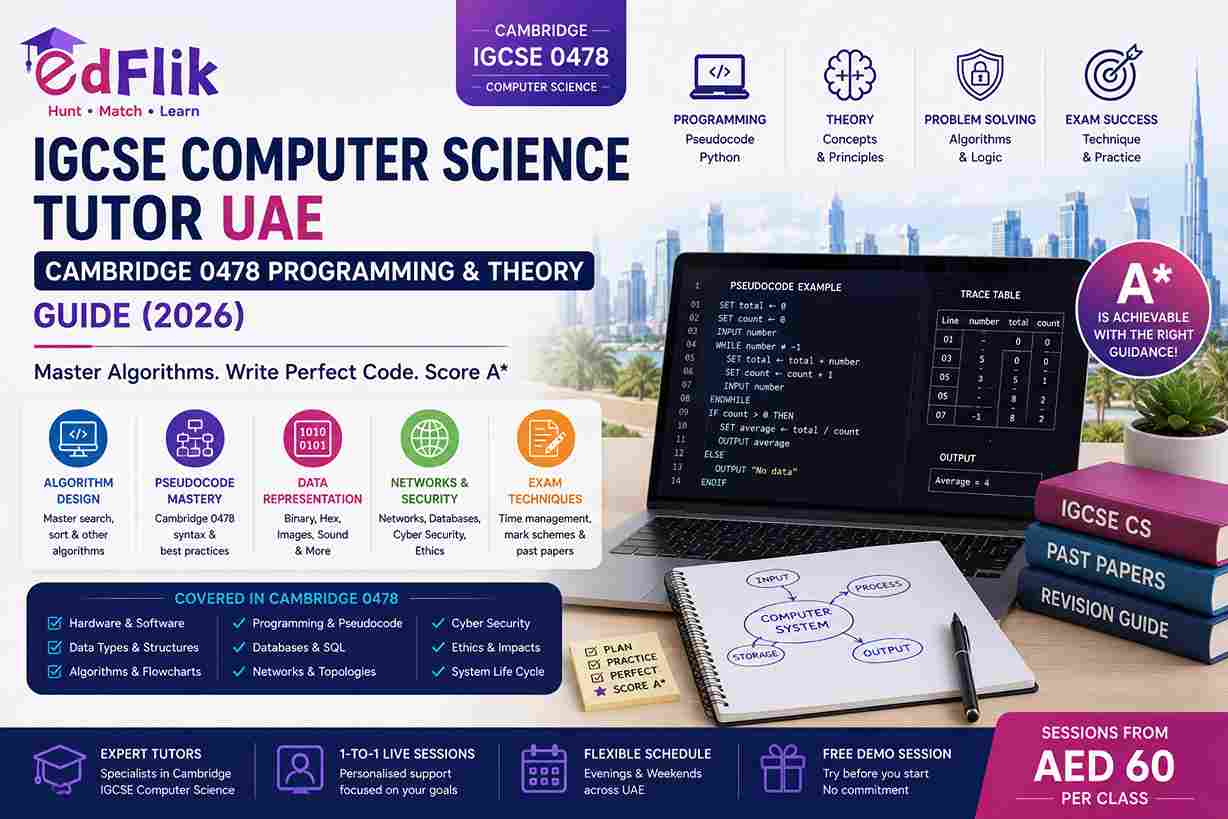
Paper 2 (Practical Algorithm Design, 1 hour 45 minutes, 75 marks) requires writing, tracing, and correcting algorithms in Cambridge CAIE's own pseudocode syntax — a formal notation system that marks are awarded for using correctly. This is not Python. This is not Java.
IGCSE Computer Science (0478) — Full Paper Structure
|
Paper |
Sections |
Marks |
% of Grade |
|
Paper 1:
Theory |
Section A
(short answer) + Section B (structured) |
75 |
50% |
|
Paper 2:
Practical |
Algorithm
design, trace tables, flowcharts, debugging |
75 |
50% |
The 7 Most-Tested Paper 1 Topics
|
Topic |
Why It Comes
Up Every Year |
|
Binary/hexadecimal
conversion |
Simple marks
students drop through careless errors; appears every paper |
|
Logic gates
and truth tables |
Consistent
8–12 mark question in every paper; AND, OR, NOT, NAND, NOR, XOR |
|
Network
topologies |
Advantages/disadvantages
of star, bus, ring, mesh — consistently tested |
|
Sorting
algorithms |
Bubble sort
and insertion sort traces appear in most papers |
|
Cybersecurity
threats |
Malware types,
phishing, encryption — definitions required precisely |
|
Database
concepts |
Table
structure, primary keys, SQL: SELECT, WHERE, FROM |
|
CPU hardware
components |
ALU, CU,
registers, cache, secondary storage types |
The Pseudocode Problem — Why Python Coders Still Lose Marks
|
Feature |
Python |
Cambridge
IGCSE Pseudocode |
|
Output |
print("Hello") |
OUTPUT
"Hello" |
|
Input |
name =
input("Enter: ") |
INPUT name |
|
For loop |
for i in
range(1, 11): |
FOR i ← 1 TO
10 ... NEXT i |
|
While loop |
while
condition: (indent) |
WHILE
condition DO ... ENDWHILE |
|
If statement |
if x > 5:
(indent) |
IF x > 5
THEN ... ENDIF |
|
Assignment |
x = 5 |
x ← 5 |
|
Array indexing |
arr[0]
(zero-indexed) |
arr[1]
(ONE-indexed in Cambridge) |
|
String length |
len(name) |
LENGTH(name) |
|
A student who
writes print("Answer") instead of OUTPUT "Answer" in
Paper 2 may lose the output mark even though the logic is correct. Cambridge
mark schemes are explicit about pseudocode syntax compliance. |
Most Demanding Paper 2 Question Types
Trace tables
Given pseudocode with a specific input, complete the trace table showing the value of each variable at each step. Students must follow the code exactly — including loops that change variables in non-intuitive ways.
Algorithm design
Design pseudocode to solve a specified computational problem — e.g., "write pseudocode for a program that reads 10 numbers and outputs the largest." Students must handle edge cases and structure code with appropriate subroutines.
Debugging
Given pseudocode with errors, identify the errors and rewrite the corrected version. Students must distinguish between syntax errors (wrong Cambridge keyword) and logic errors (correct syntax, wrong outcome).
How EdFlik Prepares UAE Students for IGCSE Computer Science
EdFlik's IGCSE CS tutors are matched to Cambridge CAIE specifically. Every session uses Cambridge past papers, Cambridge pseudocode syntax, and Cambridge mark-scheme compliance as the standard. A typical programme:
• Year 10 Term 1: Paper 1 theory topics systematically (3–4 topics per fortnight)
• Year 10 Term 2: Paper 2 pseudocode — all Cambridge syntax, algorithm design practice
• Year 11: Past paper drilling, trace table practice, debugging, mock papers timed
• Final 8 weeks: Full paper practice, mark-scheme review, examiner report analysis
|
From AED 65
per session. Free trial session. Dubai, Abu Dhabi, Sharjah — all UAE
emirates. Book at www.edflik.com or WhatsApp +91 88788 96600. |
Frequently Asked Questions
Q: Is IGCSE Computer Science hard?
Harder than most students expect. Paper 1 covers 11 topic areas requiring precise technical knowledge. Paper 2 requires Cambridge-specific pseudocode syntax that differs from Python or any real language.
Q: What is Paper 2 in IGCSE Computer Science?
Paper 2 (50% of total grade) assesses algorithm design using Cambridge CAIE pseudocode, trace tables, flowcharts, and debugging. Students write pseudocode by hand using Cambridge's specific syntax with explicit end-keywords.
Q: Why do students who know Python fail Paper 2?
Cambridge pseudocode uses different syntax: OUTPUT not print(), FOR...NEXT not for/range(), WHILE...ENDWHILE not indented while, and 1-indexed arrays. Correct logic in Python syntax does not earn marks.
Q: What are the most tested Paper 1 topics?
Binary/hexadecimal conversion, logic gates and truth tables, network topologies, sorting algorithms (bubble and insertion sort traces), cybersecurity, database concepts, and CPU hardware components.
Q: Do I need coding experience before taking IGCSE Computer Science?
No, but prior coding experience makes Paper 2 logic easier. Students without prior coding need 3–4 additional sessions at the programme start to build algorithm design intuition.