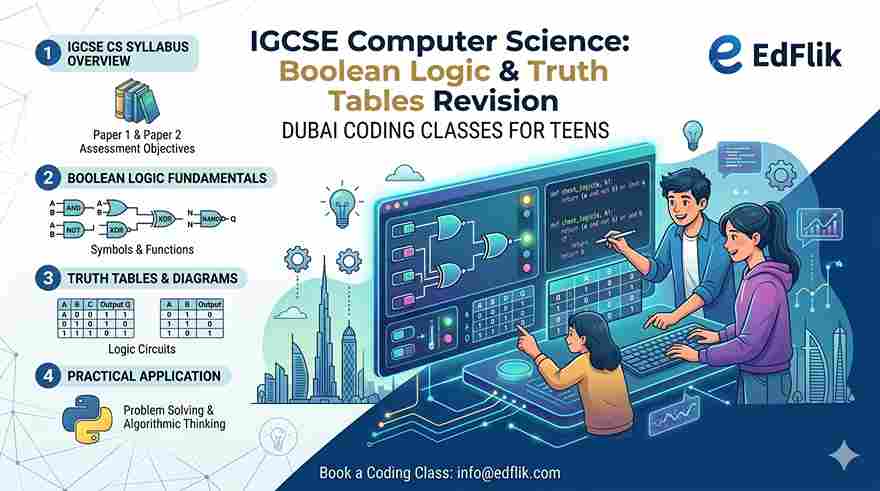
IGCSE computer science boolean logic, truth tables revision, coding classes for teens Dubai
Last Updated: September 2026 | By EdFlik Education Team
For students studying Cambridge IGCSE Computer Science (0410 / 0984) or Pearson Edexcel IGCSE Computer Science in international schools across Dubai and the UAE, computer science is rapidly becoming one of the most exciting and strategically vital subjects on the curriculum.
While learning how to write loops, functions, and arrays in Python builds your programming fluency, mastering the fundamental hardware logic that powers electronic circuits and decision-making is equally essential. Among all theoretical topics in the syllabus, Boolean Logic and Truth Tables consistently serve as a decisive exam battleground. Many students stumble not because the math is overly complex, but because they confuse logic gate symbols, misinterpret logical operators, or fail to trace complex combinational logic circuits.
In this comprehensive guide, our expert computer science tutors break down core revision notes on Boolean logic, provide a step-by-step masterclass on constructing truth tables, and explore why enrolling in specialized coding classes for teens in Dubai can give your academic journey a massive competitive edge.
Part 1: Revision Notes — Boolean Logic and Logic Gates
Boolean algebra deals with binary variables—values that are either true ($1$) or false ($0$). In computer science, logic gates are electronic circuits that perform specific logical operations on one or more binary inputs to produce a single binary output.
1. The Three Primary Logic Gates
You must be able to recognize the standard circuit symbols (both ANSI/US and IEC shapes, though Cambridge primarily uses ANSI/US standard shapes), write out the Boolean expressions, and construct accurate truth tables for the three fundamental gates:
- NOT Gate (Inverter):
- Function: Inverts the input. If input is $0$, output is $1$. If input is $1$, output is $0$.
- Boolean Expression: $Q = \text{NOT } A$ (or $\bar{A}$)
- AND Gate:
- Function: Outputs $1$ only if both inputs are $1$.
- Boolean Expression: $Q = A \cdot B$ (or $A \text{ AND } B$)
- OR Gate:
- Function: Outputs $1$ if at least one input is $1$.
- Boolean Expression: $Q = A + B$ (or $A \text{ OR } B$)
2. The Derivative Logic Gates
Examiners love testing your ability to combine gates or use inverted combinations:
- NAND Gate (NOT-AND): The exact opposite of an AND gate. It outputs $0$ only when both inputs are $1$; otherwise, it outputs $1$ ($Q = \overline{A \cdot B}$).
- NOR Gate (NOT-OR): The exact opposite of an OR gate. It outputs $1$ only when both inputs are $0$; otherwise, it outputs $0$ ($Q = \overline{A + B}$).
- XOR Gate (Exclusive-OR): Outputs $1$ if the inputs are different (one is $0$ and the other is $1$). If both inputs are the same ($0,0$ or $1,1$), the output is $0$ ($Q = A \oplus B$).
Part 2: Step-by-Step Masterclass on Constructing Truth Tables
When faced with a complex combinational logic circuit in an exam paper (combining multiple gates like AND, OR, and NOT), creating a systematic truth table is the foolproof way to secure full marks.
1. Determining the Number of Rows
The number of rows in a truth table depends entirely on the number of inputs ($n$). The formula is:
$$\text{Number of rows} = 2^n$$
- For $2$ inputs ($A$ and $B$), you will have $2^2 = 4$ rows.
- For $3$ inputs ($A$, $B$, and $C$), you will have $2^3 = 8$ rows.
2. Systematic Binary Input Pattern
Always fill your input columns in a standardized binary counting sequence to ensure you never miss a combination:
- For 3 inputs ($A, B, C$):
- $A$: $0, 0, 0, 0, 1, 1, 1, 1$ (Halving: 4 zeros, 4 ones)
- $B$: $0, 0, 1, 1, 0, 0, 1, 1$ (Halving again: 2 zeros, 2 ones, 2 zeros, 2 ones)
- $C$: $0, 1, 0, 1, 0, 1, 0, 1$ (Alternating: 0, 1, 0, 1...)
3. Adding Intermediate Columns for Complex Circuits
If an exam question asks for the truth table of a complex expression like $Q = (A \text{ AND } B) \text{ OR } (\text{NOT } C)$, never try to calculate the final output in your head.
- Create intermediate columns for each sub-expression (e.g., Column 1 for $(A \text{ AND } B)$, Column 2 for $(\text{NOT } C)$).
- Combine your intermediate columns in the final output column. This structured methodology guarantees you won't make careless arithmetic or logical errors under exam pressure.
Part 3: Why Specialized Coding Classes for Teens in Dubai Matter
While school classrooms cover the IGCSE syllabus, building true technological fluency requires practical, hands-on application. Enrolling in structured coding classes for teens in Dubai provides invaluable benefits that extend far beyond exam grades:
- Bridging Theory and Practice: Coding classes help students see how abstract concepts like Boolean logic translate directly into real-world software development, game design, and physical computing (like Arduino or Raspberry Pi circuits).
- Early Preparation for Advanced Studies: Transitioning smoothly from IGCSE Python into IB Computer Science or Pearson Edexcel IAL Information Technology requires advanced algorithmic problem-solving skills taught in specialized youth coding programs.
- Fostering Computational Thinking: Expert mentorship encourages teens to embrace debugging as a creative puzzle rather than a frustrating roadblock, building lifelong resilience and analytical confidence.
Part 4: Top 4 Strategies to Secure an A* in IGCSE Computer Science
- Memorize Gate Symbols and Truth Tables: Do not leave your exam preparation to guesswork. Flashcard your logic gate symbols and their corresponding truth tables until you can reproduce them instantly.
- Practice Tracing Logic Circuits: When given a diagram, trace the binary inputs step-by-step through each gate using a pencil on your question paper, labeling intermediate wire states ($0$ or $1$) directly on the diagram.
- Master Pseudocode Conventions: IGCSE papers frequently test logic using standard pseudocode structures (
IF...THEN...ELSE,WHILE...DO,INPUT,OUTPUT). Practice writing clean, indented code without syntax errors. - Review Past Paper Examiner Reports: Read the official Cambridge or Edexcel examiner reports to see where students globally lose marks on theory and logic questions—allowing you to sidestep those exact traps.
Struggling with Boolean logic, tracing complex circuits, or preparing for your IGCSE Computer Science exams? EdFlik offers expert, 1-to-1 online tutoring and coding classes customized specifically for international school students across Dubai and the UAE, helping you build technical fluency and secure top grades.Book a Free Demo Class Today!
Frequently Asked Questions (FAQs)
Q1: What is the difference between an AND gate and a NAND gate?
Ans: An AND gate outputs $1$ only when all inputs are $1$. A NAND (Not-AND) gate performs the exact opposite operation: it outputs $0$ only when all inputs are $1$, and outputs $1$ for all other input combinations.
Q2: How many rows will a truth table have if a logic circuit has 4 inputs?
Ans: Using the formula $2^n$ (where $n$ is the number of inputs), a circuit with 4 inputs ($A, B, C, D$) will have $2^4 = 16$ rows in its truth table.
Q3: Why is Python taught in almost all IGCSE Computer Science classrooms?
Ans: Python features clean, readable, English-like syntax that allows students to focus entirely on mastering fundamental programming logic—such as selection, iteration, and data structures—without getting bogged down by complex punctuation rules.
Q4: How can EdFlik help my child succeed in IGCSE Computer Science and coding?
Ans: EdFlik connects students across Dubai and the UAE with vetted, experienced 1-to-1 online tutors and coding mentors. Our personalized sessions focus on clarifying difficult theoretical concepts, mastering past paper questions, and building hands-on coding projects.