IGCSE English Language Tutor in the UAE: How to Score A* in Cambridge 0500
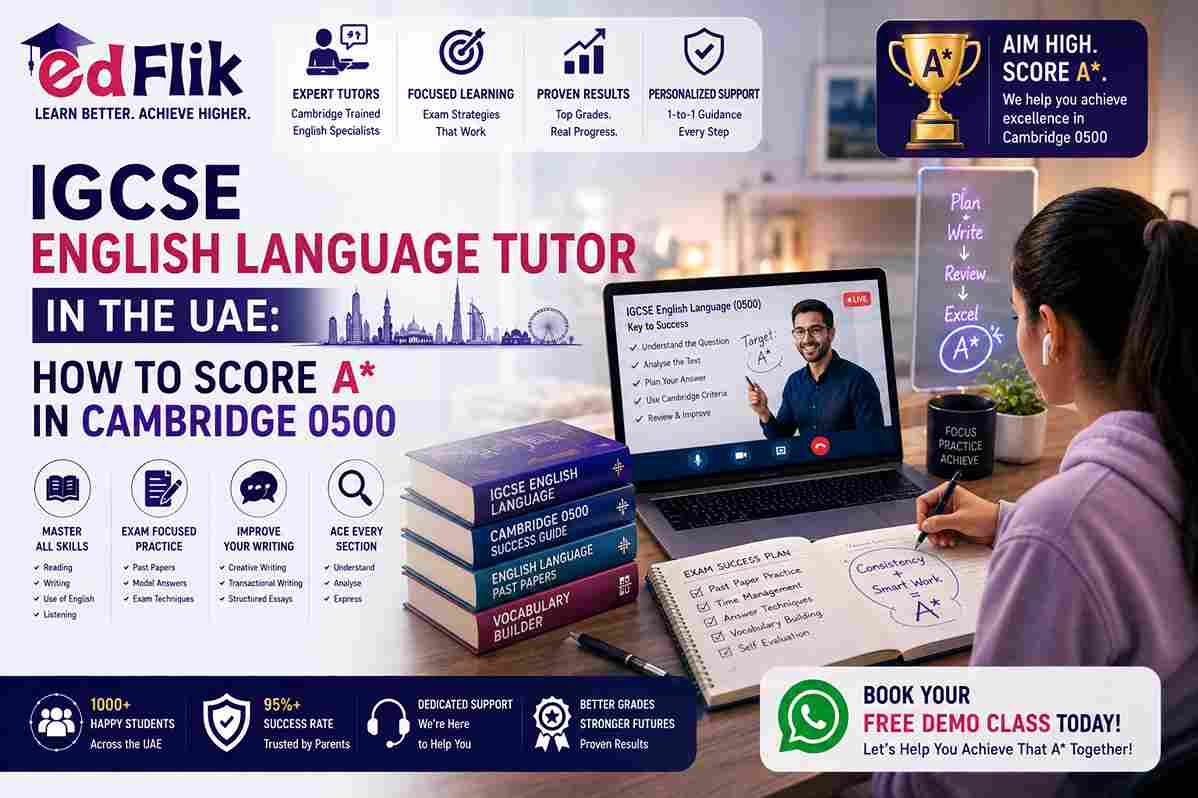
Cambridge IGCSE English Language is one of the most universally required IGCSE qualifications across UAE international schools — and one of the most frequently underestimated. Students who are comfortable with English as a spoken language routinely underperform in the examination because IGCSE English Language tests specific analytical, written, and textual skills that fluency alone does not provide. An IGCSE English Language tutor in the UAE who understands the Cambridge 0500 mark scheme and paper structure makes a concrete, measurable difference to examination scores.
Why UAE Students Underperform in IGCSE English Language
Dubai, Abu Dhabi, and Sharjah are home to students whose written English ranges from near-native to beginner level — and the examination does not distinguish between them at the preparation stage. Every student studying IGCSE English Language at a UAE international school sits the same Paper 1 and Paper 2, against the same mark scheme, regardless of their English background.
Three patterns produce the most mark loss:
Reading Questions Answered at Insufficient Depth
IGCSE English Language reading questions are mark-scheme specific. A question asking for 'three things the writer suggests about the city' expects three distinct points, each with embedded evidence from the text. A student who writes a general summary earns fewer marks than one who writes three separate, evidence-backed statements. Many students answer comprehension questions as they would answer a conversational question — explaining what they understood — rather than as they would answer a mark-scheme question — providing specific evidence for specific marks.
Language Effect Questions Without the Right Vocabulary
Questions asking students to 'explain how the writer uses language to create a sense of tension' (or atmosphere, or vivid imagery) reward responses that identify a specific language feature (metaphor, repetition, short sentence) and explain its effect on the reader in detail. Students without explicit training in literary analysis vocabulary — who cannot name language techniques or explain their effect — consistently underperform on these questions even when they feel the effect of the writing. Tutoring builds this vocabulary explicitly.
Directed Writing That Copies Rather Than Adapts
The directed writing task in Paper 1 is the highest-mark question in the examination. It requires students to produce a piece of writing (a letter, an article, a speech) for a specific purpose and audience, using information from one of the source texts. Students who copy large sections of the source text verbatim, who write in the wrong form, or who fail to adapt their language for the specified audience consistently lose marks. The directed writing task rewards original voice alongside source text use, and this balance is teachable.
What Paper 2 Extended Writing Tests
Paper 2 tests extended writing through two questions:
· Question 1 — a piece of descriptive or narrative writing, typically from a prompt, image, or scenario. Students are given approximately 350 to 500 words and assessed on content, structure, and language quality.
· Question 2 — a piece of argumentative, discursive, or persuasive writing on a given topic. Students must organise a clear argument, use evidence and counterargument, and write with controlled and varied prose.
Extended writing is assessed on three criteria: Content (relevance, ideas, structure), Style and Accuracy (sentence variety, vocabulary, technical accuracy), and Personal Voice (authentic and engaging written expression). Students who write grammatically but blandly underperform on Style. Students who have interesting ideas but poor organisation underperform on Content. A tutor identifies which criteria are limiting each student's grade and builds targeted practice around those specific dimensions.
How EdFlik Provides IGCSE English Language Tutoring in the UAE
EdFlik provides one-to-one IGCSE English Language tutoring for Grade 9 and 10 students across Dubai, Abu Dhabi, Sharjah, and the wider UAE. Tutors are matched to the Cambridge 0500/0522 specification and work through past papers with mark-scheme feedback on reading, directed writing, and extended writing. For non-native English speakers, sessions combine examination technique with targeted vocabulary and writing development. Sessions from AED 45, free trial at edflik.com.
Frequently Asked Questions
What is the difference between Cambridge IGCSE English Language 0500 and 0522?
Cambridge IGCSE English Language 0500 and Cambridge IGCSE English Language (Count-in Oral) 0522 test the same written skills and use the same written papers — Paper 1 and Paper 2. The difference is in the oral component: 0500 includes a separately graded oral endorsement (Pass, Merit, or Distinction) that does not affect the written grade; 0522 includes the oral component as part of the final assessed grade, counting toward the final IGCSE result. Most UAE international schools enter students for 0500, where the written papers determine the A* to G grade and the oral endorsement is separate. Students and parents should check which specification their school uses when planning tutoring and revision.
What does IGCSE English Language Paper 1 test?
Cambridge IGCSE English Language Paper 1 (Reading and Directed Writing) presents two unseen texts and asks students to demonstrate three skills across its questions: reading for detail and inference, understanding of how writers use language for effect, and the ability to use source text information in a piece of directed writing. The paper is 2 hours long and worth 50 marks. Section 1 typically has multiple short questions on both texts, including a question asking students to identify and explain language effects. Section 2 is a directed writing task — a piece of writing for a specific purpose and audience that uses information from one of the source texts. This directed writing question is the highest-mark question on the paper.
What makes a strong directed writing response in IGCSE English?
A strong directed writing response in Cambridge IGCSE English Language demonstrates four qualities: it fulfils the task brief precisely (correct form — letter, report, speech — correct audience, correct purpose); it uses information from the source text accurately and selectively; it develops ideas beyond simple copying and adapts the source material for the new context; and it is written in controlled, accurate, and varied prose. The most common weakness is students who copy large sections of the source text verbatim rather than selecting and adapting. A strong response also shows awareness of the audience — a letter to a school principal is written differently from a blog post for teenagers — and the student's own voice is present throughout.
How early should a UAE student start preparing for IGCSE English Language?
Effective preparation for Cambridge IGCSE English Language 0500 benefits from a consistent approach throughout Grade 9 and Grade 10, not just a concentrated push before the examination. Students who practise analytical reading, directed writing, and extended writing regularly throughout both years develop the writing quality and reading fluency that the examination rewards. Starting structured examination preparatio
n in September of Year 10 — working through past papers, practising under timed conditions, and receiving detailed written feedback from a tutor — provides enough time for genuine improvement before the May/June or October/November examination series.
Book a Free IGCSE English Language Trial Class
EdFlik's IGCSE English Language tutors work with UAE students across all levels toward A and A* in Cambridge 0500. Sessions from AED 45. Free trial at edflik.com.