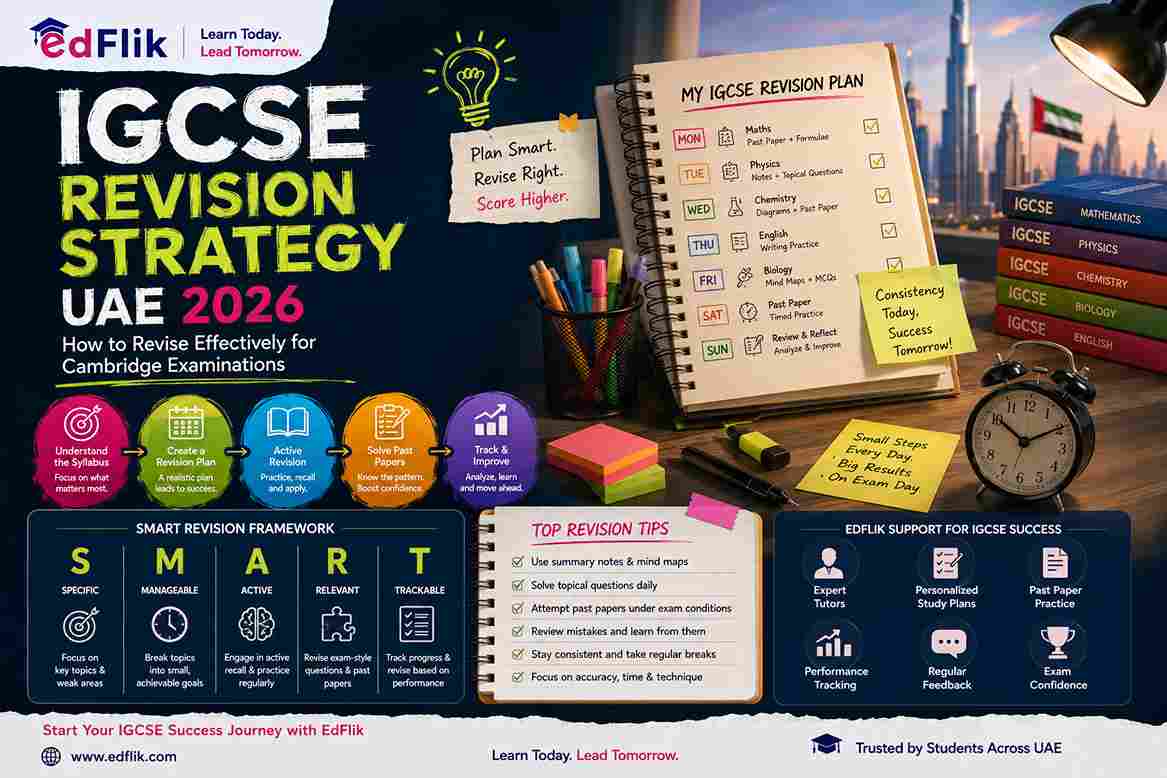
IGCSE Revision Strategy UAE 2026 — How to Revise Effectively for Cambridge Examinations
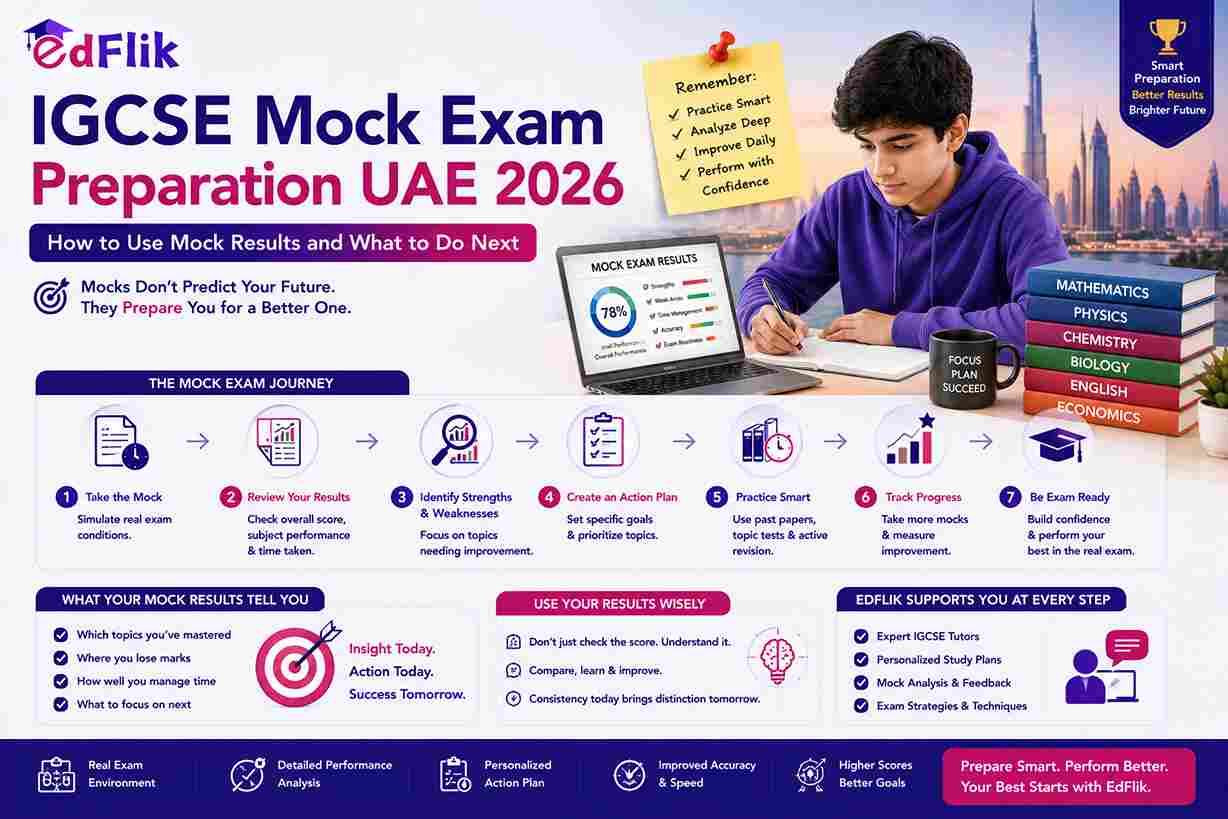
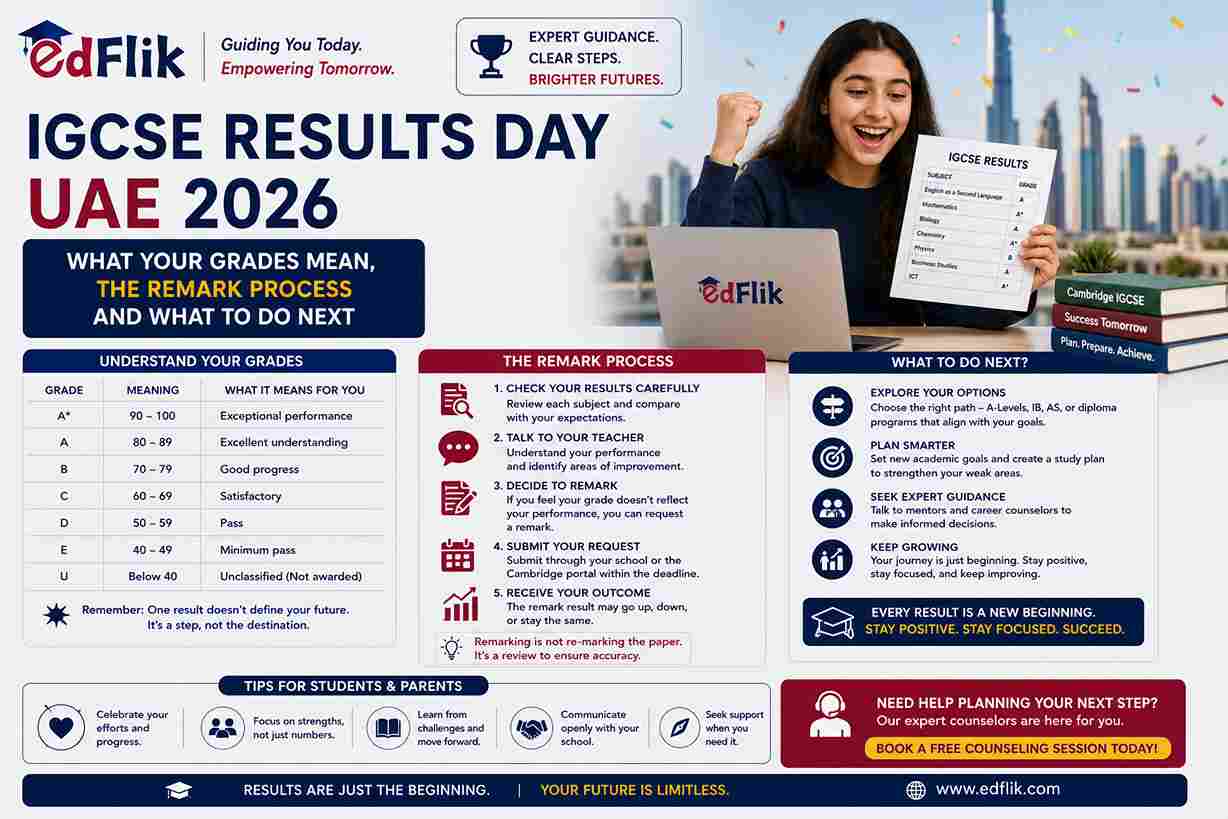
IGCSE revision in UAE is frequently misapproached — students who have worked hard throughout the year sit their November mock examinations expecting their effort to show up in the results, and are surprised when the grade is lower than expected. The reason is almost always the same: the revision methods used (re-reading notes, highlighting textbooks, reviewing class examples) are the least effective methods for producing IGCSE grade improvement. This guide covers the revision strategies that work — specifically for Cambridge IGCSE examinations.
The Revision Hierarchy — From Least to Most Effective for IGCSE
|
Revision
Method |
Effectiveness
for IGCSE |
Why |
|
Re-reading
textbook chapters |
Very low |
Creates
familiarity illusion — text feels known but cannot be recalled independently
in an exam; produces no mark-scheme language practice |
|
Highlighting
and annotating notes |
Low |
Active
engagement with text but still passive — no retrieval practice; highlighted
notes look impressive but do not improve recall in exam conditions |
|
Writing
summary notes from memory |
Medium |
Forces recall
— identifying what can and cannot be remembered; better than re-reading but
produces general knowledge rather than mark-scheme aligned responses |
|
Flashcards for
key terms and definitions |
Medium-high |
Effective for
terminology and definitions; less effective for multi-step questions and
essay technique; good supplement to past paper practice |
|
Answering past
paper questions without time limit |
High |
Active
retrieval practice; identifies specific gaps; builds question-type
recognition |
|
Completing
full timed past papers + marking against Cambridge mark scheme |
Highest |
Combines timed
pressure, question-type practice, mark-scheme language development, and
technique identification; the method closest to actual exam conditions |
The Past Paper Protocol — The Core IGCSE Revision Tool
The Cambridge past paper + mark scheme combination is the most valuable revision tool available to UAE IGCSE students — and the one most underused. Effective past paper practice requires a specific protocol to produce grade improvement:
• Step 1 — Complete the paper under full timed conditions. No notes, no textbook, no phone. The same conditions as the actual examination. This is non-negotiable — untimed past paper practice does not build the time management and exam pressure skills needed.
• Step 2 — Mark immediately using the official Cambridge mark scheme. Available free on the Cambridge Past Papers website (pastpapers.papacambridge.com or the official Cambridge portal). Not a textbook answer key — the Cambridge mark scheme specifically.
• Step 3 — Categorise every lost mark by question type. Not by topic — by question type. "I lose marks on 'explain' questions requiring a cause-effect chain" is more actionable than "I lose marks on Physics electricity."
• Step 4 — Target the highest-mark-loss question types in the following week. Practice specifically those question types with model answers taken directly from the mark scheme. Do not practice the question types already done well — that time is wasted.
• Step 5 — Complete the next past paper 2-3 weeks later. Check whether the targeted question types have improved. If yes, find the next highest-mark-loss type. If no, investigate whether the gap is conceptual or linguistic.
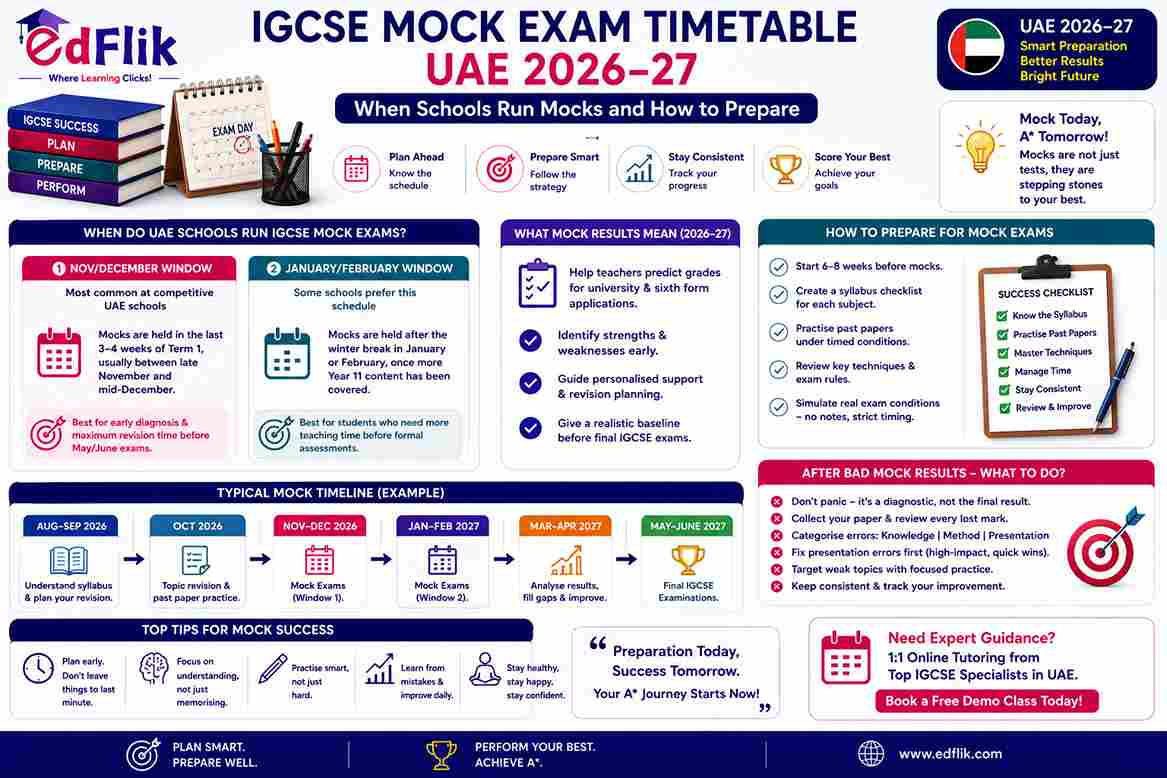
IGCSE Revision Timeline for UAE Students — January to June 2027
|
Period |
Revision
Focus |
Past Paper
Frequency |
|
January (after
mock results) |
Diagnostic
analysis of mock scripts; identify top 5 mark-loss question types per
subject; build targeted revision priority list |
First timed
past paper per subject — use as diagnostic baseline |
|
February —
March |
Targeted gap
closure — 2-3 focused sessions per week on highest-mark-loss question types;
no general content revision at this stage |
One timed full
paper per subject every 2-3 weeks |
|
April |
Mark scheme
language consolidation — study model answers for highest-value questions;
diagram technique; essay structure practice |
One timed full
paper per subject per week |
|
May (exam
month) |
Technique
polish only — no new content; timed section practice; confidence building;
sleep consistency |
Section
practice only — avoid full papers the day before an exam in the same subject |
Subject-Specific Revision Tips for UAE IGCSE Students
• IGCSE Mathematics: Every answer must show full working. Practise the method mark habit — write the formula, substitute the values, show the calculation, state the answer with units — even for "obvious" steps.
• IGCSE Sciences (Physics, Chemistry, Biology): Learn the mark-scheme language patterns for the 10 most common question types. "Particles collide more frequently with more energy" is different from "particles gain more kinetic energy" — the mark scheme specifies which earns marks.
• IGCSE English Language: Time both sections separately. Many UAE students spend too long on Section A (reading) and have insufficient time for Section B (writing). Paper 2 creative writing: plan 5 minutes, draft 30 minutes, review 5 minutes.
• IGCSE Economics and Business: The evaluation essay structure (define, apply, two sides, justified conclusion) earns marks regardless of which specific arguments are made. Practise the structure before the content.
|
EdFlik IGCSE
tutors use the past paper protocol as the foundation of every session —
diagnostic identification of mark-loss question types, targeted technique
work, and weekly timed practice. From AED 55 per session. Free diagnostic.
Book at www.edflik.com or WhatsApp +91 88788 96600. |
Frequently Asked Questions
Q: What is the most effective IGCSE revision method?
Retrieval practice using past papers under timed conditions, followed by immediate mark scheme review. Active production of answers (not passive re-reading) combined with mark scheme alignment is the highest-ROI revision approach.
Q: How should UAE IGCSE students plan their revision timetable?
Work backward from the first exam. Allocate time by diagnostic mark loss (not feeling of insecurity). 45-60 minute blocks with breaks. One full timed past paper per subject every 2-3 weeks from January. Maintain 8 hours of sleep — sleep consolidation is essential for performance.
Q: How many past papers should UAE IGCSE students complete?
6-10 full papers per subject under timed conditions. Approximately one every 2-3 weeks from January. Quality of mark-scheme review after each paper matters more than quantity of papers completed.
Q: What is the difference between passive and active revision?
Passive: reading, re-reading, highlighting — no output produced. Active: answering questions, recalling from memory, producing answers under exam conditions. Research shows active revision produces 40-60% better retention for the same time investment.
Q: What revision strategies should UAE IGCSE students avoid?
Highlighting and re-reading notes (fluency illusion), last-week cramming, revising topics that feel insecure rather than where marks are actually lost, and studying without breaks (diminishing returns from hour 3 of continuous study).