IGCSE Revision Plan for UAE Students 2026

How to Build the Perfect IGCSE Revision Plan: A Step-by-Step Guide for UAE Students
Building an effective IGCSE revision plan is one of the highest-impact things a UAE student can do in the months before their Cambridge examinations. Most students know they need to revise. Far fewer have a structured plan that works — one that covers the right content, uses past papers at the right time, and builds the examination confidence that translates into actual results. This step-by-step guide tells you exactly how to do it.
Step 1: Know Your Examination Schedule and Work Back from It
The Cambridge IGCSE timetable for the May/June series is published on the Cambridge International website several months in advance. The starting point of every good revision plan is a printed examination timetable pinned up where the student sees it daily. For each subject, mark the examination date, the paper codes (Paper 2, Paper 4, Paper 6), and the time allocated per paper.
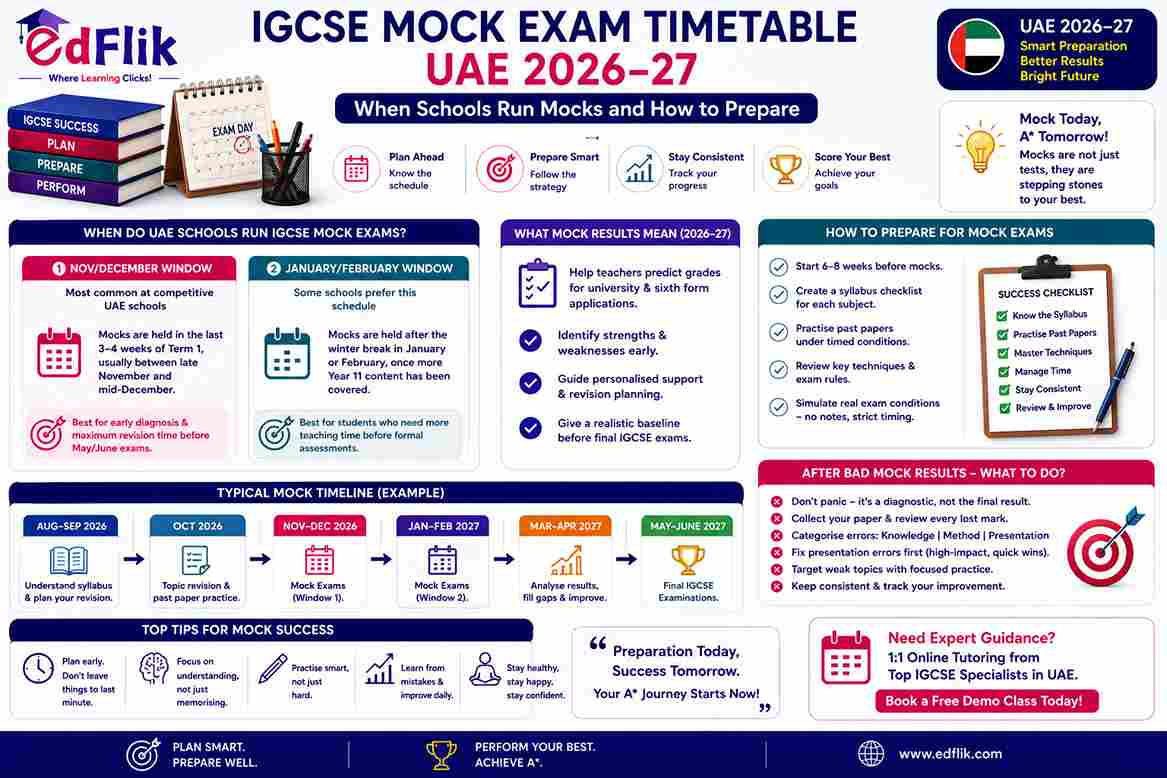
Working backward from each examination date, create a personal calendar. If IGCSE Mathematics Paper 4 is on 14 May, you need at least four to six weeks of intensive revision leading into it — which means intensive Maths preparation should begin no later than the first week of April. Lay out all subjects on the calendar to identify where examinations cluster and where revision time will be most constrained.
Step 2: Conduct a Subject Audit — Know Your Gaps Before You Start
Before writing a single revision note, do a subject audit for each IGCSE subject. Use the Cambridge syllabus as your checklist. Go through every topic and sub-topic in the Extended tier for each subject and honestly rate your confidence level: solid, needs review, or not known.
This audit typically takes two to three hours per subject and is the most valuable revision activity most students have never done. It transforms a vague sense of 'I need to revise Chemistry' into a specific list of topics: 'I need to revise stoichiometry, organic reaction pathways, and Paper 6 experimental design.'
Step 3: Build Your Revision Timetable
A workable IGCSE revision timetable has three characteristics:
1. It is realistic given school commitments, extracurricular activities, and daily energy levels. A timetable that requires five hours of uninterrupted revision after a full school day will not be followed.
2. It allocates more time to weaker subjects and more time to subjects with complex multi-paper structures (like Sciences, where Papers 2, 4, and 6 each require separate preparation strategies).
3. It builds in rest and buffer time. A timetable with no slack will collapse the first time a mock examination, family event, or illness disrupts the schedule.
For most UAE students juggling school, extracurriculars, and family life, a realistic structure is two to three focused revision blocks of 45 to 60 minutes per weekday, with slightly longer blocks at weekends. Each block should focus on one subject and one activity type — not a general sweep of multiple subjects.
Step 4: Use Active Revision Techniques, Not Passive Ones
Active Revision (High Retention)
· Past paper practice — working through questions with no notes, then reviewing mark schemes to identify mistakes
· Flashcard recall — write a concept on one side, the answer on the other; test yourself without reading the card first
· Teach it back — explain a concept out loud as if to someone unfamiliar with it; gaps in your explanation reveal gaps in your understanding
· Mind mapping from memory — draw out a topic map from scratch without referring to notes, then compare it with your notes to see what was missed
· Timed practice under exam conditions — set a timer, put away all notes, answer questions as you would in the actual examination
Passive Revision (Low Retention — Avoid Over-Using)
· Re-reading notes
· Highlighting textbooks
· Copying notes
· Watching video explanations without practising the content immediately after
Step 5: Use Past Papers in Two Phases
Phase 1: Diagnostic Use (January–March)
Use past papers to identify topics and question types that cost you marks. Work through papers at your own pace, with notes available if needed. After completing each paper, compare your answers against the mark scheme in detail. For every mark lost, note the topic and the reason — was it a knowledge gap, a calculation error, a misunderstood command word, or a missing diagram?
Phase 2: Exam-Conditions Practice (April–Examinations)
From April onwards, practise under strict timed conditions. No notes. No pauses. Full papers completed in the allocated time. Mark immediately after completion. Track your mark per paper over time — the trend should show gradual improvement. If a particular paper's marks are not improving, that is a signal to focus additional tutoring support on that component.
Step 6: Plan Your Exam-Week Strategy
The week before each examination should involve maintenance, not intensive new learning. This is the period for:
· One or two final timed past papers to confirm readiness
· A final review of definitions and formulae that must be recalled precisely
· Confirming the examination venue, time, permitted equipment, and what stationery is required
· Adequate sleep — the evidence consistently shows that sleep quality in the days before an examination has a larger impact on performance than additional revision hours
How an EdFlik Tutor Supports Your IGCSE Revision Plan
An EdFlik tutor does not replace a revision plan — they make it work more efficiently. In the diagnostic phase, a specialist tutor reviews past paper results with the student and identifies the specific gaps that past papers reveal. In the practice phase, they provide mark-scheme-level feedback on responses that the student cannot generate themselves through self-study. For students who find it hard to maintain revision discipline independently, regular scheduled sessions with a tutor provide accountability and structure.
EdFlik provides IGCSE tutoring for all major subjects across Dubai, Sharjah, Abu Dhabi, Ajman, and the wider UAE. Sessions start from AED 45, with a free trial class available at edflik.com.
Frequently Asked Questions
When should UAE students start IGCSE revision?
Most UAE students sit Cambridge IGCSE examinations in the May/June series, with examinations typically beginning in mid-April and running through early June. A well-structured revision plan should begin no later than the first week of January — giving approximately four months of structured preparation. Students who have identifiable subject gaps should begin earlier, ideally in October or November, so that content gaps can be addressed before the dedicated revision phase. Starting in March leaves insufficient time for anything more than surface-level coverage.
How many hours per day should I study for IGCSE exams?
Quality of study matters more than raw hours. For most students, two to three hours of focused, active revision per day across all subjects — during the school term — produces better outcomes than attempting to study for five or six hours with frequent distraction. During the examination period itself, many students increase to three to four hours of revision per day per subject in the final two weeks before each examination. The most important variable is not total hours but the ratio of active practice (past papers, flashcard recall, self-testing) to passive review (reading notes, highlighting).
How should I use IGCSE past papers in my revision?
Past papers should be used in two distinct ways. Early in the revision period (January to March), use them to identify which topics cost the most marks — work through papers without strict timing and use mark schemes to understand exactly where points are being lost. From April onwards, shift to using past papers under strict timed, exam-condition practice. One full paper per week per subject under timed conditions, reviewed against the mark scheme immediately after completion, is a reliable approach for the six weeks before examinations begin.
Is it better to revise all subjects equally or focus on weak ones?
A targeted approach works better than equal distribution for most students. Identify which subjects represent the greatest gap between your current performance and your target grade. Allocate a greater proportion of your revision time to those subjects. However, do not neglect subjects where you are already performing well — IGCSE grades require consistent performance across all components of each subject, and a student who is comfortably at grade A in a subject can lose marks through inadequate exam preparation. A practical split for most students is 60% of revision time on weakness-priority subjects, 40% on maintaining and polishing stronger subjects.
Book a Free IGCSE Revision Session
EdFlik tutors work alongside UAE students through their IGCSE revision, providing subject-specific guidance, past paper marking, and targeted support for examination technique. Free trial available. Sessions from AED 45. Book at edflik.com.