IGCSE Results Day UAE 2026 — What Your Grades Mean, the Remark Process and What to Do Next
Cambridge IGCSE results day in August is one of the highest-stakes single days for thousands of UAE students and families. In the 24 to 48 hours after results are released, parents and students have specific, urgent questions: What do these grades mean? Can I still get into the Sixth Form I wanted? Can I request a remark? Should I retake? This guide answers all of them, specifically for UAE students and parents.
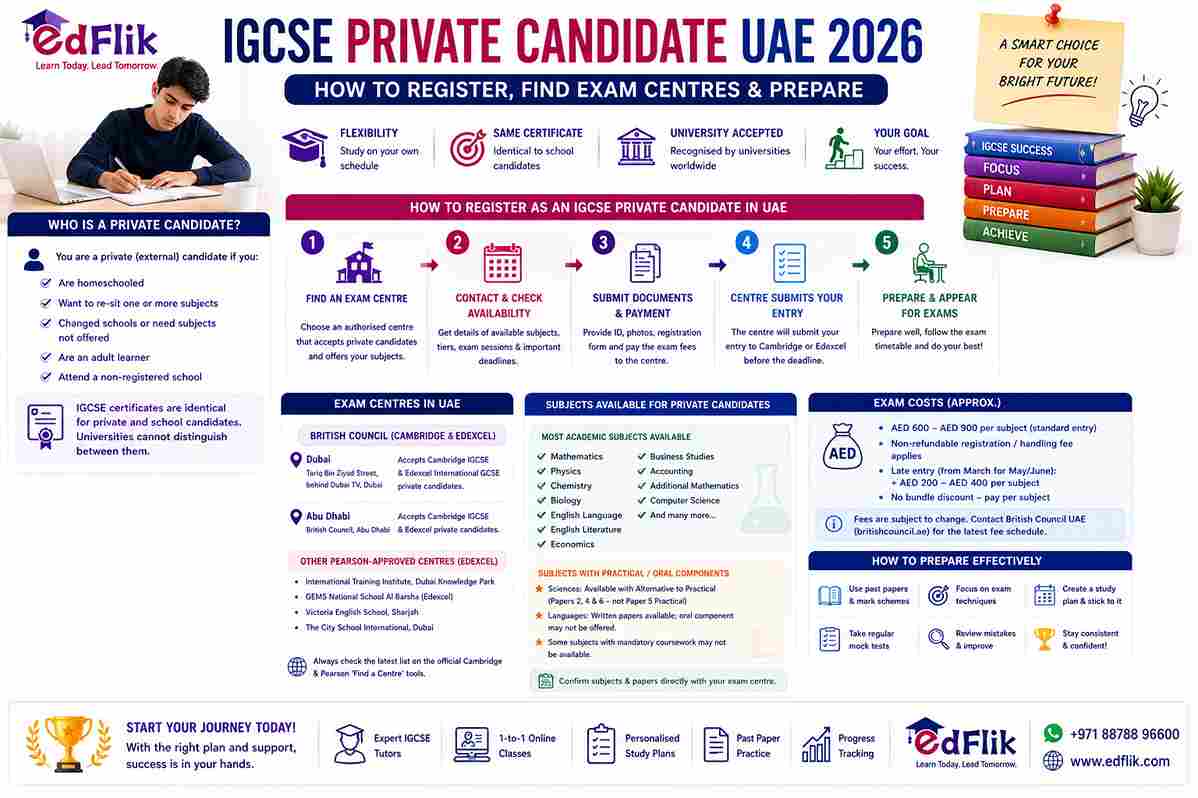
When IGCSE Results Come Out in UAE 2026
|
Exam Series |
Release Date |
How to Access |
|
May/June 2026
Cambridge IGCSE |
Second
Thursday of August 2026 (approximately August 13, 2026) |
Through
school; via Cambridge Results Online; direct via Cambridge candidate portal |
|
October/November
2026 Cambridge IGCSE |
Second
Thursday of January 2027 |
Through
school; via Cambridge Results Online |
|
May/June 2026
Edexcel IGCSE |
Mid-August
2026 (same week as Cambridge) |
Through
school; via Pearson student results portal |
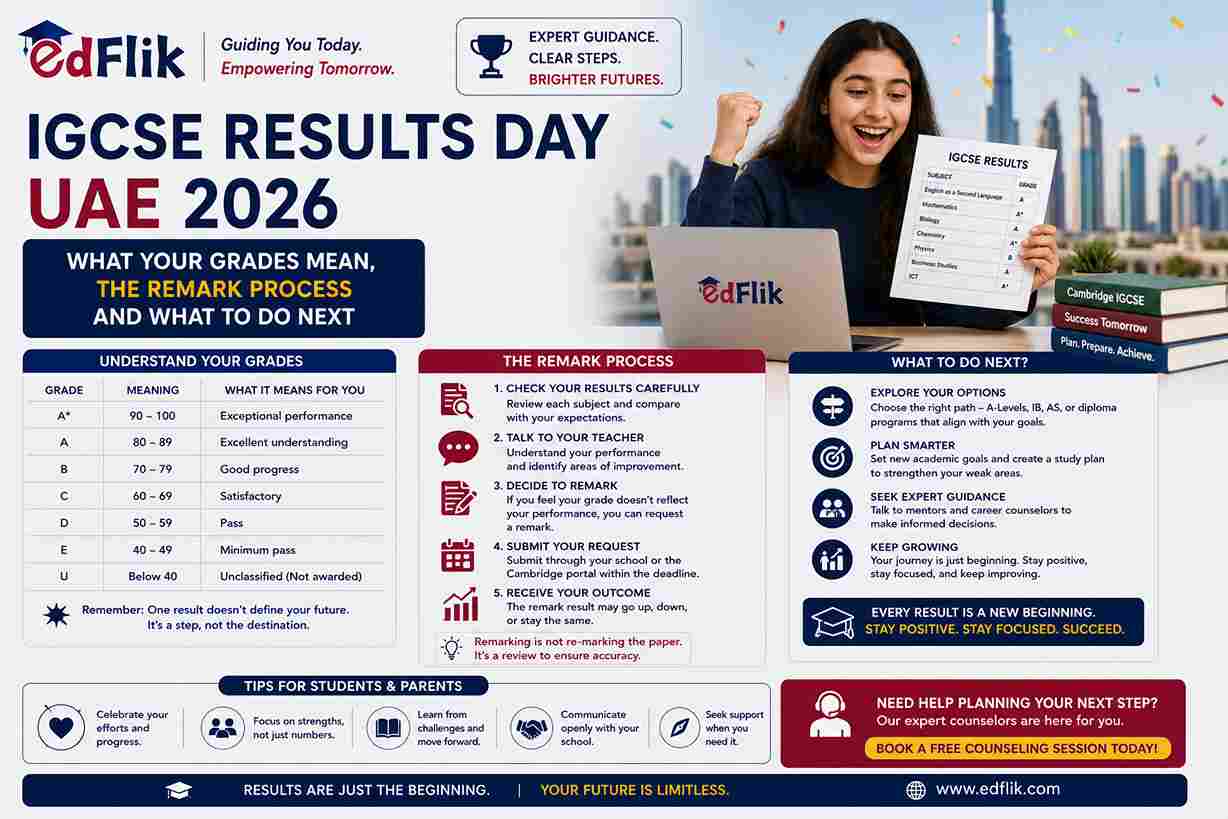
What IGCSE Grades Mean — The Quick Reference
|
Grade (A*-G) |
What It Means |
Common
Requirement It Meets |
|
A* |
Highest grade
— outstanding performance in the subject |
Required for
the most competitive A-Level entries; signals potential for A-Level at the
highest level |
|
A |
Excellent
performance — above grade boundary by a significant margin |
Typically
sufficient for A-Level in that subject at most UAE Sixth Forms; minimum for
competitive university IGCSE requirements |
|
B |
Good
performance — solid and reliable understanding of the course |
Minimum for
many A-Level science entries; meets most standard Sixth Form entry
requirements |
|
C |
Satisfactory —
meets the pass threshold |
The minimum
grade for most Sixth Form subject entries and university IGCSE requirements;
meets the "5 at grade C" benchmark |
|
D |
Below typical
pass threshold for Sixth Form purposes |
Does not
typically qualify for A-Level in this subject; may qualify for general Sixth
Form entry alongside stronger grades in other subjects |
|
E-G |
Below
expectations — significant gaps in the assessed content |
Sixth Form
entry conditions not typically met for this subject; retake consideration is
appropriate |
|
The most
important thing to do in the first 24 hours after results: contact your
school to discuss Sixth Form entry before assuming the worst. Many UAE
schools have flexibility for students who narrowly missed a threshold,
particularly if the student has a strong overall profile across all subjects. |
Cambridge Post-Results Services — Remarks and Script Access
|
Service |
What It Does |
Cost Range |
When to Use
It |
Deadline |
|
Access to
Scripts (ATS) |
Provides a
scan of your marked script — you can see exactly where marks were gained and
lost |
Lower cost |
Always useful
as a first step — before deciding whether to request a remark |
Late
August/September |
|
Clerical Check
(CC) |
Verifies that
all marks were correctly totalled and transferred; corrects any clerical
errors |
Very low cost |
When results
seem significantly different from expected with no obvious explanation |
Late
August/September |
|
Review of
Marking (ROM) |
A senior
examiner independently re-marks the paper — grade can go up or down |
Higher cost |
When the grade
is at a boundary (e.g. C/B boundary) and the script shows marks close to the
next grade |
Late
August/September |
|
Priority
Review of Marking (PROM) |
Expedited ROM
— results returned faster for students awaiting university offers |
Highest cost |
When
university entry or Sixth Form entry is contingent on a specific grade and
time is critical |
Earlier
deadline |
Key decision rule: a Review of Marking (ROM) is worth considering when the grade is exactly at a grade boundary. It is much less likely to change the grade when a student is clearly in the middle of a grade band. The Access to Scripts service first will help determine whether a ROM is warranted.
What to Do If Grades Are Lower Than Expected
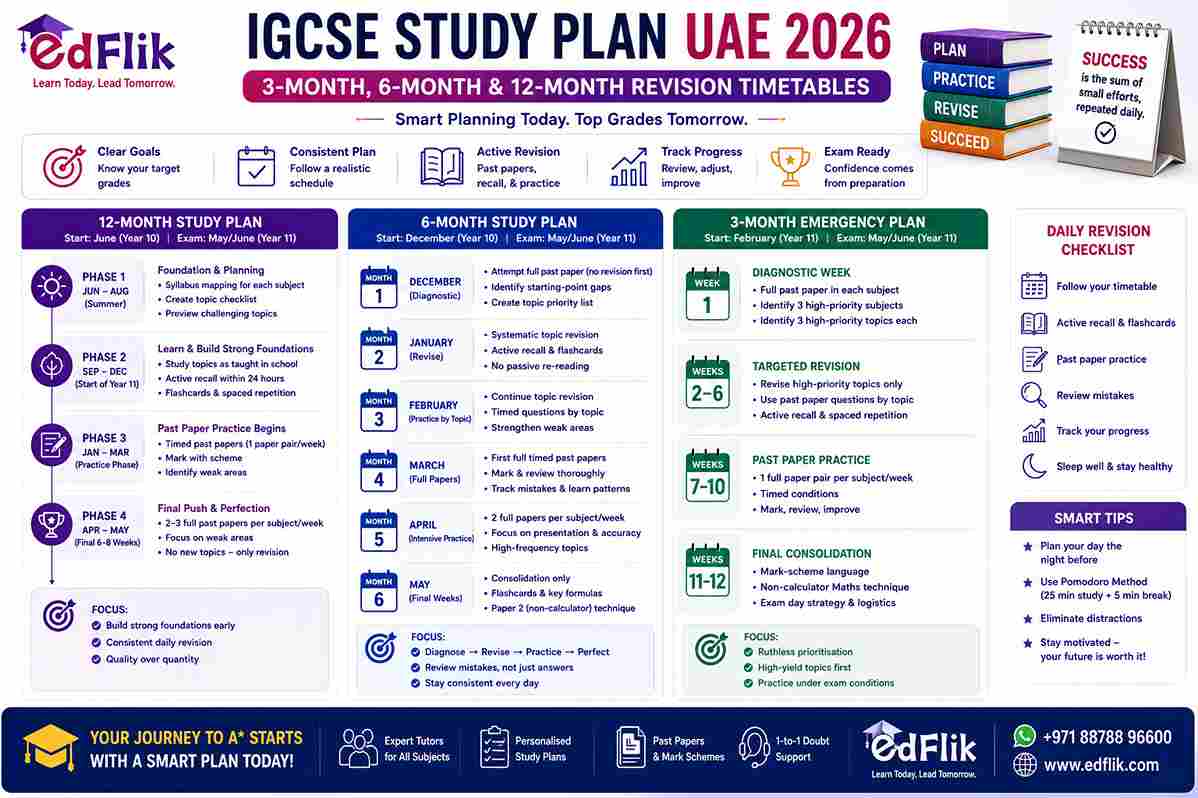
Step 1 — Within 48 Hours: Speak to Your School
Before making any decisions, speak to your school's Head of Sixth Form or Guidance Counsellor. Many UAE schools have conditional entry options, subject-specific entry appeals, or alternative programme pathways that are not apparent from the published grade requirements. Do not assume that a grade of C in one subject automatically closes the Sixth Form door.
Step 2 — Assess Which Grades Are Critical
Not all lower-than-expected grades carry the same consequences. A grade C in an elective subject you are not continuing has almost no impact. A grade C in Maths when you need a B for A-Level Maths is a significant issue. Identify which grades genuinely affect your Sixth Form or university pathway before deciding which to address first.
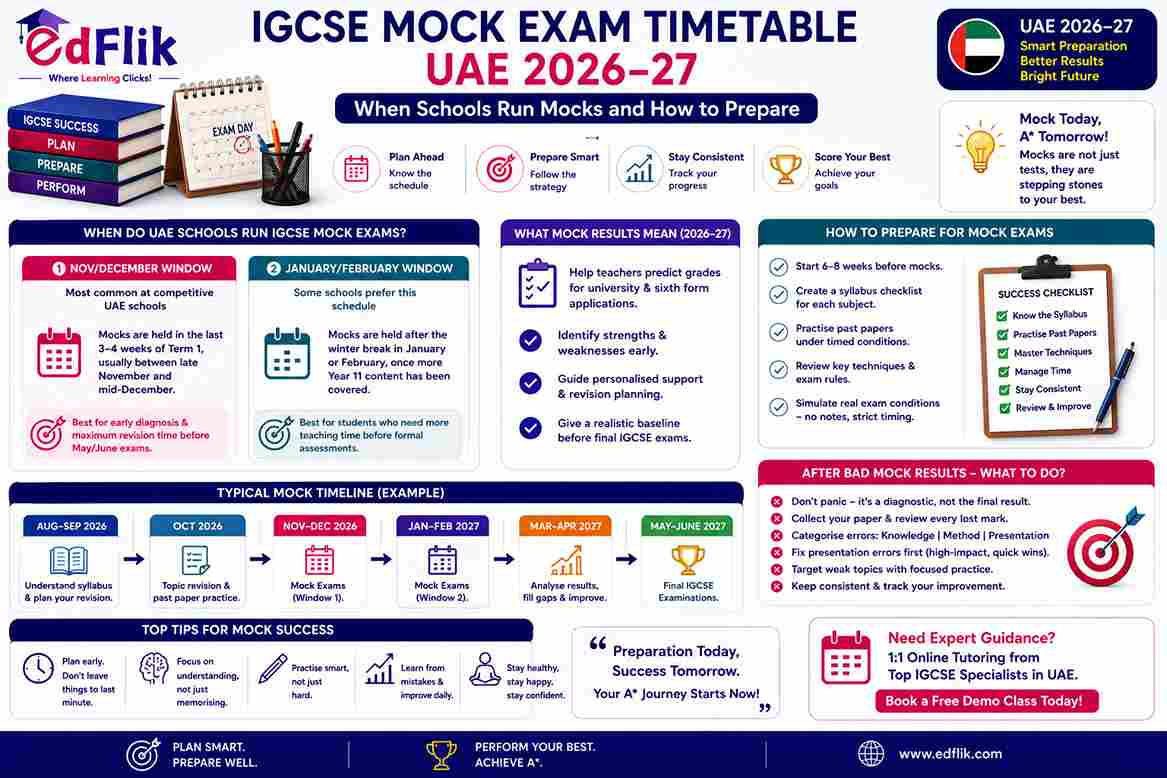
Step 3 — Consider the October/November Retake
Cambridge IGCSE offers an October/November examination series. UAE students who are registered as private candidates (or whose school enters them for November sittings) can retake subjects 3 months after results. Cambridge accepts the best grade across all sittings. This is the fastest route to improving a grade that genuinely matters for Sixth Form or university entry.
Step 4 — Begin Targeted Tutoring Immediately
If a retake is the decision, starting tutoring the week after results is not too early — for a November sitting, there are approximately 11-12 weeks. A targeted preparation programme using past papers and mark schemes, focused specifically on the areas where marks were lost (identifiable from the Access to Scripts service), is the most efficient preparation approach for a retake.
|
EdFlik
provides IGCSE retake tutoring for October/November sittings across all
subjects and curricula. Sessions begin from August. Past-paper based,
mark-scheme focused, 1:1. From AED 60 per session. Book immediately after
results day at www.edflik.com or WhatsApp +91 88788 96600. |
Frequently Asked Questions
Q: When are Cambridge IGCSE results released in UAE 2026?
The second Thursday of August 2026 (approximately August 13) for the May/June series. Accessible through your school or via the Cambridge candidate portal.
Q: What IGCSE grades do I need for A-Level and IB entry?
Typically 5 IGCSEs at grade C or above for Sixth Form entry. Most A-Level subjects require grade B (6) in the same or related IGCSE. Check your specific school's requirements — they vary.
Q: Can I request a remark on my IGCSE papers?
Yes — Cambridge offers Access to Scripts, Clerical Check, Review of Marking, and Priority Review of Marking. Deadlines are late August/September and are submitted through your school.
Q: What should I do if my IGCSE results are lower than expected?
(1) Speak to your school within 48 hours. (2) Request Access to Scripts to understand where marks were lost. (3) Assess whether a Review of Marking is warranted. (4) Decide whether an October/November retake is needed. (5) Begin tutoring preparation immediately if retaking.
Q: How many times can you retake IGCSE?
As many times as needed. May/June and October/November sittings offer two opportunities per year. Cambridge accepts the best grade across all sittings.