IGCSE to University UAE 2026 — Complete Pathway Guide for UAE Students
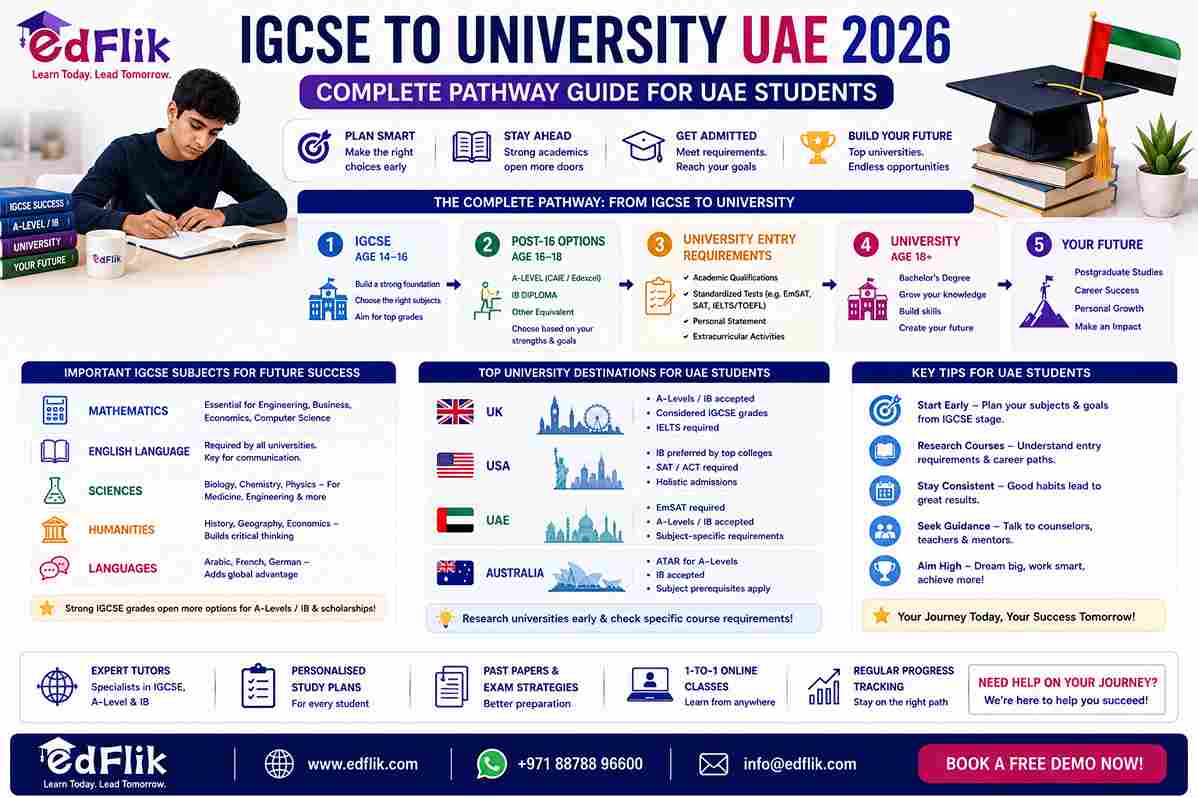
One of the most common misconceptions among UAE IGCSE families is that IGCSE results directly determine university entry. They do not — but they have a more significant influence on the university pathway than most families realise. IGCSE grades determine which A-Level or IB subjects a student can take; those post-16 qualifications are what university admissions offices read first. But the IGCSE profile shapes the trajectory, the subject options, and in competitive applications, the shortlisting outcome. This guide explains the complete pathway from IGCSE to university for UAE students — across every major destination.
Step 1 After IGCSE — The Post-16 Decision
No university in any country currently accepts IGCSE qualifications alone for direct entry to degree programmes. IGCSE is a secondary school qualification for students aged 14 to 16. University entry requires post-16 qualifications. The pathway:
|
Post-IGCSE
Option |
Duration |
Leads To |
Best For |
|
Cambridge A-Level (CAIE) |
2 years (Years 12 to 13) |
UK, UAE, Australia, Canada, global universities |
Students targeting UK universities; depth in 3 to 4 subjects;
clear academic direction |
|
Edexcel International A-Level (IAL) |
2 years — but modular (unit resits possible) |
Same global acceptance as CAIE A-Level |
Students at Edexcel schools; those who may need to resit
individual units |
|
IB Diploma Programme |
2 years (Grades 11 to 12) |
US, Canada, Europe, UK, UAE, global universities |
Breadth-preferring students; US and European university targets;
independent research capability |
|
Foundation Programme |
1 year |
UK, Australian, Canadian universities |
Students whose IGCSE profile does not yet meet direct A-Level
entry requirements; faster pathway |
|
BTEC alongside A-Level |
2 years |
Primarily UK vocational and applied degree courses |
Students with strong practical or vocational interests alongside
academic subjects |
Most UAE British-curriculum school students progress to A-Level at their current school (if offered) or transfer to an IB World School for sixth form. The choice between A-Level and IB is one of the most important academic decisions UAE families make — for a full comparison, see /ib-vs-a-level-uae/.
IGCSE Grades and UK University Admissions
UK universities are the most natural destination for UAE IGCSE students — the qualification was designed by Cambridge in the UK, and every UK university admissions office understands it deeply. How IGCSE grades matter in UK applications:
|
University
Type |
IGCSE Role |
Specific
Requirements |
|
Oxbridge (Oxford and Cambridge) |
Strong profile expected; used in shortlisting alongside A-Level
predictions |
Typically A* and A grades in subjects related to the course;
especially critical for highly competitive courses (PPE, Medicine, Natural
Sciences) |
|
Russell Group (top 24 UK universities) |
Used for shortlisting when A-Level predictions are similar across
applicants |
No fixed minimum but competitive profiles typically show B or
above in relevant subjects; English Language minimum usually B or above |
|
UK Medical Schools |
Specific IGCSE grade conditions are common |
Typically require A or A* in IGCSE Biology, Chemistry, Maths, and
English Language; Imperial requires 7s (A equivalent) in relevant subjects |
|
Most UK universities |
Listed on UCAS form; English Language requirement universal |
Grade C or above in IGCSE English Language is near-universal
minimum; Grade B or above for more selective programmes |
|
University of Edinburgh |
Strong IGCSE profile beneficial |
Medicine: requires A in IGCSE Biology, Chemistry, and Maths
alongside A-Level requirements |
UAE University Requirements — IGCSE Plus EmSAT
UAE universities have a unique dual requirement that UK, US, and Australian universities do not: alongside A-Level or IB Diploma results, all UAE university applicants must sit the EmSAT (Emirates Standardised Test). This applies to all students regardless of nationality. The IGCSE profile feeds into UAE university applications as follows:
|
UAE
University |
IGCSE Minimum |
Key Subjects
Required |
EmSAT
Requirement |
|
Khalifa University |
5 IGCSEs at C or above |
Maths and Physics at B or above for Engineering; Science subjects
for Science programmes |
Maths 1250+, Physics 1100+, English 1100+ for Engineering |
|
UAEU (UAE University) |
5 IGCSEs at C or above including English and Maths |
Programme-specific; Medicine requires Science IGCSEs at high
grades |
Maths 900–1100 (programme dependent); English 900+ |
|
NYU Abu Dhabi |
Strong IGCSE profile (A*/A dominant) |
All subjects; breadth and rigour valued |
Competitive EmSAT scores alongside TOEFL/IELTS and additional
holistic criteria |
|
American University of Sharjah (AUS) |
5 IGCSEs at C or above |
English Language and Maths required; programme-specific
additional subjects |
English 1100+; Maths 1000–1100 (programme dependent) |
|
University of Birmingham Dubai |
5 IGCSEs including English and Maths |
Programme-specific subject requirements |
EmSAT required — score varies by programme; confirm directly |
The EmSAT requirement means that UAE students applying to local universities need to prepare for two separate high-stakes assessments: their A-Level or IB Diploma examinations, and the EmSAT. For a complete EmSAT preparation guide, see /emsat-tutor-uae/.
US University Applications — How IGCSE Features
US university admissions are holistic — the application includes GPA, standardised test scores (SAT/ACT), extracurricular activities, essays, and teacher recommendations. IGCSE grades feed into US applications as follows: IGCSE grades are converted to a GPA equivalent — predominantly A*/A grades translate to a 4.0 GPA context; IGCSE subject breadth (taking 8 to 10 subjects) demonstrates the well-roundedness that US universities value; strong IGCSE grades in subjects related to the intended major reinforce academic narrative; and IGCSE Maths and Sciences at high grades support STEM major applications.
|
US Target
University Tier |
Expected
IGCSE Profile |
Additional
Requirements |
Best Post-16
Pathway |
|
Ivy League + top 10 (Harvard, MIT, Yale) |
Predominantly A*/A across 8 to 10 subjects |
SAT 1450+; exceptional extracurriculars; compelling essays; 3
strong teacher references |
IB Diploma (EE and TOK demonstrate research capability valued by
US admissions) |
|
Top 25 (UCLA, UMich, Georgetown, NYU) |
Mostly A*/A; some B acceptable in non-core subjects |
SAT 1350+; strong extracurriculars; good essays |
Both IB and A-Level accepted — IB slightly preferred for liberal
arts colleges |
|
Top 50 (US News ranking) |
Majority A with some B acceptable |
SAT 1200+; reasonable extracurricular profile |
Both accepted equally |
|
Good US universities broadly |
Minimum C or above in core subjects |
SAT 1050+; basic extracurriculars |
Both accepted |
Which IGCSE Subjects Matter Most for University — By Degree Course
|
University
Course |
Essential
IGCSE Subjects |
Recommended
Additional IGCSEs |
Post-16
Pathway |
|
Medicine / Dentistry |
Biology (A*/A), Chemistry (A*/A), Maths (A*/A), English Language
(A/B) |
Physics (A/B) |
A-Level Biology, Chemistry, Maths (+ Physics recommended) |
|
Engineering |
Maths (A*/A), Physics (A*/A), English Language (B+) |
Chemistry, Computer Science |
A-Level Maths, Physics (+ Chemistry or Further Maths) |
|
Law |
English Language (A/B), English Literature or History (A/B) |
Economics, a Modern Language |
A-Level History, English Literature, one other humanity or
language |
|
Economics / Finance |
Maths (A*/A), Economics (A/B), English Language (B+) |
Business Studies, a second language |
A-Level Maths, Economics (+ a third essay-based subject) |
|
Computer Science |
Maths (A*/A), Computer Science (A/B) |
Physics, Additional Maths |
A-Level Maths, Computer Science (+ Physics or Further Maths) |
|
International Relations / Politics |
English Language (A/B), History or Geography (A/B) |
Economics, a Modern Language |
A-Level History, Politics or Economics, English Literature |
Australian and Canadian Universities — IGCSE to Entry
Australian universities convert A-Level and IB Diploma results to ATAR (Australian Tertiary Admission Rank) equivalents. IGCSE grades feed into Australian applications through the post-16 qualifications — the IGCSE profile itself is not directly assessed but shapes which A-Level or IB Diploma subjects a student can take, which determines the ATAR equivalent. Group of Eight (Go8) research universities — University of Melbourne, ANU, University of Sydney, University of Queensland, UNSW, Monash, University of Adelaide, University of Western Australia — all accept Cambridge A-Level and IB Diploma results with standard conversion tables.
Canadian universities (McGill, University of Toronto, UBC, McMaster for Medicine) are increasingly familiar with Cambridge IGCSE pathways. The University of Toronto posts specific A-Level equivalent grade requirements; McGill uses a point system that maps A-Level grades directly. Both Cambridge A-Level and IB Diploma are well-understood by Canadian admissions offices.
Frequently Asked Questions — IGCSE to University UAE
Q: Can IGCSE results alone get you into university?
A: No. IGCSE is a secondary school qualification for ages 14 to 16. Direct university entry requires post-16 qualifications: Cambridge A-Level or IB Diploma. IGCSE grades matter significantly — they determine which post-16 subjects are available, contribute to shortlisting at competitive UK universities, and form minimum entry requirements alongside A-Level offers at some universities.
Q: What post-IGCSE qualification should UAE students choose for university?
A: A-Level for UK-focused applicants who prefer depth in 3 to 4 subjects. IB Diploma for US, Canadian, or European targets, or students who thrive across multiple disciplines simultaneously. Both are equally accepted in UK, UAE, and Australian universities. The choice should be driven by academic profile, school offering, and target destination — not by perceived prestige.
Q: What IGCSE grades do UK universities require?
A: No universal fixed minimum — but Oxbridge expects mostly A*/A in relevant subjects; medical schools require A or A* in Biology, Chemistry, Maths, English Language; all UK universities require English Language at Grade C or above (most require B or above for competitive programmes). IGCSE profiles are used in shortlisting when A-Level predictions are similar.
Q: What do UAE universities require from IGCSE students?
A: 5 IGCSEs at C or above including English and Maths, plus A-Level or IB Diploma results, plus EmSAT scores — required for all UAE university applicants. EmSAT Maths 900–1250+ and English 900–1100+ depending on university and programme. No UAE university application is complete without EmSAT results alongside the international qualification.
Q: Which IGCSE subjects are most important for university?
A: English Language (Grade C or above universally required; B or above for competitive programmes) and Mathematics (Grade B or above for all STEM, business, and economics courses). Beyond these: Biology and Chemistry for Medicine; Maths and Physics for Engineering; English and History for Humanities; Economics and Maths for Finance. Subject coherence with intended degree matters to admissions offices.
How EdFlik Supports UAE Students on Their University Pathway
EdFlik provides the IGCSE subject tutoring that builds the grade profile needed for competitive post-16 and university access. Sessions from AED 60. Free demo. Book at www.edflik.com.