IGCSE Grade Boundaries UAE 2026 — What Marks You Need for A*, A, B Per Subject
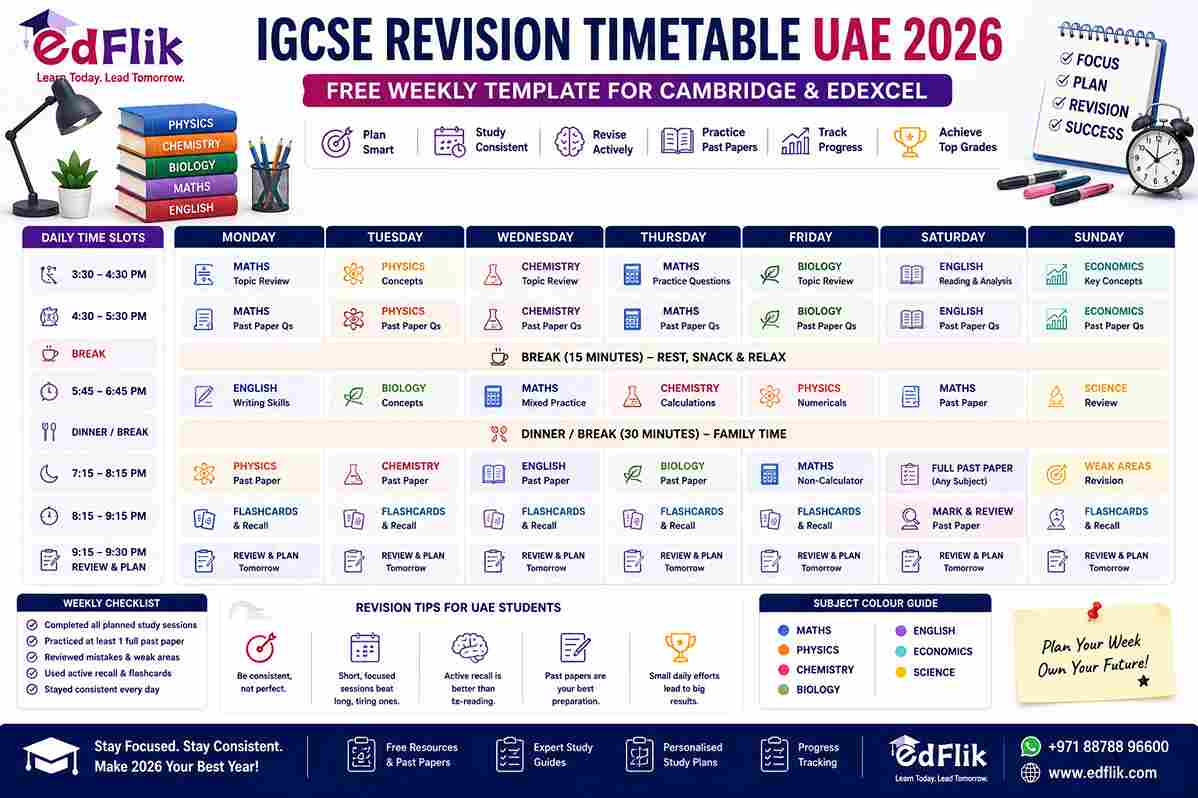
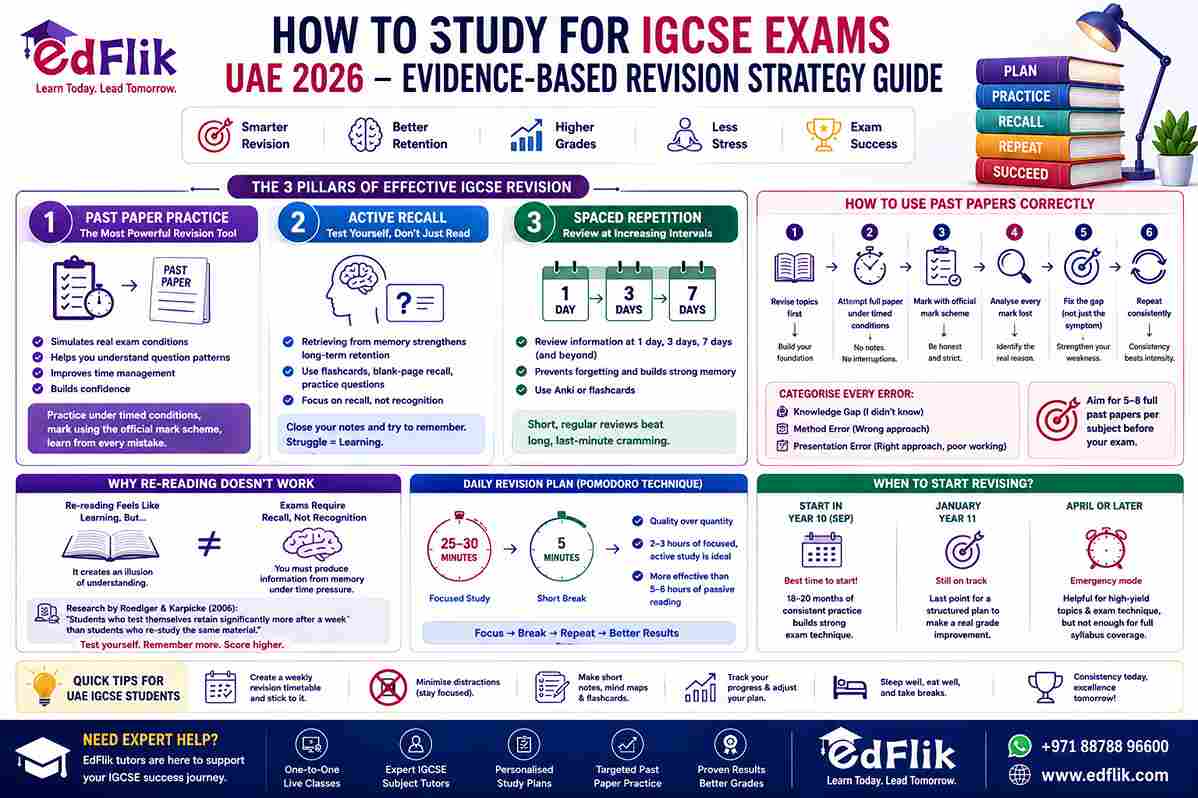
'What mark do I need for an A*?' is one of the most common questions UAE IGCSE students ask — and one of the most misunderstood. Grade boundaries are not fixed, they are not published in advance, and they vary by subject, by tier, and by exam series. This guide explains how Cambridge IGCSE grade boundaries work, where to find the official figures, and what historical ranges look like for the most common UAE IGCSE subjects so you can calibrate your past paper targets correctly.
How Cambridge IGCSE Grade Boundaries Work
Cambridge IGCSE grade thresholds are set after each examination series — not before. The process:
1. After marking is complete, Cambridge assembles a grade threshold committee of experienced senior examiners for each subject.
2. The committee reviews the paper difficulty, the distribution of candidate marks, and the expected performance of the candidature based on the subject syllabus.
3. They set the minimum mark required for each grade (A*, A, B, C, D, E for Extended; C, D, E, F, G for Core) at both the component level and the overall level.
4. These thresholds are published on the Cambridge International website as official grade threshold tables, typically in August for the June series and January for the October/November series.
The practical implication for UAE students: the A* boundary in your subject this year will not be exactly the same as it was last year. It will be in a similar range, but the exact figure depends on how the specific June 2026 or October/November 2026 papers turned out. Always target a mark range based on historical averages, not a single year's threshold.
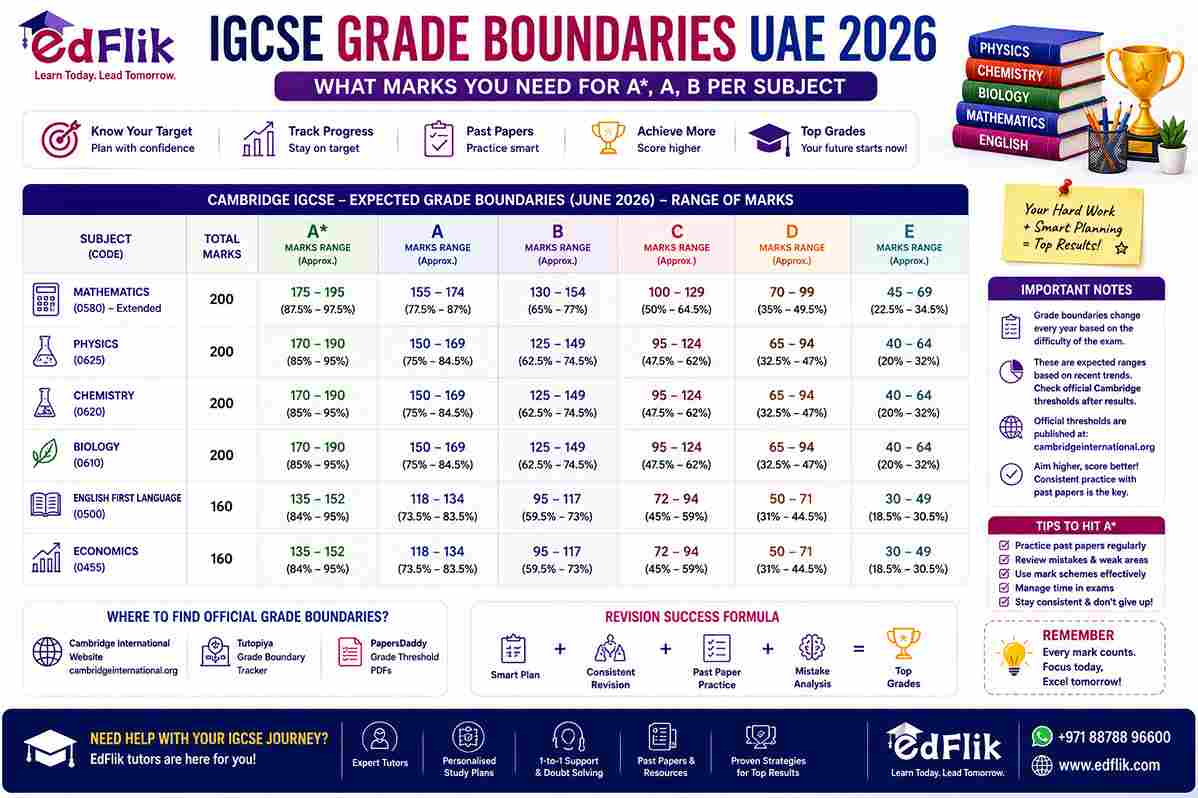
Approximate Grade Boundaries — Cambridge IGCSE Key Subjects
These are approximate historical ranges based on published grade threshold data from multiple recent series. They are indicative — always check the official Cambridge grade threshold tables at cambridgeinternational.org for the specific series you are revising for:
|
Subject |
Total Marks |
Approx A* |
Approx A |
Approx B |
Approx C |
|
Mathematics 0580 Extended |
200 (P2: 70 + P4: 130) |
~175–195 |
~145–174 |
~115–144 |
~85–114 |
|
Chemistry 0620 Extended |
200 (P2: 80 + P4: 80 + P6: 40) |
~165–185 |
~135–164 |
~105–134 |
~75–104 |
|
Physics 0625 Extended |
200 (P2: 30 + P4: 80 + P6: 40 = max 150 — confirm with current
spec) |
Varies by spec |
Varies by spec |
Varies by spec |
Varies by spec |
|
Biology 0610 Extended |
200 (P2: 30 + P4: 80 + P6: 40 = 150 marks — confirm with current
spec) |
Varies by spec |
Varies by spec |
Varies by spec |
Varies by spec |
|
English Language 0500 |
~140 (P1: 50 + P2: 50 + P3: 40) |
~115–130 |
~95–114 |
~75–94 |
~55–74 |
|
Economics 0455 Extended |
180 (P1: 90 + P2: 90) |
~150–170 |
~120–149 |
~90–119 |
~65–89 |
Important: for Physics 0625 and Biology 0610, the total mark calculation depends on the specific paper components entered. UAE students should confirm with their school exactly which papers they sit (typically Papers 2, 4, and 6 for Extended tier) and calculate the total marks accordingly. The approximate percentage ranges for grades remain consistent across subjects: A* = approximately 85 to 92 percent; A = approximately 73 to 84 percent; B = approximately 60 to 72 percent.
How to Use Grade Boundaries in Your Past Paper Practice
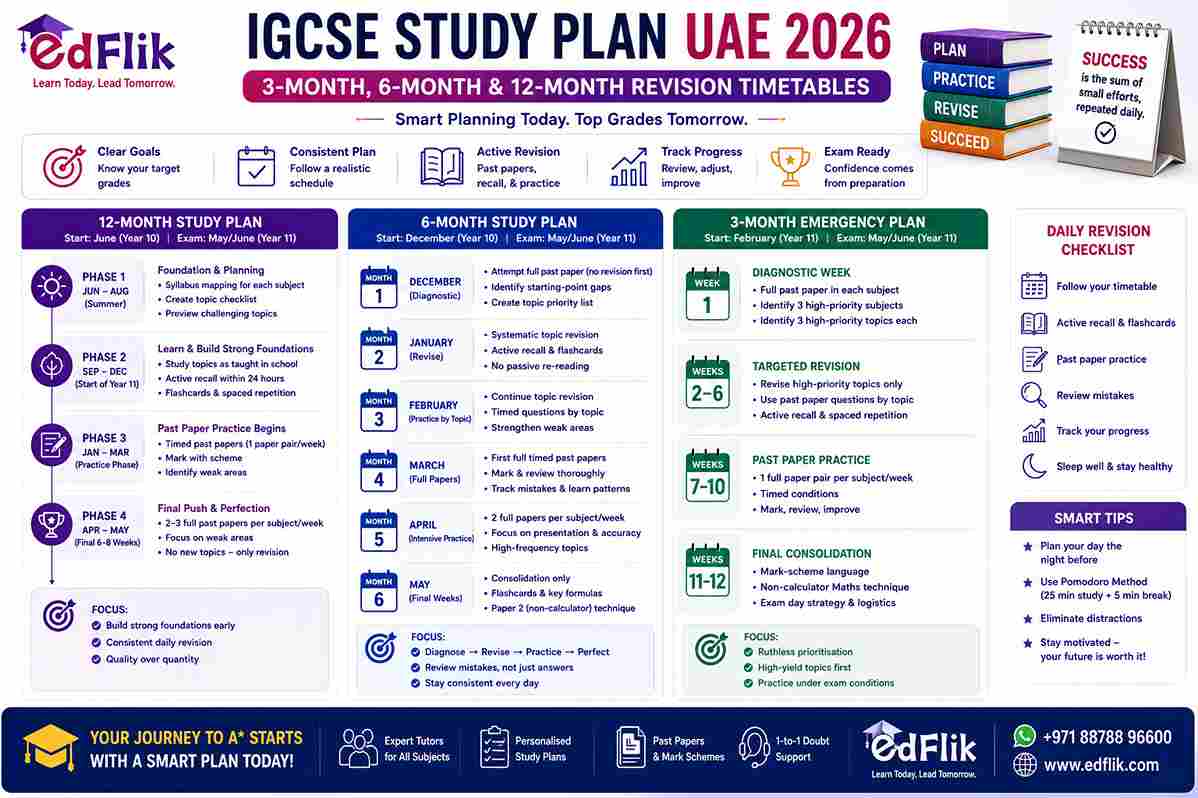
The most strategic use of grade boundary information in IGCSE revision:
Calculate Your Current Percentage in Each Subject
After completing and marking a past paper, calculate your percentage of total marks. If you scored 147 out of 200 in IGCSE Maths, your percentage is 73.5 percent. Looking at the approximate A range (73 to 84 percent), you are right at the border between B and A. Consistent scoring above 80 percent is needed to have a reliable buffer for the actual A* threshold.
Track Progress Across Multiple Papers
Grade boundaries are only useful if you track your past paper scores over time. A student who scores 73 percent on Paper 1, 76 percent on Paper 2, and 80 percent on Paper 3 is improving. A student who alternates between 70 and 75 percent over 5 papers has reached a plateau and needs a targeted technique intervention — not more papers.
Target Your Revision to the Right Grade Band
Grade boundary data helps calibrate revision priorities: if you are consistently scoring 60 to 65 percent in IGCSE Chemistry (B range), you have specific technique weaknesses rather than major knowledge gaps — because the C to B gap is about core content, while the B to A gap is about technique precision and question coverage. EdFlik Chemistry tutors specifically diagnose whether a student's gap is in knowledge (needs topic revision) or technique (needs mark-scheme language and ionic equation practice).
Where to Find Official Cambridge IGCSE Grade Thresholds
|
Source |
What's
Available |
When Updated |
|
Cambridge International (official) |
cambridgeinternational.org/grade-threshold-tables — official
grade thresholds by subject, series, and tier |
August (June series) and January (Oct/Nov series) |
|
PapersDaddy |
Grade threshold PDFs included alongside each past paper session
download |
Concurrent with each exam series |
|
Tutopiya Grade Predictor |
Interactive tool that estimates grade based on raw mark entered |
Ongoing — but verify against official Cambridge data |
|
SmartExamResources |
Grade threshold tables for IGCSE subjects including Sciences and
Maths |
Typically updated with each series release |
Grade Boundaries by Subject — What Drives the Threshold Up or Down
|
Subject |
Factors That
Push Boundary Higher (easier paper) |
Factors That
Push Boundary Lower (harder paper) |
|
Mathematics 0580 |
More straightforward algebraic questions; fewer multi-step
proofs; accessible statistics topics |
Novel application of vectors or functions; difficult 3D
trigonometry; challenging circle theorem combinations |
|
Chemistry 0620 |
Familiar topic combinations; standard identification tests;
well-precedented organic reactions |
Unusual industrial process context; non-standard electrolysis
scenarios; difficult ionic equation questions |
|
Physics 0625 |
Calculation questions with clear numeric setups; standard wave
and electricity questions |
Unfamiliar experimental contexts; multi-step mechanics problems;
novel electromagnetism scenarios |
|
English Language 0500 |
Accessible, clear-stimulus passages; well-signposted tasks |
Ambiguous stimulus material; challenging summary topic; complex
transactional writing task |
Frequently Asked Questions — IGCSE Grade Boundaries UAE
Q: How does Cambridge set IGCSE grade boundaries?
A: After each examination series — not before. A senior examiner committee reviews the paper difficulty and candidate mark distribution and sets grade thresholds based on the standard of performance on that specific paper. Thresholds are published on the Cambridge International website in August (June series) and January (October/November series).
Q: What marks do UAE students need for A* in IGCSE Maths 0580?
A: Approximately 175 to 195 out of 200 marks (87.5 to 97.5 percent) based on historical ranges. The exact threshold varies by year — easier papers produce higher thresholds, harder papers lower. Consistently scoring above 85 percent (170/200) in past paper practice gives a reliable buffer for the actual A* threshold.
Q: Where can UAE students find official IGCSE grade thresholds?
A: Official grade threshold tables: cambridgeinternational.org/programmes-and-qualifications/cambridge-upper-secondary/cambridge-igcse/grade-threshold-tables. Published after each series. PapersDaddy includes grade threshold PDFs alongside past paper downloads.
Q: Why do IGCSE grade boundaries change from year to year?
A: Because each paper is a different level of difficulty. Cambridge's threshold-setting process adjusts boundaries so that grades represent the same standard across different years despite paper difficulty variation. An A* represents the same level of achievement every year even when the specific paper is easier or harder.
Q: How should UAE students use grade boundary information in revision?
A: Calculate your percentage after each past paper. Track progress across multiple papers. If within 5 percent of the A* range consistently, your focus is technique refinement. If more than 15 percent below A*, knowledge gaps are the priority before technique. Use historical boundary ranges (not single-year thresholds) as targets.
How EdFlik Supports IGCSE Students in Targeting Their Grade Goals
EdFlik tutors use past paper scores and grade boundary data to calibrate the specific techniques and topics each UAE student needs most. Sessions from AED 60. Free demo. Book at www.edflik.com.