Managing Exam Anxiety UAE 2026 — Student and Parent Guide for IGCSE, IB and A-Level Students
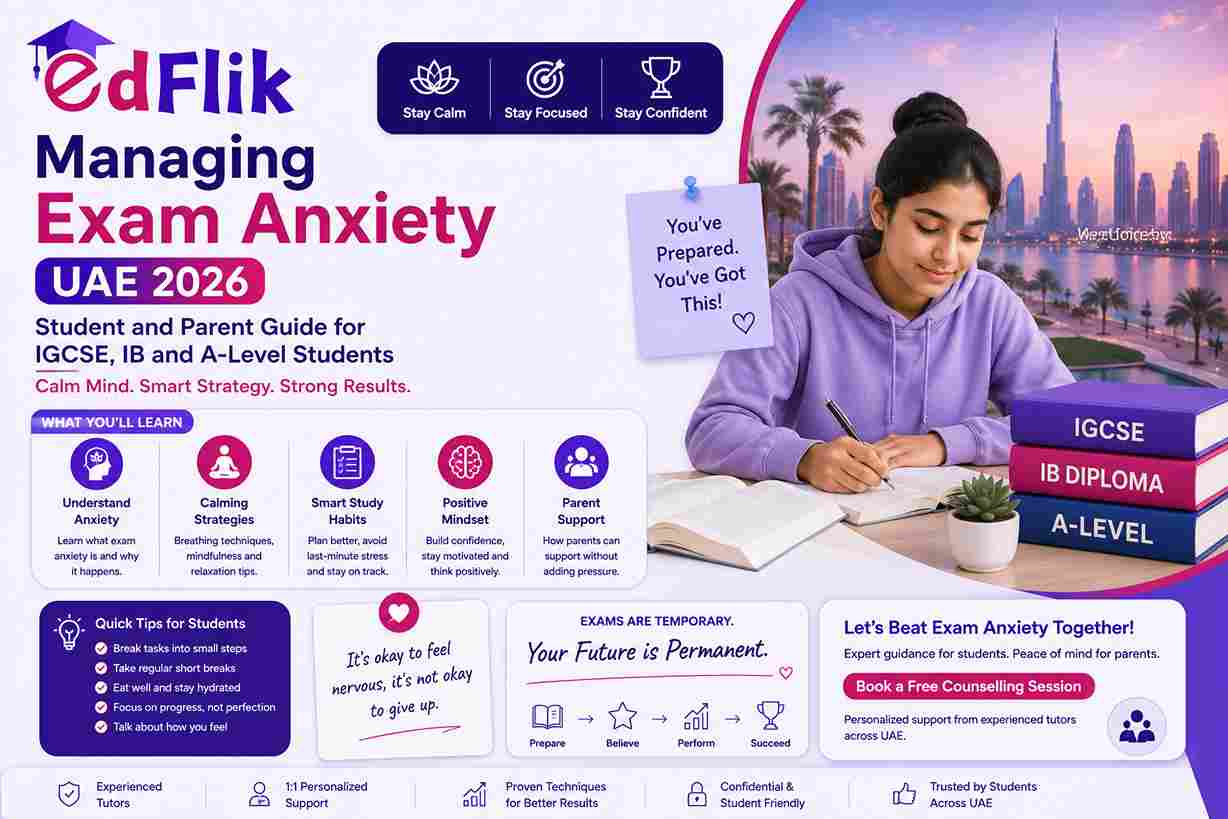
Exam anxiety is the most commonly reported non-academic challenge affecting IGCSE, IB, and A-Level students at UAE private schools. It is also one of the most misunderstood — mistaken by parents and students alike for either a character weakness to push through, or a fixed condition to be managed around. Neither is accurate. Exam anxiety in UAE students is most commonly driven by one or more of three factors: insufficient preparation producing genuine uncertainty about performance; inadequate familiarity with the examination format producing heightened novelty-anxiety; or external pressure creating a perceived stakes level higher than the actual academic risk. All three are addressable.
The UAE-Specific Anxiety Context
UAE school exam anxiety has some characteristics specific to the environment:
• High-performing peer cohort: At Dubai College, Repton, Kings, Brighton College, NLCS, and Cranleigh, the student body is academically selected or self-selecting at a high level. A student performing at the national 60th percentile would be below average in these cohorts. The calibration point that "I am not doing well compared to my peers" is often real, not distorted.
• University conditional offers: When a student has a conditional offer of ABB from a UK university, every examination carries direct consequence. This creates rational high-stakes anxiety that is proportionate to the real situation — not catastrophising.
• Expatriate family context: Many UAE families are expatriate, with grandparents, extended family, and cultural communities in home countries who observe and comment on children's academic performance. The social visibility of examination results adds an additional pressure layer.
• High parental educational ambition: UAE parents across all communities show consistently high educational ambition for their children. Medical and engineering career aspirations are common from early secondary school — creating a long runway of anticipated outcome before the student has sat a single IGCSE.
What Reduces Exam Anxiety — Evidence-Based Approaches
|
Strategy |
Why It Works |
How to
Implement |
|
Active
retrieval practice (past papers, flashcard testing) |
More accurate
self-assessment — students who test recall discover specifically what they
know and do not know; this replaces generalised "I don't know
anything" anxiety with specific targeted gaps |
One timed past
paper per subject per fortnight from January; check mark scheme immediately;
build specific revision list from what the paper reveals |
|
Timed practice
under realistic conditions |
Examination
anxiety is partly anxiety about the examination environment; familiarity
reduces novelty-anxiety |
Complete full
papers at the kitchen table, timed, with no reference materials — the same
conditions as the actual exam; do this from mock preparation onward, not just
in the final week |
|
Specific daily
revision targets |
Vague large
tasks ("revise Chemistry") are unactionable and generate avoidance;
specific small tasks ("complete 3 past paper questions on
electrochemistry mark scheme technique") are completable, producing a
sense of progress |
Write the next
day's revision list the evening before — specific topics, specific question
counts, specific time allocation |
|
Sleep schedule
maintenance |
Sleep
consolidates memory and regulates emotional regulation; sleep-deprived
students perform significantly worse in examinations than rested students |
Consistent
bedtime 8-9 hours before the required wake time throughout the examination
period; avoid studying after 10pm in the two weeks before examinations |
|
Physical
activity |
30 minutes of
moderate physical activity reduces cortisol (stress hormone) and improves
concentration in the subsequent 2-3 hours |
30-minute
walk, swim, or cycle between revision sessions — not a luxury during exam
periods but a performance-enhancing tool |
What Parents Should and Should Not Say
Avoid
• "Don't worry, it'll be fine" — dismisses the student's concern without acknowledging it; not actually reassuring
• "This is the most important exam of your life" — amplifies stakes and transfers parental anxiety to the student
• "How do you think that paper went?" immediately after an examination — unhelpful; the student cannot change the paper now and questioning them produces rumination
• "Your cousin/sibling got A* in this, why can't you?" — creates comparison-based anxiety, not productive pressure
What Helps
• "I can see you're feeling the pressure — that makes sense. What would help most right now?" — acknowledges without amplifying; invites the student to name a concrete next step
• "You've prepared for this" — when true and when said calmly; communicates parental confidence in preparation
• "Let's not talk about results tonight; let's have dinner" — creates psychological respite from the exam atmosphere during the examination period
|
EdFlik
tutoring that closes knowledge gaps directly addresses exam anxiety's most
common root cause. A student who knows they understand the material and can
demonstrate it in timed practice is significantly less anxious than one who
is uncertain about their knowledge. From AED 55 per session. Free diagnostic.
Book at www.edflik.com or WhatsApp +91 88788 96600. |
Frequently Asked Questions
Q: Is exam anxiety common among UAE school students?
Yes — very common, and UAE-specific factors (high-performing peer cohorts, university conditional offers, high parental educational ambition, expatriate family visibility) intensify it. Rational given the stakes — but not always proportionate to actual risk.
Q: What are the signs that exam anxiety is affecting academic performance?
Blanking in exams despite knowing material in revision; performing much worse in formal assessments than in practice; physical symptoms (sleep, appetite disturbance, headaches); avoidance behaviours; catastrophising language inconsistent with actual performance evidence.
Q: What revision strategies reduce exam anxiety?
Active retrieval practice (past papers over re-reading), timed practice under realistic conditions, specific daily goals over vague session planning, diagnostic clarity about what is and is not known, and consistent sleep/exercise routines.
Q: How can parents help UAE students manage exam anxiety?
Avoid grade-focused conversations before exams. Acknowledge anxiety without dismissing or amplifying. Maintain normal home routines. Express confidence in preparation. Avoid transferring own parental anxiety about results.
Q: When is exam anxiety serious enough to seek professional support?
When anxiety prevents attending examinations or submitting assessments; when physical symptoms are severe and persistent; when the student expresses hopelessness extending beyond examinations. School counsellor is the appropriate first contact.