Mastering Alimentary Canal Enzymes and Villi Absorption: IGCSE Biology Revision Guide
Last Updated: October 2026 | By EdFlik Education Team
For high school students completing the Cambridge IGCSE Biology (0610) or Pearson Edexcel IGCSE Biology (4BI1) qualifications, human nutrition and digestion represent core foundational units. Featured prominently across Paper 1 (Multiple Choice), Paper 2 (Core Theory), and Paper 4 (Extended Theory), questions testing enzyme specificity, alimentary canal organs, and the structural adaptations of villi routinely account for high-yield marks.
Every exam season, candidates lose easy marks not because they don't recognize digestion as a concept, but because of common biological inaccuracies: confusing mechanical and chemical digestion, misnaming enzyme substrates and products, or failing to explain how the microscopic structure of a villus maximizes nutrient absorption rates.
In this comprehensive, exam-focused masterclass guide, our expert IGCSE biology educators break down alimentary canal anatomy, digestive enzyme functions, fat emulsification by bile, villi adaptations, and common examiner traps to help you secure an $A^*$ grade.
Part 1: Anatomy of the Alimentary Canal & Mechanical vs. Chemical Digestion
Digestion is the process of breaking down large, insoluble food molecules into small, water-soluble molecules so they can be absorbed into the bloodstream.
                     DIGESTIVE PROCESS CLASSIFICATION
                                    |
        +---------------------------+---------------------------+
        |                                                       |
MECHANICAL DIGESTION                                    CHEMICAL DIGESTION
• Physical breakdown of food chunks                     • Breakdown of large chemical bonds
• Increases surface area for enzymes                    • Uses digestive enzymes & stomach acid
• Examples: Chewing (teeth), churning (stomach)        • Examples: Amylase breaking starch to maltose
The Journey Through the Alimentary Canal:
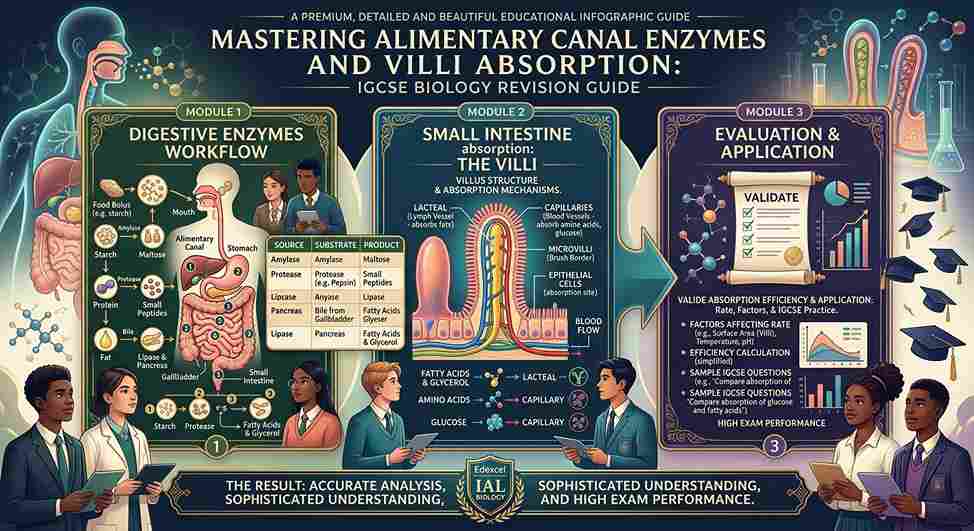
- Mouth (Oral Cavity): Teeth perform mechanical digestion (mastication) to increase food surface area. Salivary glands secrete saliva containing salivary amylase, which begins the chemical digestion of starch into maltose.
- Oesophagus: A muscular tube connecting the mouth to the stomach. Food moves down via rhythmic muscular contractions known as peristalsis.
- Stomach: A muscular sac that churns food (mechanical digestion) and secretes gastric juice containing pepsin (a protease enzyme) and hydrochloric acid. HCl provides an acidic pH (approx. pH 1.5–2.0) which optimizes pepsin activity and kills harmful bacteria.
- Small Intestine (Duodenum & Ileum):
- Duodenum: Receives secretions from the pancreas and liver (bile). Carbohydrates, proteins, and lipids are fully broken down here.
- Ileum: The primary site for the absorption of digested food molecules into the blood and lymph.
- Large Intestine (Colon & Rectum): Absorbs remaining water and mineral ions from undigested food residue, forming feces stored in the rectum before egestion.
Part 2: Major Digestive Enzymes and Their Action
Examiners love testing precise enzyme pathways. You must memorize substrates, active sites/sources, optimum conditions, and final products.
| Enzyme | Source Organ | Secreted Into | Optimum pH | Substrate | Final Product |
| Salivary Amylase | Salivary Glands | Mouth | Neutral ($\sim 7.0$) | Starch | Maltose |
| Pepsin (Protease) | Stomach Wall | Stomach | Acidic ($\sim 2.0$) | Proteins | Polypeptides / Peptides |
| Pancreatic Amylase | Pancreas | Duodenum | Slightly Alkaline ($\sim 8.0$) | Starch | Maltose |
| Trypsin (Protease) | Pancreas | Duodenum | Slightly Alkaline ($\sim 8.0$) | Proteins / Peptides | Amino Acids |
| Lipase | Pancreas | Duodenum | Slightly Alkaline ($\sim 8.0$) | Fats (Triglycerides) | Fatty Acids & Glycerol |
| Maltase | Small Intestine Wall | Ileum | Slightly Alkaline ($\sim 8.0$) | Maltose | Glucose |
The Vital Role of Bile in Fat Digestion:
- Bile is produced by the liver and stored in the gallbladder before being released into the duodenum.
- Emulsification (Mechanical Role): Bile salts break large fat droplets into microscopic droplets, massively increasing the surface area for pancreatic lipase to act upon.
- Neutralization (Chemical Role): Bile is alkaline, neutralizing acidic chyme entering the duodenum from the stomach and creating the optimum pH ($\sim 8.0$) for intestinal enzymes.
Part 3: Absorption in the Small Intestine & Structure of Villi
Once food is broken down into simple soluble monomers (glucose, amino acids, fatty acids, and glycerol), it must pass across the wall of the small intestine into the circulatory system. This is called absorption.
                       STRUCTURAL ADAPTATIONS OF VILLI
                                      |
        +-----------------------------+-----------------------------+
        |                             |                             |
 1. MICROVILLI                 2. THIN EPITHELIUM             3. CAPILLARY NETWORK
 Tiny folds on epithelial      Single layer of surface        Rich blood supply maintains
 cell membranes maximize       cells ensures a very short     a steep concentration gradient
 absorptive surface area.      diffusion distance.            for rapid diffusion.
                                      |
                                      +-----------------------------+
                                                                    |
                                                             4. LACTEAL
                                                             Specialized lymphatic vessel
                                                             absorbs fatty acids and glycerol.
How Nutrients Are Absorbed Into the Blood:
- Glucose and Amino Acids: Absorbed directly into the blood capillaries inside each villus via diffusion and active transport. The hepatic portal vein then transports them directly to the liver.
- Fatty Acids and Glycerol: Absorbed into the lacteal (the central lymph vessel inside the villus), where they are reassembled into fats and transported via the lymphatic system before entering the bloodstream.
Part 4: Top 4 Traps That Cost IGCSE Biology Students Marks
- Confusing Digestion with Egestion: Writing that "undigested food is excreted." Egestion is the removal of undigested waste (feces) via the anus. Excretion is the removal of metabolic waste products (like urea or carbon dioxide) produced by chemical reactions inside cells.
- Stating Bile Is an Enzyme: Claiming that bile digests fats chemically. Bile is not an enzyme; it is an alkaline salt solution that emulsifies fats mechanically.
- Omitting the Single-Cell Epithelium in Villi Explanations: Describing villi as having "thin walls" without specifying that the wall is a single layer of epithelial cells, which minimizes diffusion distance.
- Forgetting Optimum pH Variations: Assuming all enzymes work best at neutral pH. Remember that stomach enzymes (pepsin) require a strongly acidic environment, while intestinal enzymes require an alkaline environment.
Preparing for Cambridge or Edexcel IGCSE Biology exams and aiming for an $A^$ grade? EdFlik connects international school students globally with expert, 1-to-1 online IGCSE biology tutors, helping you master alimentary canal physiology, enzyme kinetics, villi adaptations, and past-paper mark scheme techniques. *Book a Free Demo Class Today!
Frequently Asked Questions (FAQs)
Q1: What is the difference between ingestion, digestion, absorption, assimilation, and egestion?
Ans:
- Ingestion: Taking food into the body through the mouth.
- Digestion: Breaking down large, insoluble food molecules into small, soluble ones.
- Absorption: Moving soluble food molecules through the intestinal wall into the blood and lymph.
- Assimilation: Using absorbed nutrient molecules to build new cell structures or provide energy inside cells.
- Egestion: Expelling undigested food waste out of the body through the anus.
Q2: Why does starch need to be digested while glucose does not?
Ans: Starch is a large, insoluble polymer made of thousands of glucose units joined together; it is too large to pass through the cell membranes of the gut wall. Glucose is a small, soluble monomer that can easily diffuse across cell membranes into the bloodstream.
Q3: Where does most water absorption take place in the human body?
Ans: While some water is absorbed in the small intestine, the colon (large intestine) is responsible for absorbing the vast majority of remaining water from indigestible food residue, turning liquid chyme into solid feces.
Q4: How does EdFlik support IGCSE Biology students?
Ans: EdFlik connects international school students worldwide with vetted, expert 1-to-1 online tutors specializing in Cambridge (0610) and Edexcel (4BI1) IGCSE Biology. Our personalized coaching focuses on clarifying complex physiological processes, practicing experimental design questions, and mastering past-paper mark schemes.