Mastering AP Environmental Science Carbon & Nitrogen Cycles for Abu Dhabi High Schoolers
By EdFlik Team | November 20, 2026
For high school students across Abu Dhabi—from Al Reem Island, Saadiyat Island, and Al Mushrif to Khalifa City and Al Ain—enrolled in Advanced Placement (AP) Environmental Science (APES), Unit 1: The Living World: Ecosystems sets the foundation for the entire course. Within Unit 1, biogeochemical cycles—especially the Carbon Cycle (Topic 1.4) and the Nitrogen Cycle (Topic 1.5)—appear repeatedly across both Multiple-Choice Questions (MCQs) and Free-Response Questions (FRQs), and link directly to later units on Land and Water Use (Unit 5), Energy Resources (Unit 6), Atmospheric Pollution (Unit 7), and Global Change (Unit 9).
In Abu Dhabi's American-curriculum and international schools, APES students have a unique advantage: living in a coastal desert and Arabian Gulf ecosystem makes abstract concepts like coastal blue carbon (mangrove carbon sinks), oceanic CO2\text{CO}_2CO2 absorption, arid soil nitrogen limitation, and fertilizer runoff immediately tangible. However, College Board APES scoring rubrics are notoriously strict about terminology. Simply writing "bacteria change nitrogen" or "plants take in carbon" without naming the exact chemical species (N2\text{N}_2N2, NH3/NH4+\text{NH}_3 / \text{NH}_4^+NH3/NH4+, NO2−\text{NO}_2^-NO2−, NO3−\text{NO}_3^-NO3−, CO2\text{CO}_2CO2, CaCO3\text{CaCO}_3CaCO3) and specific biological or geological processes routinely costs students easy FRQ points.
Securing a Score 5 in AP Environmental Science requires distinguishing fast versus slow carbon fluxes, memorizing the five sequential transformations of the nitrogen cycle along with their chemical formulas, and explaining how human activities disrupt both cycles.
This masterclass guide breaks down the Carbon and Nitrogen Cycles for AP Environmental Science, compares major reservoirs and flux rates, walks through an APES-style FRQ scenario, exposes common exam traps, and includes 100% copy-paste JSON-LD schema markup.
Key Takeaways
- Distinguish Reservoirs (Sinks) from Fluxes (Processes): A reservoir stores matter for a period of time (e.g., sedimentary rock, deep ocean, atmosphere, biomass), whereas a flux is the process moving matter between reservoirs (e.g., photosynthesis, cellular respiration, combustion, sedimentation).
- Separate Fast Biological Carbon from Slow Geological Carbon: Photosynthesis and respiration exchange carbon rapidly over days to years, whereas fossil fuel formation, limestone (CaCO3\text{CaCO}_3CaCO3) sedimentation, and weathering operate over millions of years—which is why burning fossil fuels rapidly increases atmospheric CO2\text{CO}_2CO2.
- Memorize the Five Nitrogen Cycle Steps and Chemical Formulas: Master Fixation (N2→NH3/NH4+\text{N}_2 \to \text{NH}_3 / \text{NH}_4^+N2→NH3/NH4+), Nitrification (NH4+→NO2−→NO3−\text{NH}_4^+ \to \text{NO}_2^- \to \text{NO}_3^-NH4+→NO2−→NO3−), Assimilation (plant uptake of NO3−\text{NO}_3^-NO3− or NH4+\text{NH}_4^+NH4+ into organic proteins/DNA), Ammonification (decomposers returning organic N to NH4+\text{NH}_4^+NH4+), and Denitrification (NO3−→N2\text{NO}_3^- \to \text{N}_2NO3−→N2 under anaerobic conditions).
- Connect Biogeochemical Disruptions to Downstream Environmental Impacts: On APES FRQs, always trace excess nitrogen fertilizers to leaching, algal blooms, and cultural eutrophication, and excess atmospheric CO2\text{CO}_2CO2 to enhanced greenhouse warming and ocean acidification.
Part 1: The Carbon Cycle — Reservoirs, Fast vs. Slow Fluxes, and Human Impacts
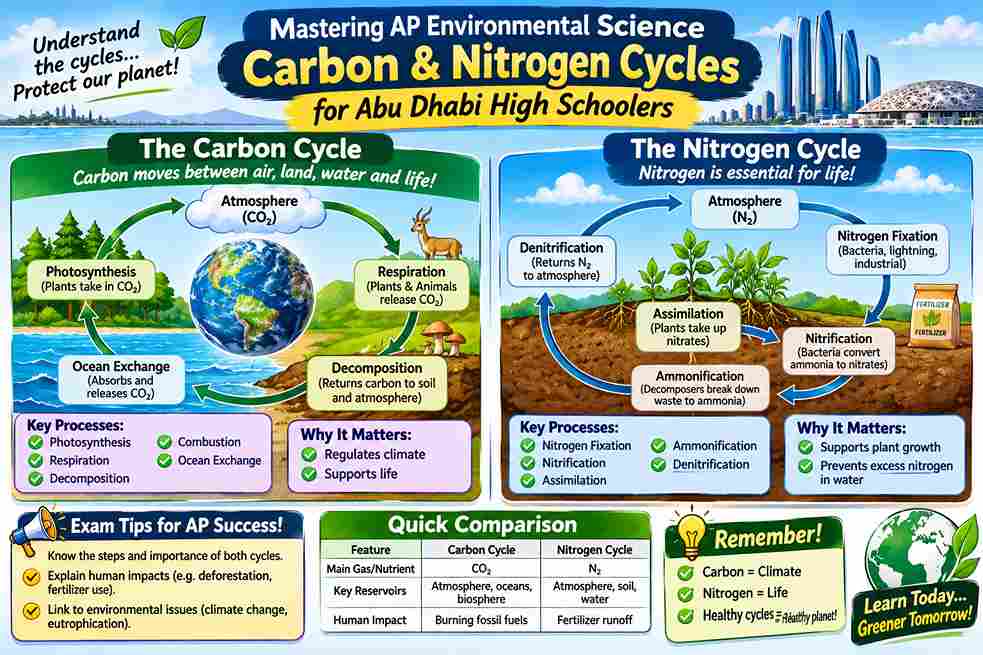
In AP Environmental Science, the global carbon cycle is organized around major carbon reservoirs and the biological, physical, and geological processes that transfer carbon among them.
Global carbon cycle reservoirs and major fluxes. Source: Made with Google AI
As shown in the carbon cycle diagram above, carbon moves continuously between the atmospheric reservoir, terrestrial biosphere and soil decomposers, fossil fuel reservoirs, and the ocean reservoir through paired processes such as photosynthesis and respiration, gas exchange, fossilization, and combustion [image_agent_tag_9452854311623430178]
Major Carbon Reservoirs & Residence Times:
- Sedimentary Rocks & Fossil Fuels (Largest Long-Term Reservoir): Limestone (CaCO3\text{CaCO}_3CaCO3), coal, oil, and natural gas store the vast majority of Earth's carbon over geological timescales (millions of years).
- Oceans (Largest Active Surface Reservoir): Dissolved inorganic carbon (CO2\text{CO}_2CO2, carbonic acid H2CO3\text{H}_2\text{CO}_3H2CO3, bicarbonate HCO3−\text{HCO}_3^-HCO3−, and carbonate CO32−\text{CO}_3^{2-}CO32−) plus marine organisms and deep-ocean sediments.
- Soil Organic Matter & Permafrost: Dead organic matter, humus, and peat decomposed slowly by soil microbes.
- Terrestrial Biomass & Atmosphere: Living plants/animals and atmospheric CO2\text{CO}_2CO2 / CH4\text{CH}_4CH4 (methane), which exchange rapidly via biological processes.
Fast vs. Slow Carbon Cycle Comparison
| Feature | Fast (Biological) Carbon Cycle | Slow (Geological) Carbon Cycle |
|---|---|---|
| Timescale | Days, seasons, to decades. | Millions of years. |
| Core Fluxes | • Photosynthesis: Removes atmospheric to build glucose. • Cellular Respiration & Decomposition: Returns (and in anaerobic wetlands) to the atmosphere. | • Sedimentation & Burial: Marine shells () and buried organic matter form limestone and fossil fuels. • Volcanism & Weathering: Slowly releases or draws down . |
| Human Disruption | Deforestation and land-use change reduce photosynthetic carbon uptake and release stored biomass carbon. | Extracting and combusting fossil fuels transfers carbon locked away for millions of years into the atmosphere in decades. |
Part 2: The Nitrogen Cycle — Five Essential Steps & Chemical Forms
Although nitrogen gas (N2\text{N}_2N2) makes up roughly 78%78\%78% of Earth's atmosphere, plants and animals cannot use N2\text{N}_2N2 directly because of the strong triple covalent bond between nitrogen atoms. Plants rely primarily on specialized bacteria (and lightning/industrial processes) to convert N2\text{N}_2N2 into biologically available forms—making nitrogen a frequent limiting nutrient in terrestrial and marine ecosystems.
The five chemical transformations of the nitrogen cycle. Source: Budi Sudarmanto / Getty Images
As illustrated in the nitrogen cycle diagram above, nitrogen cycles through five distinct biochemical stages driven largely by soil and aquatic bacteria [image_agent_tag_9452854311623432533]
              THE 5-STEP NITROGEN CYCLE SEQUENCE (APES UNIT 1.5)
                                     |
  1. NITROGEN FIXATION:  N₂  --->  NH₃ / NH₄⁺   (Nitrogen-fixing bacteria e.g. Rhizobium in legume
                                                 root nodules, cyanobacteria, or lightning/Haber-Bosch)
  2. NITRIFICATION:      NH₄⁺ ---> NO₂⁻ ---> NO₃⁻ (Aerobic nitrifying bacteria convert ammonium to
                                                 nitrite and then plant-available nitrate)
  3. ASSIMILATION:       NO₃⁻ / NH₄⁺ ---> Organic N (Plants absorb nitrate/ammonium via roots to build
                                                 amino acids, proteins, & nucleic acids; animals eat plants)
  4. AMMONIFICATION:     Organic N ---> NH₄⁺    (Decomposers—bacteria & fungi—break down waste and
                                                 dead organisms back into ammonium)
  5. DENITRIFICATION:    NO₃⁻ ---> N₂ (and N₂O) (Anaerobic denitrifying bacteria in waterlogged soils
                                                 convert nitrate back into atmospheric nitrogen gas)
Quick Memory Anchor: "FIX – NIT – ASSIM – AMMON – DENIT"
- Fixation: N2→NH3/NH4+\text{N}_2 \to \text{NH}_3 / \text{NH}_4^+N2→NH3/NH4+ (puts nitrogen into usable soil form).
- Nitrification: NH4+→NO2−→NO3−\text{NH}_4^+ \to \text{NO}_2^- \to \text{NO}_3^-NH4+→NO2−→NO3− (oxidizes ammonium into nitrate).
- Assimilation: NO3−→Proteins / DNA\text{NO}_3^- \to \text{Proteins / DNA}NO3−→Proteins / DNA (incorporates nitrogen into living tissues).
- Ammonification: Dead Biomass / Waste→NH4+\text{Dead Biomass / Waste} \to \text{NH}_4^+Dead Biomass / Waste→NH4+ (recycles organic nitrogen back to ammonium).
- Denitrification: NO3−→N2\text{NO}_3^- \to \text{N}_2NO3−→N2 (returns nitrogen gas to the atmosphere in low-oxygen soils).
Part 3: Local Context for Abu Dhabi APES Students
Applying APES concepts to real ecosystems in Abu Dhabi and the Arabian Gulf sharpens your ability to tackle unfamiliar FRQ stimulus scenarios:
- Coastal Mangroves & "Blue Carbon" Sinks: Abu Dhabi's coastal mangrove habitats (such as Jubail Mangrove Park and Mangrove National Park) capture and store carbon at high rates in waterlogged, oxygen-poor coastal sediments—slowing aerobic decomposition and locking organic carbon away for centuries unless disturbed by coastal dredging.
- Ocean Acidification & Carbonate Chemistry: As atmospheric CO2\text{CO}_2CO2 rises, oceans absorb excess CO2\text{CO}_2CO2, forming carbonic acid (H2CO3\text{H}_2\text{CO}_3H2CO3) and increasing hydrogen ion (H+\text{H}^+H+) concentration—lowering ocean pH and reducing carbonate ions (CO32−\text{CO}_3^{2-}CO32−) needed by coral reefs and calcifying organisms.
- Arid Soils & Agricultural Fertilizer Runoff: Arid sandy soils naturally contain low organic matter and low baseline nitrogen. When synthetic nitrate fertilizers (produced via the industrial Haber-Bosch process) are over-applied to landscaping or agriculture, excess water-soluble nitrate (NO3−\text{NO}_3^-NO3−) leaches into runoff and coastal waters—triggering algal blooms, bacterial decomposition of dead algae, hypoxia (depleted dissolved oxygen), and fish kills (cultural eutrophication).
Part 4: Full APES-Style FRQ Walkthrough
Prompt: A coastal agricultural watershed experiences heavy application of synthetic ammonium nitrate fertilizer prior to seasonal rainfall.
(a) Identify the nitrogen cycle process by which soil bacteria convert ammonium (NH4+\text{NH}_4^+NH4+) into nitrate (NO3−\text{NO}_3^-NO3−), and state one environmental condition required for this process to occur efficiently. [2 marks]
(b) Explain how excess nitrate runoff from the agricultural fields leads to decreased dissolved oxygen levels in the adjacent coastal bay. [3 marks]
(c) Describe one realistic agricultural practice farmers can implement to reduce nitrogen runoff into nearby waterways without abandoning crop production. [1 mark]
Model Scoring-Rubric Solution:
Part (a) — 2 Points:
- Process Identification (1 pt): Nitrification (carried out by nitrifying bacteria).
- Environmental Condition (1 pt): Aerobic conditions (presence of dissolved oxygen O2\text{O}_2O2 in well-aerated soil), as nitrifying bacteria require oxygen to oxidize NH4+\text{NH}_4^+NH4+ into NO2−\text{NO}_2^-NO2− and NO3−\text{NO}_3^-NO3−.
Part (b) — 3 Points:
- Algal Overgrowth (1 pt): Excess nitrate (NO3−\text{NO}_3^-NO3−) acts as a limiting nutrient in aquatic systems, stimulating rapid, excessive growth of surface algae (algal bloom / cultural eutrophication).
- Light Blockage & Plant Die-Off (1 pt): Dense surface algae block sunlight from reaching submerged aquatic plants, causing underwater plants (and eventually the short-lived algae) to die and sink.
- Aerobic Decomposition Depletes O2\text{O}_2O2 (1 pt): Aerobic bacteria decompose the large influx of dead organic matter, consuming dissolved oxygen (O2\text{O}_2O2) through cellular respiration faster than it is replenished—creating hypoxic/anoxic dead zones.
Part (c) — 1 Point:
- Mitigation Practice (1 pt): Plant vegetative riparian buffer strips along field edges/waterways to absorb excess nitrate through root assimilation before runoff enters the bay (other full-credit answers: precision/split fertilizer application, planting nitrogen-fixing cover crops such as legumes during off-seasons, or using drip irrigation to minimize leaching).
Part 5: Top 4 Exam Traps That Cost APES Students Marks
- Confusing Nitrogen Fixation with Nitrification: Nitrogen fixation starts with atmospheric N2\text{N}_2N2 and produces NH3/NH4+\text{NH}_3 / \text{NH}_4^+NH3/NH4+. Nitrification starts with NH4+\text{NH}_4^+NH4+ and produces NO2−\text{NO}_2^-NO2− and NO3−\text{NO}_3^-NO3−. Mixing up the starting molecules loses immediate MCQ and FRQ points.
- Saying "Algae Use Up All the Oxygen While Growing": During daylight, live algae actually produce oxygen via photosynthesis. Dissolved oxygen crashes after the algae die, when aerobic decomposers (bacteria) consume O2\text{O}_2O2 breaking down the dead organic matter. Always include the decomposer step on eutrophication FRQs!
- Thinking the Atmosphere Is the Largest Carbon Reservoir: Nitrogen's largest reservoir is the atmosphere (78%78\%78%), whereas Carbon's largest reservoir is sedimentary rock and fossil fuels (followed by the oceans)—not the atmosphere.
- Writing Vague Statements Like "Pollution Harms the Ecosystem": College Board rubrics award zero points for generic phrases like "bad for the environment" or "harms wildlife". Always name the exact chemical pollutant, biological mechanism, and ecological outcome.
For expert 1-on-1 online tutoring support to master AP Environmental Science biogeochemical cycles, quantitative FRQ math, and Score 5 exam strategies in Abu Dhabi, book a class on EdFlik.
Frequently Asked Questions (FAQs)
Q1: Why is nitrogen often a limiting nutrient in ecosystems even though the atmosphere is 78% nitrogen?
Ans: Atmospheric nitrogen exists as unreactive N2\text{N}_2N2 gas held together by a strong triple covalent bond that plants and animals cannot break. Ecosystems depend on nitrogen-fixing bacteria (or lightning/industrial fixation) to convert N2\text{N}_2N2 into biologically usable ammonia/ammonium (NH3/NH4+\text{NH}_3 / \text{NH}_4^+NH3/NH4+) and nitrate (NO3−\text{NO}_3^-NO3−).
Q2: Which step of the nitrogen cycle requires anaerobic (oxygen-free) conditions?
Ans: Denitrification requires anaerobic conditions. In waterlogged, oxygen-poor soils or wetland sediments, denitrifying bacteria use nitrate (NO3−\text{NO}_3^-NO3−) in place of oxygen during respiration, converting it back into atmospheric nitrogen gas (N2\text{N}_2N2) and nitrous oxide (N2O\text{N}_2\text{O}N2O).
Q3: How do burning fossil fuels and deforestation together disrupt the carbon cycle?
Ans: Burning fossil fuels transfers carbon from a slow geological reservoir into the atmosphere far faster than oceans and forests can absorb it, while deforestation removes photosynthetic carbon sinks and releases carbon stored in biomass and disturbed soils—accelerating atmospheric CO2\text{CO}_2CO2 buildup and global warming.