Mastering Cambridge IGCSE Pseudocode: How to Avoid Common Syntax Errors in Paper 2
Last Updated: September 2026 | By EdFlik Education Team
For students studying Cambridge IGCSE Computer Science (0478 / 0984), Paper 2 (Problem-Solving and Programming) is where your algorithmic logic is put to the ultimate test. While many students master flowcharts and problem decomposition easily, they frequently drop preventable marks due to minor syntax errors in their pseudocode.
Unlike real-world programming languages like Python or JavaScript—which are forgiving and packed with shortcuts—Cambridge pseudocode follows a strict, standardized specification outlined by the official guide. Examiners do not look for "general logic that kinda works"; they look for exact compliance with keywords, declarations, assignments, and scoping rules.
In this comprehensive exam guide, we break down the most common syntax traps students fall into during Paper 2 and provide a clear roadmap to securing a top $A^*$ grade.
Part 1: Why Students Lose Marks in Paper 2 Pseudocode
The number one culprit behind lost marks in IGCSE pseudocode is "Syntax Soup"—the habit of accidentally mixing Python, Java, or general plain English shortcuts into an exam answer.
Because Cambridge pseudocode is a formalized specification, examiners deduct marks for incorrect assignment arrows, missing variable declarations, uncapitalized keywords, and improper array boundaries. Let's examine the core areas where students trip up and how to fix them.
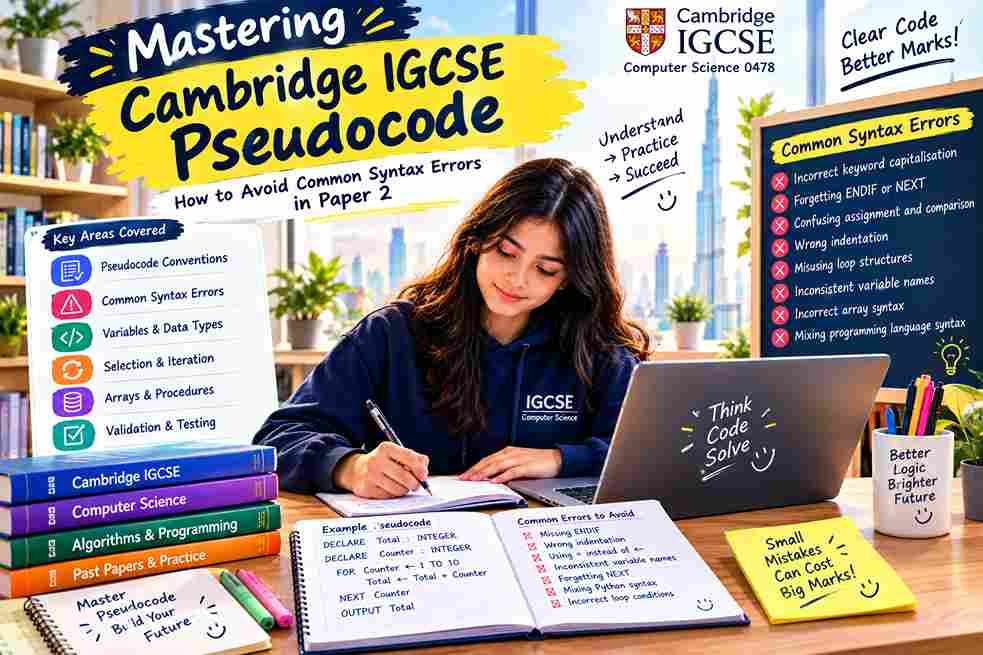
Part 2: The Top 5 Syntax Errors to Avoid
1. Using = Instead of <- for Assignment
In Python, = is used to assign values to variables. In Cambridge IGCSE pseudocode, assignment must be represented using the left arrow operator ($\leftarrow$).
- Incorrect:
Score = 10 - Correct:
Score <- 10(Note: A single equals sign=in Cambridge pseudocode is strictly reserved for relational equality checks insideIFstatements or loops, such asIF Score = 10 THEN).
2. Forgetting Variable Declarations (DECLARE)
In loose languages, you can create a variable out of thin air by typing a name and assigning a value. In official Cambridge pseudocode, good practice and syllabus standards expect variables and arrays to be declared with their explicit data types (INTEGER, REAL, CHAR, STRING, BOOLEAN):
- Incorrect:
Total <- 0(without declaring)
Correct:Plaintext
DECLARE Total : INTEGER
Total <- 0
3. Messing Up Array Index Bounds
Arrays in Cambridge IGCSE are traditionally 1-indexed (starting at element 1, unlike Python which starts at 0). Furthermore, arrays must be declared explicitly with their lower and upper bounds.
- Incorrect:
DECLARE Scores : ARRAY[10] OF INTEGER - Correct:
DECLARE Scores : ARRAY[1:10] OF INTEGER
4. Forgetting THEN, ENDIF, and DO in Loops
Control structures have strict closing keywords. Missing an ENDIF or forgetting the DO keyword in a pre-condition loop will cost you structural marks.
- The WHILE Loop Trap:
- Incorrect:
WHILE Counter < 10 - Correct:
WHILE Counter < 10 DO...ENDWHILE
- Incorrect:
- The IF Statement Trap: Always ensure multi-line selections conclude with
ENDIF.
5. Confusing String Concatenation Operators
When joining text strings and variables together in an OUTPUT statement, Cambridge pseudocode uses the ampersand (&) or commas. Mixing up string formatting can result in syntax flags.
Correct Example:Plaintext
OUTPUT "Your total score is ", Score
// OR using concatenation
OUTPUT "Your total score is " & NUM_TO_STRING(Score)
Part 3: Quick Reference Checklist for Paper 2
Before handing in your exam paper, run your pseudocode answers through this quick syntax checklist:
- Are keywords capitalized? (e.g.,
IF,THEN,ELSE,ENDIF,FOR,TO,NEXT,WHILE,DO,ENDWHILE) - Are variable names in mixed case (CamelCase)? (e.g.,
MaxScore,StudentName) - Did you use
DIVandMODcorrectly? Remember that10 DIV 3gives whole number quotient (3), while10 MOD 3gives the remainder (1). - Are subroutines structured properly? Remember that functions must use
RETURNand procedures are invoked using theCALLkeyword.
Preparing for Cambridge IGCSE Computer Science Paper 2 or striving for top grades across international school curricula? EdFlik connects students globally with expert, 1-to-1 online computer science tutors specializing in pseudocode tracing, algorithm design, and exam technique.Book a Free Demo Class Today!
Frequently Asked Questions (FAQs)
Q1: Can I write my Cambridge IGCSE pseudocode answers in Python or Java instead?
Ans: No. Examiners strictly mark against the official Cambridge pseudocode specification. Using Python syntax (like print(), len(), or = for assignment) will result in lost marks.
Q2: Is indentation mandatory in Cambridge pseudocode?
Ans: While minor indentation errors won't automatically zero an answer, failing to indent nested IF statements or loops makes your code difficult to trace, increasing the likelihood of logic errors and lost structure marks.
Q3: What is the difference between a PROCEDURE and a FUNCTION in exams?
Ans: A PROCEDURE performs a set of actions and does not return a direct value to the main program (and is called using CALL). A FUNCTION performs a calculation and must explicitly RETURN a single value back to the caller.
Q4: How does EdFlik support IGCSE Computer Science students?
Ans: EdFlik connects international school students worldwide with vetted, experienced 1-to-1 online tutors specializing in IGCSE Computer Science. Our sessions focus on mastering trace tables, dry-running algorithms, and writing flawless exam-standard pseudocode.