Mastering Enzyme Kinetics and Inhibition Graphs: A-Level Biology Revision Guide
Last Updated: October 2026 | By EdFlik Education Team
For high school students completing their A-Level Biology qualification—whether studying under AQA, OCR, Pearson Edexcel, or Cambridge International (CIE)—enzymes form the foundational pillar of biological chemistry. While most students quickly memorize basic concepts like activation energy, active sites, and the "lock and key" or "induced fit" models, the topic becomes challenging when it transitions into quantitative analysis: Enzyme Kinetics and Inhibition Graphs.
On A-Level exam papers, questions featuring Michaelis-Menten kinetics, Vmax, Km, competitive inhibition, non-competitive inhibition, and Lineweaver-Burk plots act as major grade differentiators. These questions require you to interpret data, analyze graphical trends, calculate initial rates of reaction, and explain molecular interactions with mathematical precision.
In this comprehensive masterclass guide, our expert A-Level biology educators break down the mechanics of enzyme kinetics, decode competitive vs. non-competitive inhibition graphs, and provide a step-by-step revision framework to help you secure an A∗ grade.
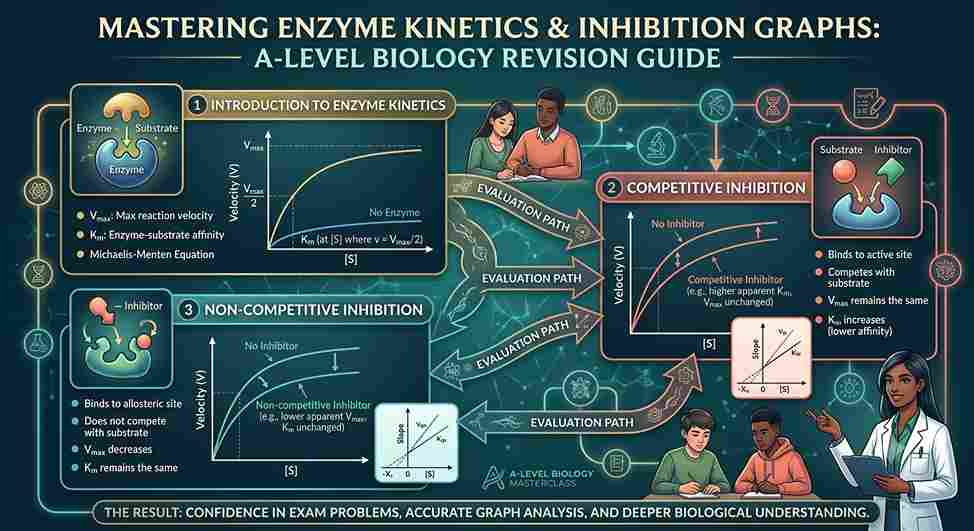
Part 1: The Core Principles of Enzyme Kinetics (Vmax and Km)
Enzymes are biological catalysts that speed up chemical reactions by lowering activation energy without being consumed in the process. To analyze how efficiently an enzyme functions, biochemists measure the rate of reaction relative to substrate concentration ([S]).
       Rate of Reaction (V)
               ^
  Vmax --------|--------------------------+ (Saturation Point)
               |                         /
     Vmax/2 ---|------------+           /
               |           /|          /
               |          / |         /
               |         /  |        /
               +--------+---+-------+------> Substrate Concentration [S]
                        0   Km
1. Maximum Velocity (Vmax)
At low substrate concentrations, the rate of reaction increases linearly because substrate concentration is the limiting factor. As substrate concentration rises, active sites become increasingly occupied. Eventually, the system reaches a point where all active sites are fully saturated with substrate molecules.
At this saturation plateau, the reaction reaches its maximum theoretical speed, known as Vmax. At Vmax, enzyme concentration becomes the limiting factor.
2. The Michaelis Constant (Km)
The Michaelis constant (Km) is defined as the substrate concentration at which the rate of reaction reaches exactly half of Vmax (21Vmax).
- Low Km Value: Indicates high affinity between the enzyme and its substrate. The enzyme requires only a low concentration of substrate to reach half its maximum velocity.
- High Km Value: Indicates low affinity between the enzyme and its substrate. A higher substrate concentration is needed to achieve half-maximum velocity.
Part 2: Demystifying Enzyme Inhibition Graphs
Inhibitors are molecules that bind to enzymes and decrease their catalytic activity. A-Level Biology syllabi focus on two primary types of reversible inhibition: Competitive and Non-Competitive.
    Rate of Reaction (V)
            ^
   Vmax ----|------------------------ (No Inhibitor)
            |                       /
            |                      /  (Competitive Inhibitor)
            |                     /  /
  Vmax/2 ---|--------------------+--/
            |                   /  /   (Non-Competitive Inhibitor)
            |                  /  /  /
            +-----------------+--+--+-----> Substrate Concentration [S]
1. Competitive Inhibition
- Molecular Mechanism: Competitive inhibitors share a similar molecular shape to the substrate. They compete directly for the enzyme's active site, blocking substrate molecules from binding and forming enzyme-substrate (E-S) complexes.
- Overcoming the Inhibitor: Because binding is reversible and competitive, adding a vast excess of substrate molecules outcompetes the inhibitor for active sites.
Graphical Characteristics (V vs. [S]):
- Vmax remains UNCHANGED: At very high substrate concentrations, the substrate outcompetes the inhibitor, allowing the enzyme to reach its original Vmax.
- Km INCREASES: Because the inhibitor lowers the apparent affinity of the enzyme for its substrate, a much higher substrate concentration is required to reach 21Vmax.
2. Non-Competitive Inhibition
- Molecular Mechanism: Non-competitive inhibitors bind to an allosteric site (a location on the enzyme other than the active site). This binding alters the tertiary structure and 3D conformation of the enzyme, changing the shape of the active site so it can no longer successfully bind substrate molecules or catalyze the reaction.
- Substrate Insensitivity: Increasing substrate concentration has no effect because the substrate cannot bind to altered active sites, regardless of how many substrate molecules are present.
Graphical Characteristics (V vs. [S]):
- Vmax DECREASES: A portion of the enzyme population is effectively rendered non-functional, lowering the total maximum rate the system can achieve.
- Km remains UNCHANGED: The remaining unaffected enzyme molecules retain their normal affinity for the substrate, meaning 21 of the new reduced Vmax is reached at the exact same substrate concentration (Km).
Part 3: Lineweaver-Burk Plots (Double-Reciprocal Graphs)
For advanced A-Level papers (such as OCR A and CIE A-Level Biology), kinetics are often displayed using a Lineweaver-Burk plot, which takes the reciprocal of both axes (V1 on the y-axis vs. [S]1 on the x-axis) to yield a straight line (y=mx+c).
        1/V (y-axis)
         ^
         |      / (Non-Competitive: Higher y-intercept, same x-intercept)
         |     /
         |    /   / (Competitive: Same y-intercept, x-intercept closer to 0)
         |   /   /
         |  /   /   / (No Inhibitor)
         | /   /   /
   ------+----+---+---------> 1/[S] (x-axis)
  -1/Km  |
Key Lineweaver-Burk Intercept Rules:
- y-intercept = Vmax1: A higher y-intercept means a lower Vmax.
- x-intercept = −Km1: An x-intercept closer to zero means a higher Km (lower affinity).
Summary Table for Lineweaver-Burk Interpretation:
| Condition | Impact | Impact | y-intercept () | x-intercept () |
|---|---|---|---|---|
| Competitive | Unchanged | Increases | Same as control | Shifts closer to zero |
| Non-Competitive | Decreases | Unchanged | Shifts higher up | Same as control |
Part 4: How to Calculate Initial Rate of Reaction
When given a graph of Product Concentration vs. Time, examiners frequently ask you to calculate the initial rate of reaction.
- Draw a Tangent at t=0: Place a ruler against the initial steep curve at time zero and draw a straight tangent line extending outward.
- Calculate the Gradient: Use the gradient formula:Gradient (Rate)=ΔxΔy=Change in TimeChange in Product Concentration
- Units: Always provide correct composite units, such as mmol dm−3 s−1 or cm3 min−1.
Part 5: Top 4 Traps That Cost Students A-Level Biology Marks
- Stating Non-Competitive Inhibitors "Denature" the Enzyme: Claiming that allosteric binding denatures the enzyme. Denaturation specifically refers to permanent structural disruption caused by extreme heat or pH. Allosteric inhibition is a controlled, reversible conformational change.
- Mishandling Reciprocals on Lineweaver-Burk Plots: Forgetting that values on a double-reciprocal graph are inverted! A point higher up on the y-axis represents a slower velocity, and an x-intercept closer to zero represents a larger Km.
- Confusing Active Sites with Allosteric Sites: Stating that competitive inhibitors bind to allosteric sites or that non-competitive inhibitors compete for active sites.
- Omitting Units in Km and Rate Calculations: Forgetting to convert time or concentration units when calculating reaction rates or reading Km values off x-axes.
Preparing for A-Level Biology exams and aiming for an $A^$ grade? EdFlik connects international school students globally with expert, 1-to-1 online A-Level biology tutors, helping you master enzyme kinetics, biochemical pathways, genetics, and structured past-paper exam techniques. *Book a Free Demo Class Today!
Frequently Asked Questions (FAQs)
Q1: What is the biological significance of a low Km value?
Ans: A low Km indicates that an enzyme has a high affinity for its substrate. This means the enzyme can operate efficiently and reach near-maximum velocity even when cellular substrate concentrations are extremely low.
Q2: Can temperature or pH changes alter Vmax and Km?
Ans: Yes. Environmental factors like temperature and pH alter enzyme tertiary structure. Extreme pH or high temperatures lower Vmax by denaturing active sites, while minor shifts can alter substrate binding affinity (Km).
Q3: Are end-product inhibition mechanisms competitive or non-competitive?
Ans: End-product inhibition (where the final product of a metabolic pathway acts as an inhibitor for the first enzyme in the pathway) is typically non-competitive (allosteric). This allows cells to regulate metabolic pathways efficiently without competing directly with initial substrates.
Q4: How does EdFlik support A-Level Biology students?
Ans: EdFlik connects international school students worldwide with vetted, expert 1-to-1 online tutors specializing in AQA, OCR, Pearson Edexcel, and Cambridge International (CIE) A-Level Biology. Our personalized coaching focuses on clarifying complex biochemical concepts, mastering graph analysis, and practicing past-paper exam technique.