Mastering IB English Paper 1: Literary Analysis Guide and Finding Expert Tutors in the UAE
Last Updated: September 2026 | By EdFlik Education Team
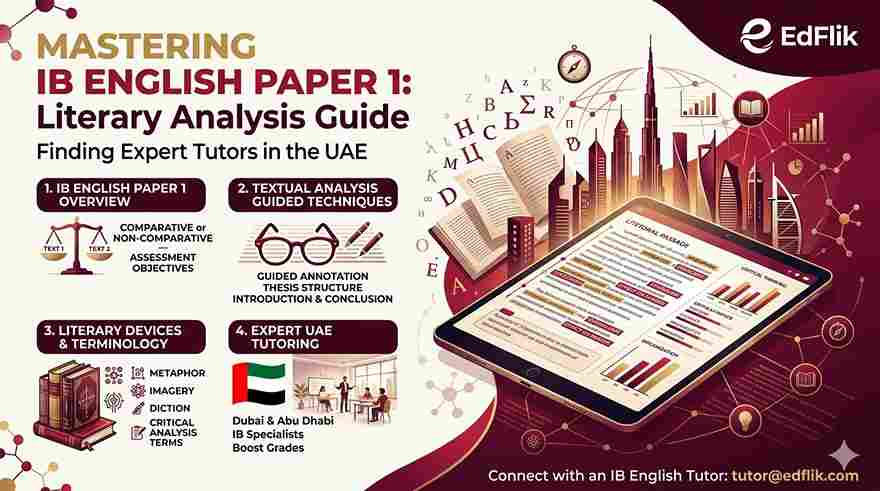
For students enrolled in the International Baccalaureate (IB) Diploma Programme (DP) studying English A: Literature or English A: Language and Literature across international schools in the UAE (including Dubai, Abu Dhabi, and Sharjah), Paper 1 is one of the most high-stakes components of the core examinations. Carrying a heavy percentage of your final grade, Paper 1 tests your ability to perform a sophisticated, unguided textual analysis of a previously unseen non-literary text (for Language and Literature) or a literary text (for Literature).
Many DP2 students struggle not because they lack analytical insight, but because they lack a rigorous, repeatable essay structure. Walking into an exam room without a clear organizational framework often results in disorganized, descriptive writing rather than a cohesive critical evaluation.
In this comprehensive guide, our expert IB English tutors break down the exact Paper 1 essay structure, share advanced literary and stylistic analysis techniques, and explain how working with an expert online IB English tutor UAE can help you secure a top Grade 7.
Part 1: Deconstructing IB English Paper 1
Paper 1 consists of a single compulsory essay based on a previously unseen text.
- For SL Students: You will be given one text (ranging from advertisements, opinion columns, and graphic novels to speeches and essays) and must write a structured analysis guided by a prompting question.
- For HL Students: You will be given a choice of two unseen texts (one non-literary, one literary extract) and must choose one to analyze without a guiding question.
The Four Assessment Criteria (The IB Rubric)
To score a Band 5 (top mark) across the rubric, your essay must excel in four distinct areas:
- Criterion A: Understanding and Interpretation: How well do you grasp the deeper meanings, authorial choices, and central message of the text?
- Criterion B: Analysis and Evaluation: How thoroughly do you analyze how the text uses stylistic devices, structural choices, and language features to create meaning? (Never just describe what the text says; analyze how it works).
- Criterion C: Focus and Organization: Is your essay logically structured, coherent, and tightly focused on your thesis?
- Criterion D: Language: Is your register formal, sophisticated, and grammatically precise?
Part 2: The Ultimate 5-Paragraph Paper 1 Essay Structure
A top-scoring Paper 1 essay follows a rigorous, analytical architecture rather than a chronological summary.
1. The Introduction (Approx. 100–120 words)
Your introduction must be sharp and purposeful. Use the AAA model:
- Author, Title, Text Type, and Context (e.g., "In the persuasive opinion column 'Digital Shadows', published in The Guardian in 2024, journalist Jane Doe...").
- Audience and Purpose: Who is the target audience, and what is the overarching purpose or message of the text?
- Argumentative Thesis: State your controlling thesis answering how the text achieves its purpose through specific stylistic choices (e.g., "Through an escalating tone of moral urgency, satirical metaphors, and a tripartite structural shift, Doe critiques modern surveillance capitalism").
2. Body Paragraphs — The Analytical Core (3 Paragraphs)
Avoid organizing your body paragraphs chronologically (e.g., "Paragraph 1 talks about the beginning of the text, Paragraph 2 talks about the middle"). Instead, organize your paragraphs thematically or by stylistic groupings:
- Paragraph 1: Focus on structural choices and opening hooks (e.g., juxtaposition, framing, or tone establishment).
- Paragraph 2: Focus on rhetorical or literary devices (e.g., imagery, diction, figurative language, or visual layout).
- Paragraph 3: Focus on the stylistic climax, shift in tone, and concluding impact.
- Structuring Each Body Paragraph (The MEAL Plan):
- Main Idea / Topic Sentence.
- Evidence: Short, embedded textual quotes or specific visual references.
- Analysis: Deconstruct how the specific words, syntax, or stylistic features create emotional or intellectual resonance.
- Link: Tie the paragraph back to your overarching thesis statement.
3. The Conclusion (Approx. 75–100 words)
- Synthesize your arguments without simply repeating your introduction word-for-word.
- Reflect on the broader implications of the text: Why does this text matter, and how effectively does it influence its audience?
Part 3: Advanced Strategies for Literary and Stylistic Analysis
Examiners heavily penalize essays that read like "feature spotting" (listing devices like “the author uses alliteration here, and a metaphor there” without explaining their effect).
1. The "So What?" Test
Whenever you identify a stylistic device, immediately ask yourself: So what? What does this make the reader feel, think, or do?
- Weak: "The author uses personification when she writes 'the city choked on its own ambition'."
- Strong: "The personification of the city as choking forces the reader to visualize urbanization not as abstract progress, but as a suffocating, self-destructive biological crisis, effectively subverting conventional narratives of economic growth."
2. Mastering Authorial Choices Terminology
Depending on whether your text is literary or non-literary, embed precise metalanguage into your analysis:
- For Literary Texts: Narrative voice, focalization, motifs, pacing, enjambment, juxtaposition, symbolism, and pathetic fallacy.
- For Non-Literary Texts: Vector lines, salience, typography, modality, ethos/pathos/logos, juxtaposition, and call-to-action.
Part 4: The Advantage of an Online IB English Tutor in the UAE
IB English A is notoriously subjective; many students struggle because school feedback can sometimes feel vague or inconsistent. Working with a specialized online IB English tutor UAE provides targeted advantages:
- Timed Essay Drills: Practicing how to annotate an unseen text and write a complete, polished essay within the strict 90-minute exam limit.
- Rubric Mastery: Reviewing your practice essays line-by-line against official IB assessment criteria to eliminate descriptive tendencies and elevate your critical analysis.
- Personalized Feedback: Tailored coaching that targets your specific weaknesses—whether that is thesis formulation, embedding quotes smoothly, or expanding your analytical vocabulary.
Part 5: Top 4 Strategies to Secure a Grade 7 in IB English Paper 1
- Spend 15 Minutes Annotating: Never start writing immediately. Dedicate the first 15 minutes to active reading: underline striking metaphors, map out structural shifts, and identify the author's primary attitude and target audience.
- Embed Quotes Seamlessly: Never drop a long quote as a standalone sentence. Weave short, punchy fragments of text directly into your own grammatical syntax.
- Maintain Objective Academic Register: Avoid casual phrases like "this makes the reader feel like..." Instead, use precise analytical verbs: highlights, evokes, underscores, challenges, problematizes, subverts, or illuminates.
- Practice Across Text Types: Do not just practice poetry or prose extracts. Ensure you are comfortable analyzing political cartoons, infographics, opinion columns, advertisements, and speeches.
Struggling to unpack unseen texts, structure your literary analysis, or manage your time during IB English Paper 1? EdFlik offers expert, 1-to-1 online tutoring customized specifically for the IB Diploma Programme, helping you build analytical confidence and secure a Grade 7.Book a Free Demo Class Today!
Frequently Asked Questions (FAQs)
Q1: Is a guiding question provided for IB English Paper 1?
Ans: For Standard Level (SL) students, a guiding question is always provided to help focus your analysis. For Higher Level (HL) students, no guiding question is provided; you must independently formulate your own line of inquiry based on the text you choose.
Q2: How long should my Paper 1 essay be?
Ans: While the IB does not enforce a strict word limit, most successful top-band Paper 1 essays range between 600 to 900 words. Quality of argument and depth of analysis matter far more than length.
Q3: Can I write about things outside the text (context)?
Ans: Paper 1 is an unguided analysis of an unseen text. You should focus entirely on textual features and internal evidence. Bringing in external historical context is generally discouraged unless it is explicitly embedded within the provided text itself.
Q4: How can EdFlik help me find an expert IB English tutor in the UAE?
Ans: EdFlik connects students across Dubai, Abu Dhabi, and the UAE with vetted, experienced 1-to-1 online tutors specializing in IB English A: Literature and Language & Literature. Our personalized sessions focus on clarifying difficult texts, mastering essay structures, and refining exam technique.