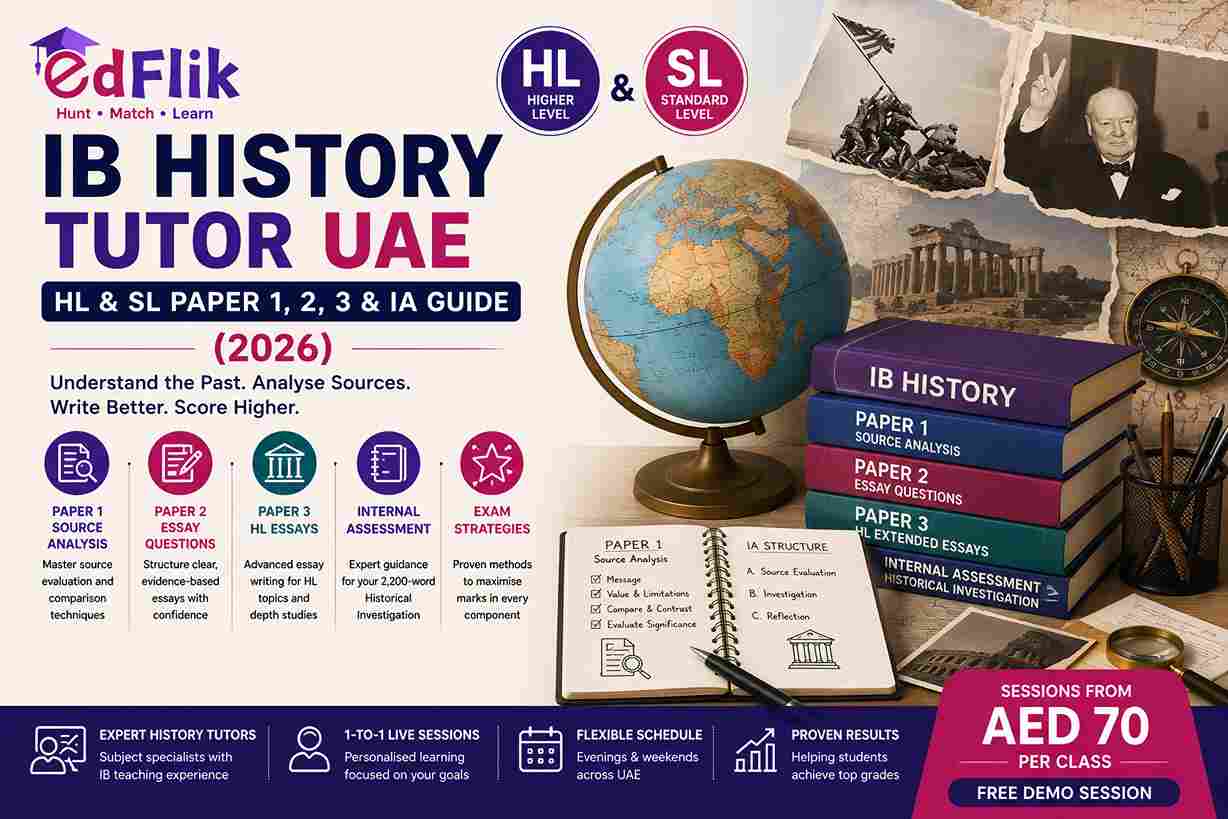
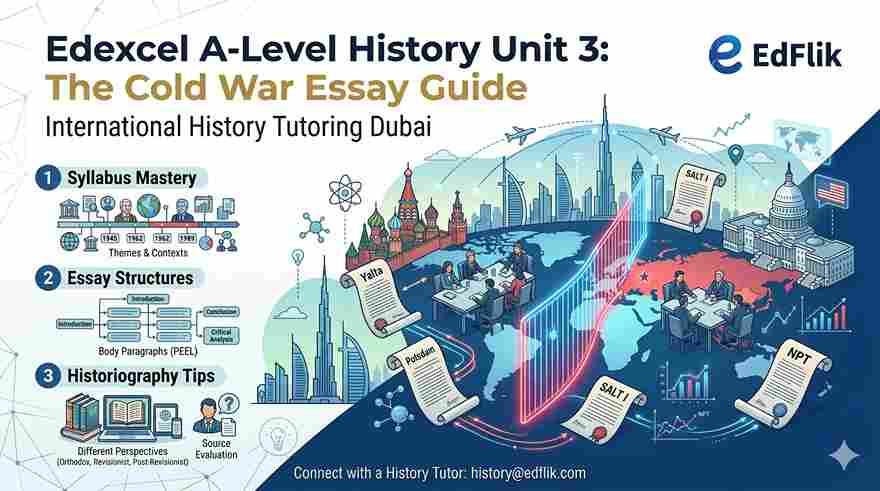
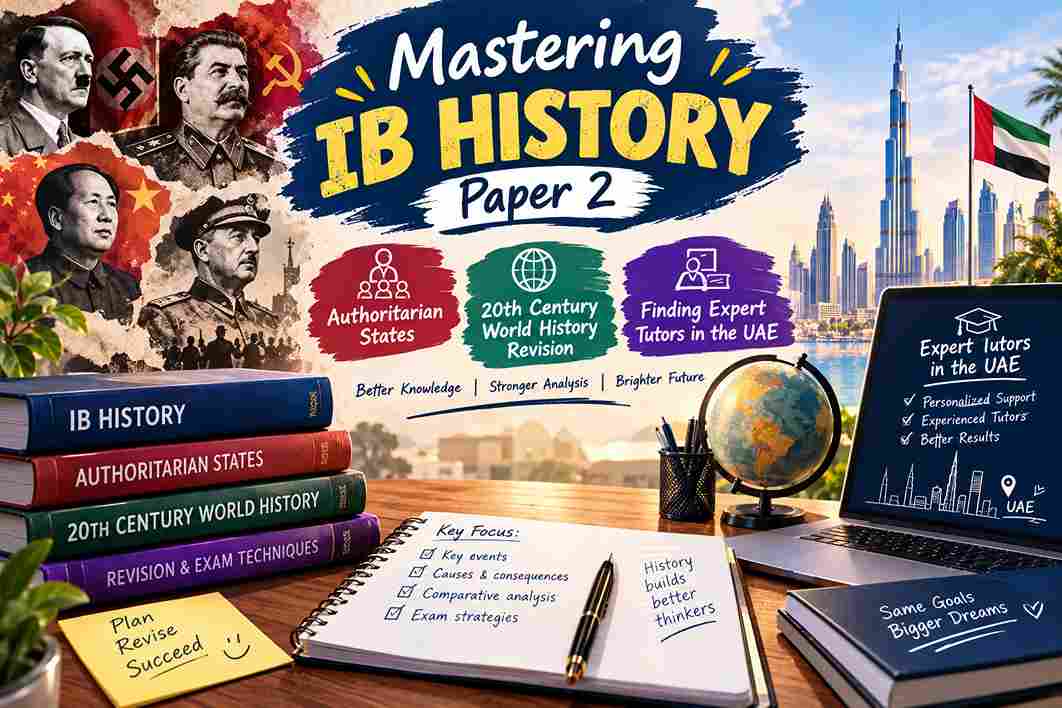
Mastering IB History Paper 2: Authoritarian States, 20th Century World History Revision, and Finding Expert Tutors in the UAE
Last Updated: September 2026 | By EdFlik Education Team
For students enrolled in the International Baccalaureate (IB) Diploma Programme (DP) studying History HL/SL across international schools in the UAE (including Dubai, Abu Dhabi, and Sharjah), Paper 2 is a formidable intellectual hurdle. Among the prescribed theme-based modules, Authoritarian States (Topic 10) stands as one of the most popular yet demanding units in twentieth-century world history.
Examining how autocratic leaders rise to power, consolidate their authority, and maintain control through ideology, coercion, and social policy requires much more than memorizing timelines and dates. Examiners reward historical analysis, comparative perspective, historiographical awareness, and structured essay architecture. Walking into an exam room with mere narrative summaries will only secure a mediocre grade.
In this comprehensive guide, our expert IB history tutors break down the essential revision framework for Authoritarian States, share advanced essay-writing strategies, and explain how working with an expert IB history tutor UAE can help you secure a top Grade 7.
Part 1: Deconstructing IB History Paper 2 — Authoritarian States
Paper 2 requires students to answer two essay questions from two different topic areas (or within prescribed regional/thematic boundaries depending on your cohort structure). For Authoritarian States, you are tested on your ability to compare and evaluate two different leaders from different regions across the twentieth century.
1. The Core Syllabus Framework (The Three Pillars)
To achieve a Band 5 across the IB History assessment criteria, your essays must systematically address three core analytical pillars:
- Pillar 1: Origins and Rise to Power (How did they emerge?)
- Conditions: Economic crises, social division, political instability, and the impact of war or foreign intervention.
- Methods: Use of force, propaganda, charismatic leadership, legal/constitutional methods, and manipulation of existing structures.
- Pillar 2: Consolidation of Power (How did they lock in control?)
- Methods: Elimination of political opposition, creation of one-party states, constitutional changes, use of terror/coercion (secret police, purges, concentration camps), and control of the media.
- Pillar 3: Policies and Impact (What was the reality of their rule?)
- Domestic Policies: Economic policies (collectivization, industrialization, autarky), social policies (education, religion, youth groups), cultural control, and the status of women and minorities.
- Foreign Policies: Successes and failures in achieving ideological or geopolitical goals.
Part 2: Essential Case Study Combinations for Comparative Success
Because IB Paper 2 essay prompts almost always demand a comparative approach (e.g., "Compare and contrast the methods used by two authoritarian states to rise to power"), selecting your case study pairings wisely during DP1 and DP2 is critical.
Recommended Pairings:
- Left-Wing vs. Right-Wing Comparison:
- Adolf Hitler (Germany) and Joseph Stalin (USSR). Excellent for comparing totalitarian consolidation, terror, and economic transformation versus racial/ideological purity.
- Anti-Colonial / Revolutionary Emergence:
- Mao Zedong (China) and Fidel Castro (Cuba). Ideal for analyzing how agrarian peasant mobilization, guerrilla warfare, and anti-imperialist rhetoric fueled a successful revolution.
- European Middle-Power Autocracy:
- Benito Mussolini (Italy) and Adolf Hitler (Germany). Perfect for comparing fascist ideological origins, parliamentary manipulation, and the gradual shift toward totalitarianism.
Part 3: Advanced Strategies for Scoring Grade 7 in IB History Essays
Examiners heavily penalize descriptive essays that read like a chronological storybook. To break into the highest mark bands, you must adopt professional historical habits.
1. The PEEL Analytical Structure
Every body paragraph must follow a rigorous academic architecture:
- Point (Clear thematic topic sentence answering the prompt).
- Evidence (Specific historical facts, statistics, names of decrees, laws, or events).
- Evaluation / Explanation (Analyzing why this evidence matters and how it supports your argument).
- Link (Connecting back to the thesis and bridging to the comparative state if required).
2. Integrating Historiography
Top-scoring essays do not treat historical interpretations as absolute truth; they recognize that history is contested. Weave named historians into your argument naturally:
- For Stalin: Compare the revisionist perspectives of Robert Conquest (focusing on terror and totalitarian control) with Sheila Fitzpatrick (focusing on social mobility and the role of the bureaucracy).
- For Hitler: Compare intentionalist historians (such as Lucy Dawidowicz, arguing Hitler had a master plan from Mein Kampf) with structuralists/functionalists (such as Ian Kershaw, arguing policies evolved through cumulative radicalization).
Part 4: The Advantage of an Specialized IB History Tutor in the UAE
IB History is notoriously rigorous; mastering the mountain of content across Paper 1, Paper 2, and Paper 3 while writing an elite Internal Assessment (IA) can lead to severe student burnout.
Partnering with an expert IB history tutor UAE provides targeted, high-impact advantages:
- Timed Essay Mastery: Practicing how to plan and execute a balanced, comparative essay within the strict 45-minute exam window.
- Historiographical Integration: Curating a concise, manageable toolkit of historian quotes and interpretations tailored specifically to your chosen case studies.
- Rubric Alignment: Reviewing your practice essays line-by-line against official IB assessment criteria to eliminate narrative fluff and elevate your critical analysis.
Part 5: Top 4 Strategies to Secure a Grade 7 in IB History
- Never Write a Narrative: If your essay tells a story chronologically from 1917 to 1939 without analyzing themes, you will lose marks. Organize your essays thematically (e.g., economic factors, political terror, ideological propaganda).
- Memorize Precise Historical Evidence: Vague assertions like "the leader used secret police to scare people" will score poorly. Use exact terminology (NKVD, Enabling Act, Reichstag Fire Decree, Committees for the Defense of the Revolution).
- Address the Command Words Directly: Pay close attention to whether the prompt asks you to evaluate, compare and contrast, to what extent, or analyze. Tailor your thesis statement to directly tackle the prompt's specific premise.
- Practice Past Paper Planning: You do not need to write 50 full-length essays before your exams, but you should outline detailed essay plans for at least 20 to 30 past paper prompts covering all three syllabus pillars.
Struggling to unpack twentieth-century authoritarian states, structure comparative essays, or integrate historiography into your IB History exams? EdFlik offers expert, 1-to-1 online tutoring customized specifically for the IB Diploma Programme, helping you build analytical confidence and secure a Grade 7.Book a Free Demo Class Today!
Frequently Asked Questions (FAQs)
Q1: How many authoritarian states do I need to study for IB History Paper 2?
Ans: While your school may cover two or three in class, you should deeply master two distinct case studies from different regions to ensure you can answer any comparative prompt on the exam paper effectively.
Q2: Is historiography mandatory for a Grade 7 in IB History?
Ans: While the official mark scheme does not use the word "historiography," Criterion A (Knowledge and Understanding) and Criterion B (Application and Interpretation) explicitly reward awareness of different historical perspectives and interpretations. Integrating named historians is the most effective way to demonstrate this.
Q3: How should I structure my comparative essay on Authoritarian States?
Ans: The most successful approach is a thematic/block-integrated structure where each body paragraph evaluates both states through a single lens (e.g., comparing how both Mussolini and Hitler utilized youth groups for ideological indoctrination). Avoid writing one massive block on State A followed by one block on State B without comparison.
Q4: How can EdFlik help me find an expert IB History tutor in the UAE?
Ans: EdFlik connects students across Dubai, Abu Dhabi, Sharjah, and the UAE with vetted, experienced 1-to-1 online tutors specializing in IB History HL/SL. Our personalized sessions focus on clarifying complex twentieth-century political movements, mastering essay structures, and refining exam technique.