Mastering IB MYP Language Acquisition Criterion A (Listening) and Criterion B (Reading)
Last Updated: September 2026 | By EdFlik Education Team
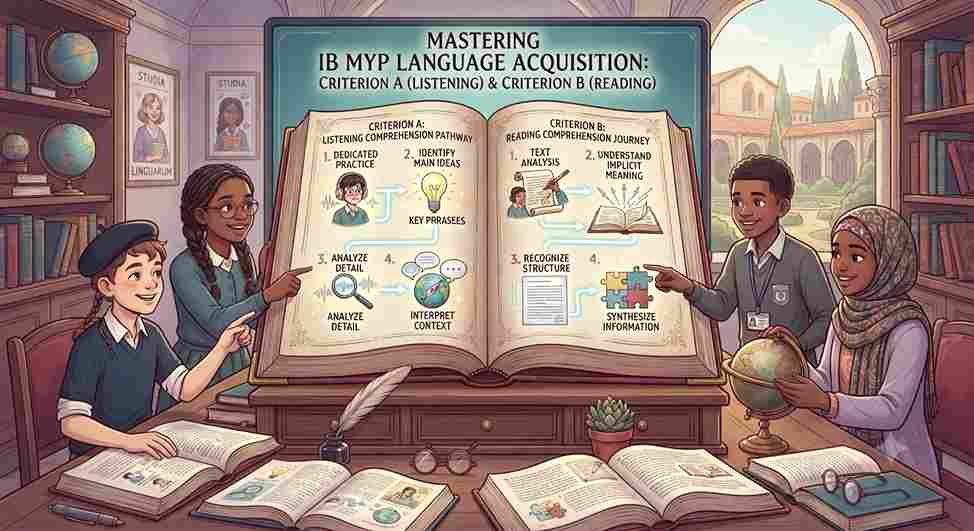
For students navigating the International Baccalaureate (IB) Middle Years Programme (MYP), Language Acquisition is a core subject group designed to build multilingualism, intercultural understanding, and global engagement. Whether you are studying an additional language at an emergent, capable, or proficient level, your receptive skills are formally evaluated through two critical pillars:
- Criterion A: Listening (Comprehending spoken and visual text)
- Criterion B: Reading (Comprehending written and visual text)
Because MYP assessment is strictly criterion-related rather than norm-referenced, scoring top marks (a Level 7 or 8) requires more than just memorizing vocabulary. You must demonstrate a thorough understanding of explicit facts, implicit meanings, text conventions, and global contexts.
In this comprehensive masterclass guide, our expert MYP language educators break down the strands of Criterion A and B, expose common student pitfalls, and share high-impact strategies to secure top marks.
Part 1: Decoding Criterion A (Listening — Comprehending Spoken and Visual Text)
Criterion A measures how well you process spoken language paired with visual elements (such as audio clips, podcasts, interviews, video segments, or presentations). Across all phases, students are assessed on three fundamental strands:
- Identifying explicit and implicit information: Pulling out factual details (who, what, when, where) as well as reading between the lines to catch underlying attitudes, tone, and unstated messages.
- Analyzing conventions: Recognizing how spoken texts are structured (e.g., the formal register of a public broadcast versus the colloquial slang of a casual podcast interview).
- Analyzing connections: Drawing links between the audio content, visual elements, and broader real-world themes or cultural contexts.
Part 2: Step-by-Step Strategies to Ace Criterion A (Listening)
1. Master the First Listen (The Global Overview)
During most MYP listening assessments, audio tracks are played two to three times.
- First Play: Do not panic trying to write down every single word. Keep your pen down or use light pencil marks. Focus entirely on the gist, main idea, and general context. Ask yourself: Who is speaking? What is the core topic? Is the tone positive, critical, or persuasive?
2. Hunt for Specific Keywords on the Second Play
- Second Play: This is when you answer targeted questions. Read through all questions before the audio starts to highlight transition keywords (dates, names, places, or question words like why, how, to what extent). When you hear matching terms in the audio, focus intensely on the surrounding sentences.
3. Do Not Ignore the Visual Elements
MYP listening texts are explicitly described as spoken multimodal texts—meaning they include visual stills, moving graphics, charts, or video gestures. Examiners award top marks when you incorporate visual clues into your comprehension responses (e.g., noting how facial expressions or background setting alter the speaker's sarcastic tone).
Part 3: Decoding Criterion B (Reading — Comprehending Written and Visual Text)
Criterion B evaluates your ability to understand, interpret, and critically engage with written and multimodal texts (such as news articles, opinion pieces, infographics, advertisements, diary entries, and literary excerpts).
The assessment strands mirror listening but focus on text-based media:
- Identifying/Analysing explicit and implicit information: Finding stated facts and interpreting writer intent, bias, and underlying subtext.
- Analyzing conventions: Recognizing format conventions (e.g., how a blog post differs structurally from a formal persuasive letter or an advertisement layout).
- Analyzing connections: Linking ideas within the text to personal experiences, global contexts, or other media sources.
Part 4: Step-by-Step Strategies to Ace Criterion B (Reading)
1. Skim First, Scan Second, Read Deeply Third
- Step 1 (Skimming): Glance at the title, subheadings, images, captions, and source attribution. This activates your prior knowledge and gives you a roadmap of what the text is about.
- Step 2 (Scanning): Read the comprehension questions first. Scan the text to locate the exact paragraphs where specific answers reside.
- Step 3 (Deep Reading): Read those targeted paragraphs closely, paying special attention to conjunctions (however, furthermore, consequently) that signal shifts in argument or tone.
2. Crack Implicit Meanings and Writer's Purpose
Top-band descriptors require you to explain why an author wrote a text, not just what they wrote.
- Look for persuasive devices, emotive vocabulary, and stylistic choices. If an advertisement uses vibrant colors and informal pronouns ("Your weekend adventure awaits"), explain how these visual and textual conventions target a younger demographic.
3. Quote Accurately and Sparingly
When a question asks you to "support your answer with evidence from the text," do not copy half a paragraph. Extract short, precise quotes and embed them smoothly into your own analytical sentences.
Part 5: Top 4 Expert Tips to Secure a Level 7 or 8
- Expand Your Authentic Vocabulary Range: Do not limit your vocabulary study to textbook glossaries. Regularly read foreign-language news websites, watch authentic foreign-language YouTube channels, and listen to native podcasts to familiarize yourself with colloquialisms and idioms relevant to your MYP phase.
- Practice Active Note-Taking: During listening exams, train yourself to write shorthand notes using symbols, abbreviations, or quick trigger words in the target language rather than trying to write full English translations.
- Pay Attention to Command Terms: Know your MYP command terms inside and out. If a question asks you to state or identify, give a brief, factual answer. If it asks you to analyze or interpret, you must break down the components and explain how or why they work.
- Review Past Marking Schemes: Look at teacher-annotated exemplars. Understanding what separates a Band 5/6 response from a Band 7/8 response helps you avoid vague answers and write with analytical precision.
Preparing for MYP Language Acquisition assessments, e-Assessments, or striving for top grades across international school curricula? EdFlik connects students globally with expert, 1-to-1 online tutors specializing in IB MYP Language Acquisition, English, Mathematics, and sciences, helping you build fluency and academic confidence.Book a Free Demo Class Today!
Frequently Asked Questions (FAQs)
Q1: How are MYP Language Acquisition phases determined?
Ans: MYP phases range from Phase 1 (Emergent) to Phase 6 (Proficient). Schools place students into phases based on their prior language learning experience, ensuring that reading and listening texts match their exact developmental level.
Q2: Can I write my answers in English during a Language Acquisition listening test?
Ans: In most MYP schools, comprehension questions for Criterion A and B are answered in English (or the language of instruction) to prove you genuinely understood the foreign text. However, always follow your specific teacher's instructions or task guidelines.
Q3: What makes a visual text important in Criterion A and B?
Ans: Multimodal texts are core to the MYP framework. Visuals (graphs, images, facial expressions, layout design) often carry implicit meaning or cultural subtext that changes how the spoken or written message is interpreted.
Q4: How does EdFlik support MYP students?
Ans: EdFlik connects students worldwide with vetted, experienced 1-to-1 online tutors specializing in IB MYP subjects. Our mentors provide targeted practice for listening and reading comprehension, formative feedback, and strategic exam prep.