Mastering Integration by Parts, Partial Fractions, and Improper Integrals in Edexcel IAL Pure Math 4
Last Updated: October 2026
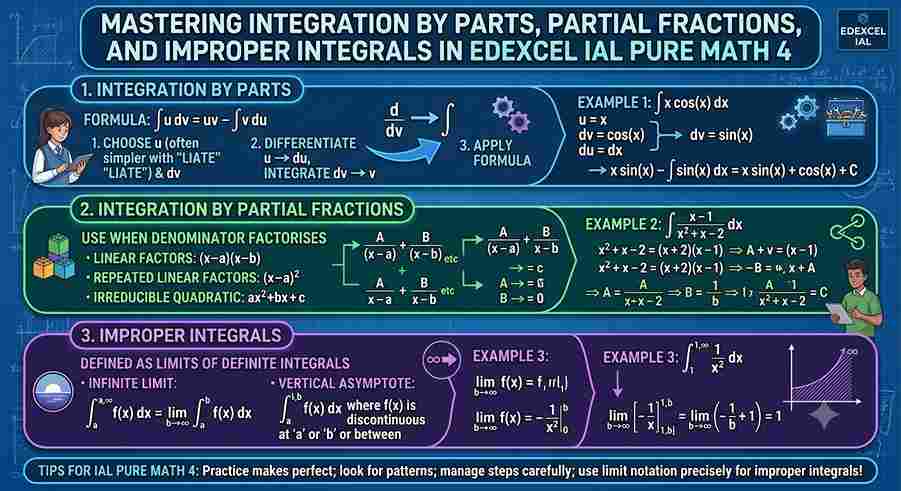
In the Pearson Edexcel International Advanced Level (IAL) Pure Mathematics 4 (WMA14/01) syllabus, integration represents the ultimate test of algebraic fluency and calculus mastery. A major source of lost marks on high-tariff P4 exam questions involves multi-stage integration problems that combine improper rational functions, partial fraction decomposition, and integration by parts.
Examiners deliberately design questions to test whether students can recognize when an algebraic fraction must first be divided before being decomposed, or when a resulting term requires integration by parts or logarithmic integration.
This comprehensive masterclass guide breaks down the core mechanics of improper integrals, partial fractions, integration by parts, step-by-step exam workflows, and top student pitfalls.
Part 1: Anatomy of an Advanced P4 Integration Problem
To successfully solve high-level P4 integration questions, you must be able to categorize the algebraic structure of the integrand and choose the correct mathematical technique at each stage.
                ADVANCED INTEGRATION METHODOLOGY FLOWCHART
                                     |
        +----------------------------+----------------------------+
        |                                                         |
1. IMPROPER FRACTION DIVISION                            2. PARTIAL FRACTION SPLIT
• Degree of Numerator ≥ Degree of Denominator            • Factorize denominator completely.
• Must perform **Polynomial Long Division**               • Express proper remainder fraction as
  or **Algebraic Inspection** first.                       sum of linear/repeated partial fractions.
        |                                                         |
        +----------------------------+----------------------------+
                                     |
        +----------------------------+----------------------------+
        |                                                         |
3. INTEGRATION METHOD SELECTION                          4. INTEGRATION BY PARTS
• Polynomial terms $\rightarrow$ Standard Power Rule.    • Use $\int u \frac{dv}{dx} dx = uv - \int v \frac{du}{dx} dx$.
• $\frac{f'(x)}{f(x)}$ terms $\rightarrow$ Natural Log ($\ln$).  • Follow **LIATE** rule to assign $u$ and $\frac{dv}{dx}$.
Part 2: Step 1 — Handling Improper Rational Functions
An algebraic fraction P(x)Q(x)\frac{P(x)}{Q(x)}Q(x)P(x) is defined as improper if the degree (highest power of xxx) of the numerator P(x)P(x)P(x) is greater than or equal to the degree of the denominator Q(x)Q(x)Q(x).
The Algebraic Identity Rule:
Before attempting partial fraction decomposition or integration, you must convert the improper fraction into a polynomial plus a proper remainder fraction:
P(x)Q(x)=Qquotient(x)+R(x)Q(x)\frac{P(x)}{Q(x)} = Q_{\text{quotient}}(x) + \frac{R(x)}{Q(x)}Q(x)P(x)=Qquotient(x)+Q(x)R(x)
Example Formulation:
If integrating x3+2x2−1x2−1\frac{x^3 + 2x^2 - 1}{x^2 - 1}x2−1x3+2x2−1, the numerator is of degree 3 and the denominator is of degree 2 (3≥23 \ge 23≥2). Dividing yields a linear quotient plus a proper remainder:
x3+2x2−1x2−1=(x+2)+x+1x2−1=(x+2)+1x−1\frac{x^3 + 2x^2 - 1}{x^2 - 1} = (x + 2) + \frac{x + 1}{x^2 - 1} = (x + 2) + \frac{1}{x - 1}x2−1x3+2x2−1=(x+2)+x2−1x+1=(x+2)+x−11
Part 3: Step 2 — Partial Fraction Decomposition
Once an improper fraction has been reduced to a proper rational remainder R(x)Q(x)\frac{R(x)}{Q(x)}Q(x)R(x), the denominator Q(x)Q(x)Q(x) must be factorized to form partial fractions.
Standard Edexcel P4 Partial Fraction Forms:
| Denominator Structure | Partial Fraction Setup |
|---|---|
| Linear Factors: | |
| Repeated Linear Factors: |
After setting up the identity, solve for constants A,B,CA, B, CA,B,C using either substitution of roots or equating coefficients. Each partial fraction can then be integrated using standard log rules or inverse power rules:
∫Ax+a dx=Aln∣x+a∣+C\int \frac{A}{x + a} \, dx = A \ln \vert{}x + a\vert{} + C∫x+aAdx=Aln∣x+a∣+C∫C(x+b)2 dx=−Cx+b+C\int \frac{C}{(x + b)^2} \, dx = -\frac{C}{x + b} + C∫(x+b)2Cdx=−x+bC+C
Part 4: Step 3 — Integrating Product Terms via Integration by Parts
When an integral involves the product of two distinct functions (e.g., algebraic ×\times× logarithmic, algebraic ×\times× exponential, or algebraic ×\times× trigonometric), apply Integration by Parts:
∫udvdx dx=uv−∫vdudx dx\int u \frac{dv}{dx} \, dx = uv - \int v \frac{du}{dx} \, dx∫udxdvdx=uv−∫vdxdudx
The LIATE Priority Mnemonic for Selecting uuu:
Always assign uuu to whichever function appears first in the LIATE order:
- L – Logarithmic functions (lnx\ln xlnx)
- I – Inverse trigonometric functions (arctanx,arcsinx\arctan x, \arcsin xarctanx,arcsinx)
- A – Algebraic functions (x,x2,3x+1x, x^2, 3x+1x,x2,3x+1)
- T – Trigonometric functions (sinx,cosx\sin x, \cos xsinx,cosx)
- E – Exponential functions (ex,e2xe^x, e^{2x}ex,e2x)
Golden Rule: Logarithms (lnx\ln xlnx) always take priority as uuu. If given ∫x2lnx dx\int x^2 \ln x \, dx∫x2lnxdx, set u=lnxu = \ln xu=lnx and dvdx=x2\frac{dv}{dx} = x^2dxdv=x2.
Part 5: Full Exam-Style Worked Example
Question: Find the exact value of the definite integral:∫23x3+x2−4x2−1 dx\int_{2}^{3} \frac{x^3 + x^2 - 4}{x^2 - 1} \, dx∫23x2−1x3+x2−4dx
Giving your answer in the form a+bln2+cln3a + b \ln 2 + c \ln 3a+bln2+cln3, where a,b,a, b,a,b, and ccc are rational constants.
Step 1: Polynomial Long Division (Improper Fraction)
The numerator x3+x2−4x^3 + x^2 - 4x3+x2−4 is of degree 3, and the denominator x2−1x^2 - 1x2−1 is of degree 2. Perform polynomial long division:
x+1(Quotient)x2−1)x3+x2+0x−4‾−(x3−x)‾x2+x−4−(x2−1)‾x−3(Remainder)\begin{array}{rl} x + 1 & \quad \text{(Quotient)} \\ x^2 - 1 \overline{\big) x^3 + x^2 + 0x - 4} & \\ \underline{-(x^3 - x)} & \\ x^2 + x - 4 & \\ \underline{-(x^2 - 1)} & \\ x - 3 & \quad \text{(Remainder)} \end{array}x+1x2−1)x3+x2+0x−4−(x3−x)x2+x−4−(x2−1)x−3(Quotient)(Remainder)
Thus:
x3+x2−4x2−1=(x+1)+x−3x2−1\frac{x^3 + x^2 - 4}{x^2 - 1} = (x + 1) + \frac{x - 3}{x^2 - 1}x2−1x3+x2−4=(x+1)+x2−1x−3
Step 2: Partial Fraction Decomposition of Remainder
Factorize the denominator: x2−1=(x−1)(x+1)x^2 - 1 = (x - 1)(x + 1)x2−1=(x−1)(x+1). Set up partial fractions:
x−3(x−1)(x+1)≡Ax−1+Bx+1\frac{x - 3}{(x - 1)(x + 1)} \equiv \frac{A}{x - 1} + \frac{B}{x + 1}(x−1)(x+1)x−3≡x−1A+x+1B
Multiply through by (x−1)(x+1)(x - 1)(x + 1)(x−1)(x+1):
x−3=A(x+1)+B(x−1)x - 3 = A(x + 1) + B(x - 1)x−3=A(x+1)+B(x−1)
- Substitute x=1x = 1x=1:1−3=A(1+1) ⟹ −2=2A ⟹ A=−11 - 3 = A(1 + 1) \implies -2 = 2A \implies A = -11−3=A(1+1)⟹−2=2A⟹A=−1
- Substitute x=−1x = -1x=−1:−1−3=B(−1−1) ⟹ −4=−2B ⟹ B=2-1 - 3 = B(-1 - 1) \implies -4 = -2B \implies B = 2−1−3=B(−1−1)⟹−4=−2B⟹B=2
So the integrand becomes:
x3+x2−4x2−1=x+1−1x−1+2x+1\frac{x^3 + x^2 - 4}{x^2 - 1} = x + 1 - \frac{1}{x - 1} + \frac{2}{x + 1}x2−1x3+x2−4=x+1−x−11+x+12
Step 3: Integrate Term-by-Term
Now integrate each term with respect to xxx:
∫(x+1−1x−1+2x+1)dx=[12x2+x−ln∣x−1∣+2ln∣x+1∣]23\int \left( x + 1 - \frac{1}{x - 1} + \frac{2}{x + 1} \right) dx = \left[ \frac{1}{2}x^2 + x - \ln\vert{}x - 1\vert{} + 2\ln\vert{}x + 1\vert{} \right]_{2}^{3}∫(x+1−x−11+x+12)dx=[21x2+x−ln∣x−1∣+2ln∣x+1∣]23
Step 4: Substitute Limits and Apply Logarithm Laws
Substitute Upper Limit (x=3x = 3x=3):
(12(3)2+3−ln∣3−1∣+2ln∣3+1∣)=(92+3−ln2+2ln4)\left( \frac{1}{2}(3)^2 + 3 - \ln\vert{}3 - 1\vert{} + 2\ln\vert{}3 + 1\vert{} \right) = \left( \frac{9}{2} + 3 - \ln 2 + 2\ln 4 \right)(21(3)2+3−ln∣3−1∣+2ln∣3+1∣)=(29+3−ln2+2ln4)
Since ln4=ln(22)=2ln2\ln 4 = \ln(2^2) = 2\ln 2ln4=ln(22)=2ln2:
=152−ln2+2(2ln2)=152+3ln2= \frac{15}{2} - \ln 2 + 2(2\ln 2) = \frac{15}{2} + 3\ln 2=215−ln2+2(2ln2)=215+3ln2
Substitute Lower Limit (x=2x = 2x=2):
(12(2)2+2−ln∣2−1∣+2ln∣2+1∣)=(2+2−ln1+2ln3)\left( \frac{1}{2}(2)^2 + 2 - \ln\vert{}2 - 1\vert{} + 2\ln\vert{}2 + 1\vert{} \right) = \left( 2 + 2 - \ln 1 + 2\ln 3 \right)(21(2)2+2−ln∣2−1∣+2ln∣2+1∣)=(2+2−ln1+2ln3)
Since ln1=0\ln 1 = 0ln1=0:
=4+2ln3= 4 + 2\ln 3=4+2ln3
Subtract Lower Limit from Upper Limit:
Value=(152+3ln2)−(4+2ln3)\text{Value} = \left( \frac{15}{2} + 3\ln 2 \right) - (4 + 2\ln 3)Value=(215+3ln2)−(4+2ln3)Value=(152−4)+3ln2−2ln3\text{Value} = \left( \frac{15}{2} - 4 \right) + 3\ln 2 - 2\ln 3Value=(215−4)+3ln2−2ln3Value=72+3ln2−2ln3\text{Value} = \frac{7}{2} + 3\ln 2 - 2\ln 3Value=27+3ln2−2ln3
Final Exact Answer: 72+3ln2−2ln3\mathbf{\frac{7}{2} + 3\ln 2 - 2\ln 3}27+3ln2−2ln3 (where a=72a = \frac{7}{2}a=27, b=3b = 3b=3, c=−2c = -2c=−2).
Part 6: Top 4 Traps That Cost Students Marks in Edexcel P4 Calculus
- Forgetting to Perform Long Division First: Attempting to decompose an improper fraction (e.g., x2x2−1\frac{x^2}{x^2 - 1}x2−1x2) directly into Ax−1+Bx+1\frac{A}{x-1} + \frac{B}{x+1}x−1A+x+1B without extracting the constant quotient first (1+1x2−11 + \frac{1}{x^2-1}1+x2−11). This leads to an algebraic collapse and zero method marks.
- Incorrect Sign Distribution on Definite Limits: Dropping negative signs when subtracting the lower limit bracket. Always write out limits inside explicit square brackets: [Upper]−[Lower][ \text{Upper} ] - [ \text{Lower} ][Upper]−[Lower].
- Misapplying Logarithm Laws on Final Expressions: Leaving answers as ln4\ln 4ln4 or ln8\ln 8ln8 when the exam paper explicitly requests single prime factors like ln2\ln 2ln2. Remember that ln(ab)=blna\ln(a^b) = b\ln aln(ab)=blna.
- Incorrect uuu Selection in Integration by Parts: Assigning u=x2u = x^2u=x2 when integrating ∫x2lnx dx\int x^2 \ln x \, dx∫x2lnxdx. Logarithms must be chosen as uuu because lnx\ln xlnx cannot be integrated directly without using integration by parts itself!
Frequently Asked Questions (FAQs)
Q1: How do I identify whether a fraction is proper or improper?
Ans: Look at the highest power of xxx in the numerator versus the denominator. If the top power is equal to or greater than the bottom power, it is improper and requires division before partial fractions.
Q2: Is the Integration by Parts formula provided in the Edexcel IAL formula booklet?
Ans: Yes! The formula ∫udvdx dx=uv−∫vdudx dx\int u \frac{dv}{dx} \, dx = uv - \int v \frac{du}{dx} \, dx∫udxdvdx=uv−∫vdxdudx is printed in the official Pearson Edexcel IAL Formulae Booklet. However, choosing uuu and vvv correctly requires memory of the LIATE rule.
Q3: When should I use substitution instead of integration by parts?
Ans: Use substitution when the integrand contains a composite function alongside a multiple of its derivative (e.g., ∫x(x2+3)4 dx\int x(x^2 + 3)^4 \, dx∫x(x2+3)4dx). Use integration by parts when integrating the product of two unrelated function types (e.g., xexx e^xxex or xcosxx \cos xxcosx).
More on A-Level
- A-Levels in the UAE: A Complete Guide to Boards, Subjects, Exams and University Entry
- Conquering Edexcel IAL Pure Math 3 Trigonometric Identities and Partial Fractions: A Masterclass Guide
- Mastering Radians, Sectors, and Arcs: Edexcel IAL Pure Math 1 Exam Masterclass
- Edexcel IAL P4 Revision Notes: Mastering Integration by Parts + Practice Questions & Tutoring Support in Abu Dhabi
- All A-Level articles