Mastering the IGCSE MFL Speaking Exam: French Oral Practice Tips and Expert Tutoring Support in Dubai
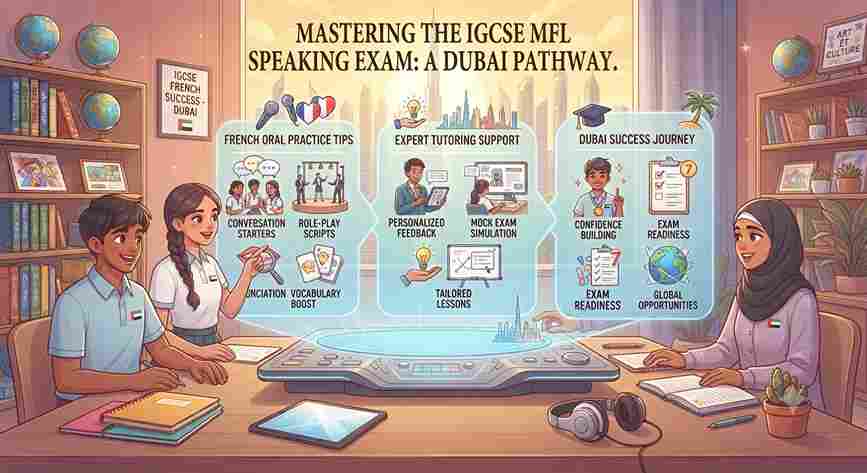
Last Updated: September 2026 | By EdFlik Education Team
For students studying Modern Foreign Languages (MFL)—such as French, Spanish, or German—across international schools in Dubai and the wider UAE, the speaking (oral) examination is often the most nerve-wracking component of the IGCSE or GCSE curriculum. Whether you are following the Cambridge (0520) or Pearson Edexcel (4FR1) specification, the speaking exam accounts for a substantial 25% of your final grade.
While students frequently spend hours practicing past reading and writing papers, oral fluency requires active, real-time linguistic agility, spontaneous reaction, and confident pronunciation.
In this comprehensive guide, our expert MFL educators break down the format of the IGCSE French speaking assessment, share high-impact oral practice strategies, and explore how specialized foreign language tutoring in Dubai can help you secure that top $A^*$ grade.
Part 1: Deconstructing the IGCSE French Speaking Exam Format
Knowing your enemy is half the battle. While exact formats vary slightly between Cambridge and Edexcel, an IGCSE French speaking test typically spans 10 to 15 minutes and is structured into distinct sections:
- Part 1: Role-Play (approx. 2–3 minutes): You act out a simulated scenario with your teacher or examiner (e.g., booking a hotel room, buying train tickets, or discussing plans with a friend). You must respond to five distinct tasks, including one surprise question that tests your spontaneous reaction.
- Part 2: Topic Presentation/Discussion (approx. 4–5 minutes): You present a short prepared topic relating to your personal life, hobbies, or cultural background, followed by a spontaneous conversation expanding on the themes.
- Part 3: General Conversation (approx. 5–7 minutes): A wider discussion covering two or three general syllabus themes (such as daily routine, school life, travel, future plans, or global issues). You are tested on your ability to narrate in past, present, and future time frames.
Part 2: Top 6 French IGCSE Oral Practice Tips
To turn exam anxiety into confident expression, integrate these proven preparation strategies into your weekly study routine:
1. Master the Three Time Frames (Le Présent, Le Passé, Le Futur)
Examiners award higher mark bands when you demonstrate grammatical range. Never stick solely to the present tense. For every topic (e.g., holidays), practice describing what you usually do (present), what you did last summer (perfect/imperfect tense), and what you plan to do next year (future/conditional tense).
2. Prepare "Flexible" Opinion Phrases
Instead of repeating basic phrases like "Je pense que..." (I think that...), build a bank of sophisticated opinions and connectors to elevate your register:
- “À mon avis, il est primordial de...” (In my opinion, it is essential to...)
- “En revanche, d'après moi...” (On the other hand, according to me...)
- “Ce que j’apprécie le plus, c’est...” (What I appreciate the most is...)
3. Record and Listen to Yourself (Active Shadowing)
Your brain processes spoken language differently when you talk versus when you listen. Record your mock role-plays and general conversation answers on your smartphone. Listen back to catch pronunciation errors (such as silent consonants or nasal vowels) and hesitations.
4. Practice Spontaneous Interruption Drills
The biggest fear in oral exams is freezing up during unexpected questions. Have a study partner, parent, or tutor ask you random, unscripted questions related to your themes. Train yourself to use fillers smoothly if you need a second to think (e.g., "C'est une question intéressante..." or "Laissez-moi réfléchir...").
5. Expand Your Vocabulary Beyond the Textbook
While textbook topics cover the basics, top-tier students use precise, topic-specific vocabulary. For environmental topics, use words like la durabilité (sustainability) or l'empreinte carbone (carbon footprint); for school topics, use le stress des examens (exam stress).
6. Focus on Intonation and Pronunciation
French is a lyrical language. Pay attention to liaisons (linking final consonant sounds to following vowels) and sentence intonation. Clear, confident pronunciation with minor grammatical slips often scores higher than hesitant, stuttered speech that is grammatically rigid.
Part 3: The Power of Specialized Foreign Language Tutoring in Dubai
Dubai is a vibrant, multicultural hub where multilingualism is a massive career asset. However, learning French or another MFL within an English-medium international school environment can make achieving native-like oral fluency challenging.
Partnering with an expert foreign language tutor in Dubai offers transformational advantages:
- Immersive 1-to-1 Conversation Practice: Eliminating classroom self-consciousness and giving you 100% speaking time during sessions.
- Targeted Pronunciation Correction: Correcting subtle phonetic habits that school teachers may miss in large classes.
- Mock Exam Simulation: Replicating strict exam conditions so you walk into your oral assessment calm, prepared, and ready to excel.
Preparing for your IGCSE French or MFL speaking exams in Dubai? EdFlik connects students across Dubai, Abu Dhabi, and the UAE with expert native and bilingual foreign language tutors, helping you build flawless oral fluency and secure top $A^$ grades.*Book a Free Demo Class Today!
Frequently Asked Questions (FAQs)
Q1: Can I bring notes or cue cards into the IGCSE French speaking exam?
Ans: For the role-play and general conversation sections, no notes or cue cards are permitted. For the prepared presentation topic, some exam boards permit brief heading notes on a cue card, but relying on memorized scripts is heavily penalized by examiners.
Q2: What should I do if I don't understand a question asked by the examiner?
Ans: Do not panic or stay silent! Practice polite French phrases to ask for repetition or clarification, such as "Pourriez-vous répéter s'il vous plaît?" (Could you repeat please?) or "Désolé, je n'ai pas bien compris." (Sorry, I didn't understand well). Examiners appreciate communication management.
Q3: How are accents and spelling tested in a speaking exam?
Ans: While spelling is not tested in an oral exam, your pronunciation of vowels and consonants is. Mispronouncing words can sometimes alter the meaning entirely (e.g., confusing ou where with o or an with en), so crisp articulation is essential.
Q4: How does EdFlik support MFL students in Dubai?
Ans: EdFlik connects international school students across Dubai with experienced 1-to-1 online and in-person tutors specializing in IGCSE and IB French, Spanish, and German. Our lessons focus on conversational confidence, grammatical accuracy, and full mock exam preparation.