Mastering Transition Metal Complex Ions and Color Changes: Edexcel IAL Chemistry Unit 5
Last Updated: October 2026 | By EdFlik Education Team
For high school students completing the Pearson Edexcel International Advanced Level (IAL) Chemistry qualification, Unit 5 (General and Industrial Chemistry - Transition Metals) is widely regarded as one of the most intellectually demanding modules on the specification. While foundational physical and organic chemistry topics build upon earlier GCSE knowledge, Unit 5 introduces advanced descriptive chemistry, complex ion coordination mechanics, d-orbital splitting, and intricate color-change equations.
Every exam season, students lose valuable marks not because they fail to memorize transition metal colors, but because they confuse ligand exchange reactions with precipitation steps, misidentify coordination numbers, or struggle to explain the quantum mechanics behind why transition metal complexes are colored.
In this comprehensive, exam-focused masterclass guide, our expert Edexcel IAL chemistry educators break down the core properties of transition metals, demystify crystal field d-d transitions, map out key color changes, and provide a structured problem-solving framework to help you secure an $A^*$ grade on Paper 2 / Unit 5.
Part 1: Defining Transition Metals and Complex Ions
Before exploring color changes, you must master the precise definitions tested by Pearson Edexcel examiners.
1. What Defines a Transition Element?
A transition element is defined as a d-block element that forms one or more stable ions with incompletely filled d-subshells.
- The Classic Edexcel Trap: Scandium ($\text{Sc}$) and Zinc ($\text{Zn}$) are d-block elements, but they are not true transition metals!
- Scandium forms only $\text{Sc}^{3+}$, which has an empty d-subshell ($3d^0$).
- Zinc forms only $\text{Zn}^{2+}$, which has a completely full d-subshell ($3d^{10}$).
- Neither forms ions with partially filled d-orbitals; hence, neither exhibits typical transition metal characteristics like colored ions or variable oxidation states.
2. Complex Ions and Ligands
A complex ion consists of a central metal ion bonded to one or more surrounding molecules or anions called ligands via coordinate (dative covalent) bonds.
- Ligand: An ion or molecule with at least one lone pair of electrons that it can donate to the central metal ion.
- Coordination Number: The total number of coordinate bonds formed between ligands and the central metal ion. (Common coordination numbers in Edexcel IAL are 6 [octahedral] and 4 [tetrahedral or square planar]).
Classification of Ligands:
- Monodentate: Donates one pair of electrons per ligand molecule (e.g., $\text{H}_2\text{O}, \text{NH}_3, \text{Cl}^-$).
- Bidentate: Donates two pairs of electrons per ligand molecule, occupying two coordination sites (e.g., ethanedioate ion $\text{C}_2\text{O}_4^{2-}$ or 1,2-diaminoethane $\text{H}_2\text{NCH}_2\text{CH}_2\text{NH}_2$).
- Polydentate / Multidentate: Donates multiple electron pairs (e.g., EDTA$^{4-}$ acts as a hexadentate ligand, forming six coordinate bonds).
Part 2: Why Are Transition Metal Complexes Colored? (d-d Transitions)
One of the most fascinating features of transition metal chemistry is the vibrant array of colors displayed by their complex ions. Exam questions frequently demand a 3-mark or 4-mark written explanation of this phenomenon.
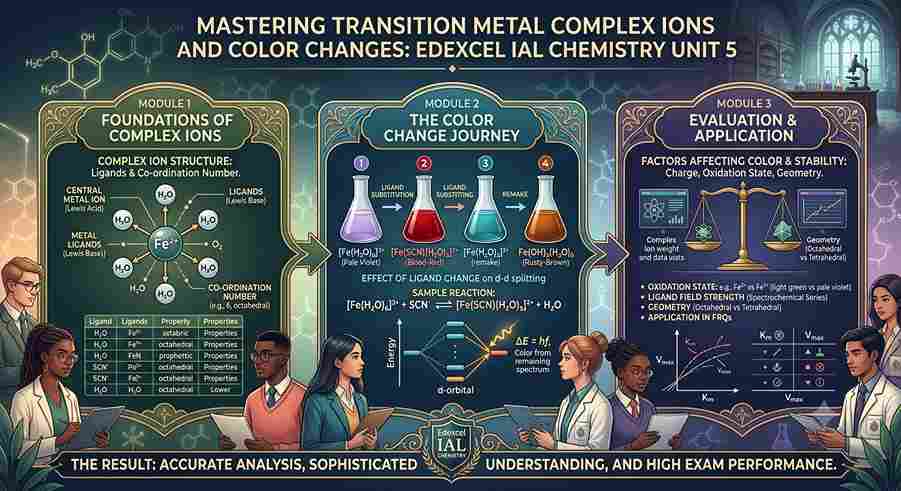
                  THE MECHANISM OF COLOR IN TRANSITION METALS
                                       |
    +----------------------------------+----------------------------------+
    |                                  |                                  |
 Ligands Approach Central Ion     d-Orbitals Split into Two Tiers    Visible Light Absorbed
 Electric field from ligands        Energy gap ($\Delta E$) created    Electron promotes (d-d transition)
 splits degenerate d-orbitals       matching a specific frequency      Remaining light transmitted/observed
Step-by-Step Explanation for Exam Answers:
- Degenerate d-Orbitals: In an isolated transition metal ion, all five d-orbitals have the same energy (they are degenerate).
- Ligand Approach and Splitting: When ligands approach the central metal ion, their lone pairs repel the electrons in the metal's d-orbitals, causing the d-orbitals to split into two distinct energy levels (an energy gap denoted as $\Delta E$).
- d-d Electron Transitions: Electrons in the lower d-orbitals absorb specific frequencies of visible light to be promoted into the higher d-orbitals. This process is known as a d-d transition.
- Transmitted Color: The color observed by the human eye is the complementary color of the frequencies absorbed from the visible spectrum.
Factors Affecting the Color of Complexes:
- Change in Oxidation State: (e.g., $\text{Fe}^{2+}$ vs. $\text{Fe}^{3+}$).
- Change in Coordination Number and Ligand Type: (e.g., replacing water ligands with chloride ligands alters the crystal field splitting energy $\Delta E$, shifting the wavelength of light absorbed).
Part 3: Key Ligand Exchange Reactions and Color Changes
Edexcel IAL Unit 5 papers heavily test your ability to recall precise starting colors, intermediate precipitate formations, and final solution colors during ligand substitution reactions.
1. Copper(II) Systems ($\text{Cu}^{2+}$)
- Hexaaquacopper(II) ion: $[Cu(H_2O)_6]^{2+}$ is a pale blue solution.
- Addition of Dropwise Sodium Hydroxide ($\text{NaOH}$): Forms a pale blue precipitate of copper(II) hydroxide:$$[Cu(H_2O)_6]^{2+} (aq) + 2OH^- (aq) \rightarrow [Cu(H_2O)_4(OH)_2] (s) + 2H_2O (l)$$
- Addition of Excess Aqueous Ammonia ($\text{NH}_3$): The pale blue precipitate dissolves in excess ammonia to form a deep blue solution via partial ligand exchange:$$[Cu(H_2O)_4(OH)_2] (s) + 4NH_3 (aq) \rightarrow [Cu(H_2O)_2(NH_3)_4]^{2+} (aq) + 2H_2O (l) + 2OH^- (aq)$$
- Addition of Concentrated Hydrochloric Acid ($\text{HCl}$ / $\text{Cl}^-$ ligands): Chloride ions are larger than water molecules, so only four can fit around the central copper ion (coordination number changes from 6 to 4). The solution turns yellow / green:$$[Cu(H_2O)_6]^{2+} (aq) + 4Cl^- (aq) \rightleftharpoons [CuCl_4]^{2-} (aq) + 6H_2O (l)$$
2. Cobalt(II) Systems ($\text{Co}^{2+}$)
- Hexaaquacobalt(II) ion: $[Co(H_2O)_6]^{2+}$ is a pink solution.
- Addition of Concentrated Hydrochloric Acid: Ligand exchange changes the coordination number from 6 to 4, turning the solution blue:$$[Co(H_2O)_6]^{2+} (aq) + 4Cl^- (aq) \rightleftharpoons [CoCl_4]^{2-} (aq) + 6H_2O (l)$$(Note: This equilibrium is temperature-sensitive and is a classic classroom and exam demonstration of Le Chatelier's Principle!)
3. Chromium(III) Systems ($\text{Cr}^{3+}$)
- Hexaaquachromium(III) ion: $[Cr(H_2O)_6]^{3+}$ is a violet solution (often appearing green due to impurities).
- Addition of Excess $\text{NaOH}$: Forms a green precipitate that dissolves in excess alkali to form a dark green solution containing chromate(III) ions $[Cr(OH)_6]^{3-}$, demonstrating amphoteric behavior.
Part 4: Stereoisomerism in Complex Ions
Transition metal complexes can exhibit stereoisomerism (both geometric and optical), which is a frequent source of challenging structure-drawing questions on Unit 5 exam papers.
1. Cis-Trans (Geometric) Isomerism
Occurs in complexes with restricted rotation around coordinate bonds.
- Square Planar Complexes ($[Pt(NH_3)_2Cl_2]$ - Cisplatin):
- Cis isomer: Similar ligands ($\text{NH}_3$ groups or $\text{Cl}$ atoms) are adjacent to each other on the same side. Cisplatin is a famous anti-cancer drug.
- Trans isomer: Similar ligands are positioned directly opposite each other across the central platinum ion.
- Octahedral Complexes ($[Co(H_2O)_4(Cl)_2]^+$):
- Cis: Chlorine atoms are at $90^\circ$ angles.
- Trans: Chlorine atoms are at $180^\circ$ angles across the metal center.
2. Optical Isomerism
Occurs when an octahedral complex contains bidentate ligands (such as ethanedioate ions $\text{C}_2\text{O}_4^{2-}$), resulting in non-superimposable mirror images (enantiomers) that rotate plane-polarized light.
Part 5: Top 4 Traps That Cost Edexcel Unit 5 Marks
- Confusing Coordination Numbers When Swapping Ligands: Assuming that substituting water molecules with chloride ions maintains a coordination number of 6. Because chloride ions ($\text{Cl}^-$) are bulky and negatively charged, only 4 chloride ions can fit around larger metal centers like $\text{Cu}^{2+}$ and $\text{Co}^{2+}$, changing the coordination number from 6 to 4.
- Omitting State Symbols or Square Brackets in Equations: Forgetting square brackets around complex ions or omitting charge symbols outside the brackets in chemical equations.
- Describing d-d Transitions Incompletely: Writing that "electrons jump energy levels" without specifying that d-electrons absorb visible light frequencies to transition between split d-orbitals.
- Confusing Precipitation with Ligand Exchange: Failing to distinguish between adding dropwise $\text{NaOH}$ (which forms an insoluble metal hydroxide precipitate) and adding excess $\text{NH}_3$ or $\text{OH}^-$ (which dissolves the precipitate via ligand substitution).
Preparing for Pearson Edexcel IAL Chemistry Unit 5 exams and aiming for an $A^$ grade? EdFlik connects international school students globally with expert, 1-to-1 online A-Level chemistry tutors, helping you master transition metal mechanisms, volumetric analysis, organic synthesis, and structured past-paper exam techniques. *Book a Free Demo Class Today!
Frequently Asked Questions (FAQs)
Q1: Why are some transition metal ions colorless (e.g., $\text{Sc}^{3+}$ and $\text{Zn}^{2+}$)?
Ans: Ions like $\text{Sc}^{3+}$ ($3d^0$) and $\text{Zn}^{2+}$ ($3d^{10}$) do not have partially filled d-subshells. Because there are no d-electrons available to undergo d-d transitions, they cannot absorb specific frequencies of visible light, making their solutions colorless.
Q2: How does the identity of the ligand affect the color of a complex?
Ans: Different ligands exert different electrostatic repulsions on the central metal ion's d-orbitals. This alters the magnitude of the d-orbital splitting energy ($\Delta E$). A change in $\Delta E$ changes the frequency (and wavelength) of light absorbed during d-d transitions, resulting in a different observed color.
Q3: What is the difference between a monodentate and a bidentate ligand?
Ans: A monodentate ligand (like $\text{H}_2\text{O}$ or $\text{NH}_3$) donates a single lone pair of electrons to form one coordinate bond with the central metal ion. A bidentate ligand (like $\text{C}_2\text{O}_4^{2-}$) has two separate atoms, each with a lone pair, allowing it to form two coordinate bonds per ligand molecule.
Q4: How does EdFlik support Edexcel IAL Chemistry students?
Ans: EdFlik connects international school students worldwide with vetted, expert 1-to-1 online tutors specializing in Pearson Edexcel IAL Chemistry (Units 1–6). Our personalized coaching focuses on clarifying complex descriptive chemistry, mastering transition metal mechanisms, and practicing under timed exam conditions.