Navigating Multiple Exam Boards: The Real Parent Challenge of Mid-Stream Curriculum Switching
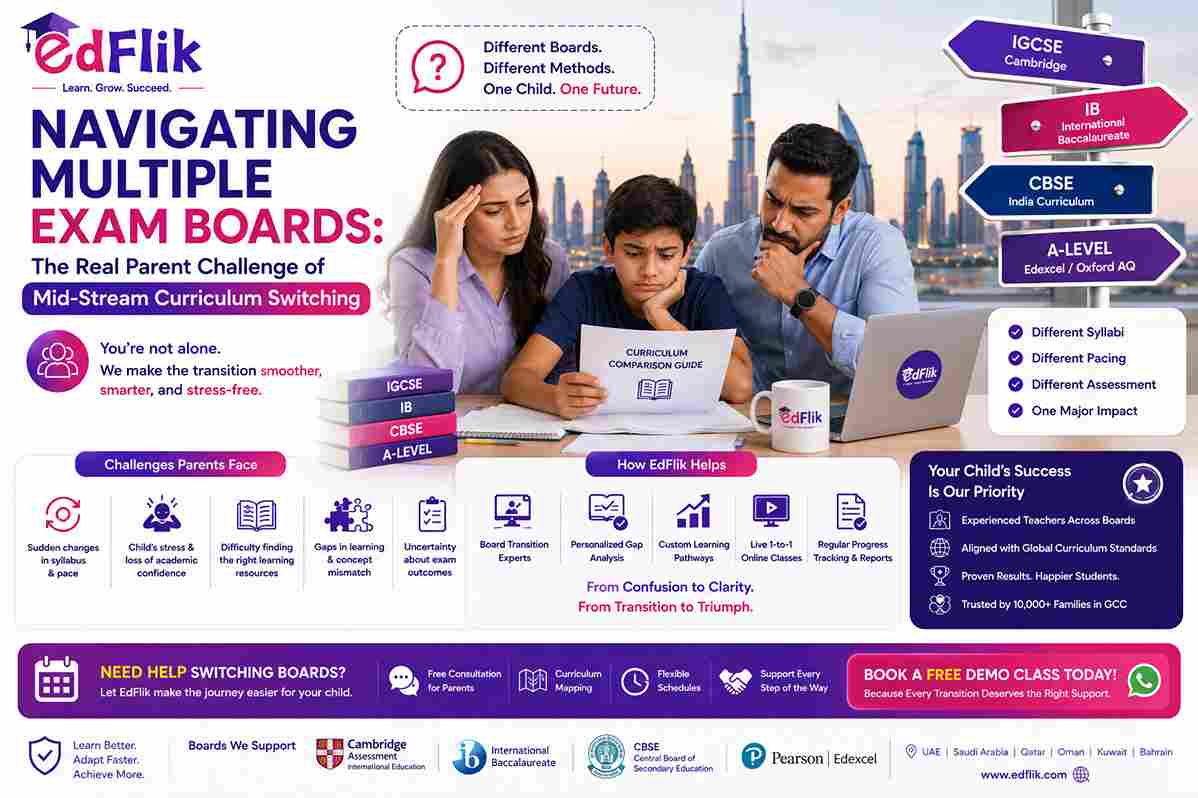
Curriculum switching is one of the most stressful education events in a GCC family's journey. Whether driven by school change, visa relocation, curriculum re-evaluation, or educational evolution, switching exam boards (IGCSE to IB, CBSE to IGCSE, AP to IB) disrupts learning continuity and creates academic anxiety for students and parents alike. Understanding the overlap, the gaps, and the recovery strategy makes the transition manageable and often becomes a positive catalyst for deeper learning.
This comprehensive guide addresses the real challenge: how to maintain academic momentum while managing curriculum transition. We'll map curriculum overlaps, identify unique demands of each curriculum, and provide tutor-backed strategies to bridge the gap. Unlike theoretical curriculum comparisons, this guide focuses on practical transition logistics that GCC families actually face.
Why Curriculum Switching Is Common in the GCC
The GCC expat population is mobile. Families relocate for work; visa policies change; school fees fluctuate; educational philosophies evolve. It's estimated that 40% of GCC expat children experience at least one curriculum switch between primary and secondary education. Schools may transition between IGCSE and IB programs; families may change schools due to relocation; Dubai schools frequently offer multiple curricula (IGCSE and IB simultaneously), forcing families to choose. These are normal GCC realities, not educational failures.
Curriculum Overlap: What Transfers, What Doesn't
IGCSE to IB (Most Common Switch): IGCSE is subject-based; IB is curriculum-based with interdisciplinary emphasis. Subjects overlap significantly (Math, Sciences, Languages, Humanities), but IB demands deeper analysis and higher-order thinking. IGCSE syllabus content (80%) transfers to IB; the additional 20% in IB involves synthesis, application, and theory of knowledge. Students switching from IGCSE to IB at age 15-16 (Grade 10-11 transition) typically spend 6-8 weeks adapting to IB's holistic demands.
CBSE to IGCSE (Regional Shift): CBSE (India-based curriculum) and IGCSE (UK-based) have less direct overlap. CBSE emphasizes rote learning and comprehensive content coverage; IGCSE emphasizes critical thinking and selective depth. Students switching CBSE→IGCSE often struggle initially with examination methodology, essay writing, and time management—not content knowledge. However, CBSE's foundational content (especially Maths, Science) transfers well; the adjustment is cognitive style more than content.
AP to IB (American to European Framework): AP courses are deep, subject-specific; IB is broader, interdisciplinary. AP students excel in exam-specific preparation; IB students develop broader understanding. Switching AP→IB means learning to make cross-subject connections; switching IB→AP means narrowing focus to specific exam boards. Direct content overlap is 60-70%; adjustment is framework and approach rather than content.
The Critical First Weeks: Recovery Strategy
When a student switches curricula mid-year, the first 2-4 weeks are critical. Educational research shows that 'curriculum shock' can reduce academic confidence by 20-30% temporarily. However, targeted tutoring during this period prevents long-term damage and accelerates recovery. EdFlik's transition tutoring focuses on three parallel tracks: (1) identifying and bridging content gaps, (2) teaching new exam board methodologies, (3) rebuilding confidence.
Week 1-2: Assessment & Gap Identification. EdFlik tutors conduct diagnostic assessments in each subject, mapping previous curriculum learning against new curriculum demands. This identifies which concepts transfer smoothly and which require reteaching. Example: A student transitioning IGCSE→IB in Physics has solid foundational mechanics (transferable), but IB demands deeper thermodynamics knowledge (gap requiring focus).
Week 3-4: Targeted Bridge Tutoring. Based on gap assessment, tutors provide intensive catch-up in missing content areas while simultaneously introducing new curriculum's teaching methodology. This dual approach prevents feeling 'behind' while maintaining learning momentum. By week 4, most students have recovered baseline confidence.
Subject-Specific Switching Challenges & Solutions
Mathematics: Switching curricula in Math is most disruptive because Math builds sequentially. IB Math demands proof understanding (not just procedure); IGCSE focuses on procedure and application. EdFlik Math tutors explicitly teach this distinction, helping students shift mindset from 'How do I solve this?' to 'Why does this method work?' Algebra, functions, and calculus transfer well; proof understanding typically requires 4-8 weeks intensive work.
Sciences (Physics, Chemistry, Biology): Conceptual foundations transfer across curricula, but depth varies. IB Science demands greater theoretical depth; AP demands exam-specific procedural knowledge; IGCSE focuses on balanced foundations. EdFlik tutors identify depth expectations for the new curriculum and scaffold accordingly. Lab practices and internal assessments differ; tutors familiarize students with new assessment formats early.
Languages: Switching language curricula is cognitively manageable (language skills transfer), but assessment methodology differs dramatically. IGCSE emphasizes structured writing and comprehension; IB requires literary analysis and written production; AP demands thematic analysis and cultural awareness. EdFlik language tutors focus on assessment methodology and style adaptation rather than language skills per se.
Timeline & Realistic Expectations
Full curriculum transition typically requires 8-12 weeks to reach comfortable competency. First 2-4 weeks are adjustment; weeks 5-8 are skill-building in new methodology; weeks 9-12 are confidence-building and depth expansion. By week 12, most students report feeling 'back on track' academically. Emotionally, confidence recovery often lags content recovery; continued tutoring through this phase maintains momentum.
Frequently Asked Questions
Q1: Will my child fall behind academically during curriculum switching?
Temporarily, yes—most students experience 2-4 week setback. However, targeted tutoring during this window prevents long-term lag. Students who transition with tutoring support often 'bounce back' by week 8-10 without permanent academic damage. Students transitioning without support may lag for 1-2 terms.
Q2: Should my child switch curricula mid-year or wait until next year?
Switching mid-year is generally less disruptive than waiting (preserves some curriculum continuity). However, switching between major assessment periods (end of term, before exams) is inadvisable. Consult your school and an EdFlik tutor on optimal timing relative to your child's assessment calendar.
Q3: Which curriculum is 'harder'—IGCSE, IB, or AP?
They're differently challenging. IB demands breadth and synthesis; AP demands subject depth; IGCSE demands balanced foundations. 'Hardness' depends on your child's cognitive strengths. Some students excel in IB's cross-curricular emphasis; others prefer AP's focused depth. A tutor's assessment can guide optimal curriculum for your child.
Q4: How much tutoring is needed during curriculum transition?
EdFlik recommends 3-4 sessions/week across subjects during the first 8 weeks, then 2-3 sessions/week ongoing. This intensive support prevents long-term lag. Some families step down tutor hours after recovery; others maintain ongoing support through exams.
Start Your Curriculum Transition with Expert Support
Sessions from AED 45, free trial at edflik.com. EdFlik tutors specialize in curriculum transitions across all exam boards.