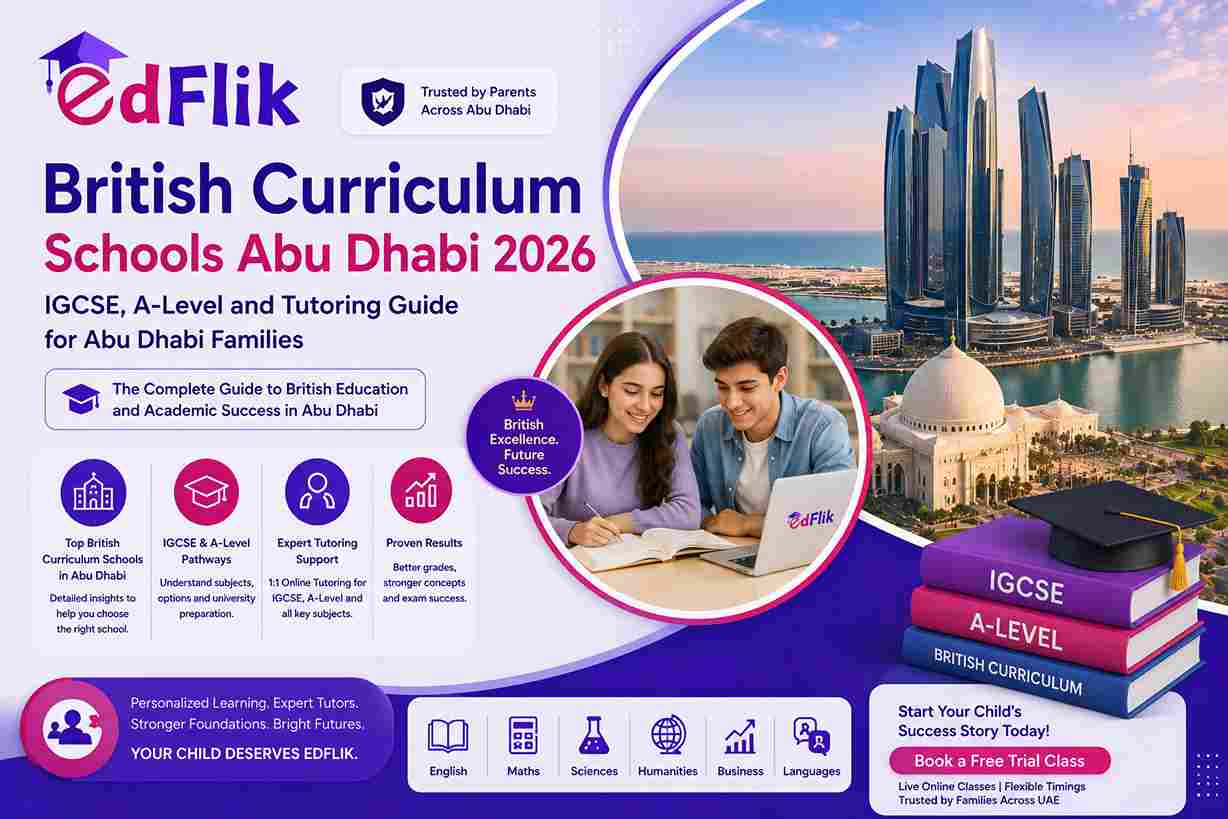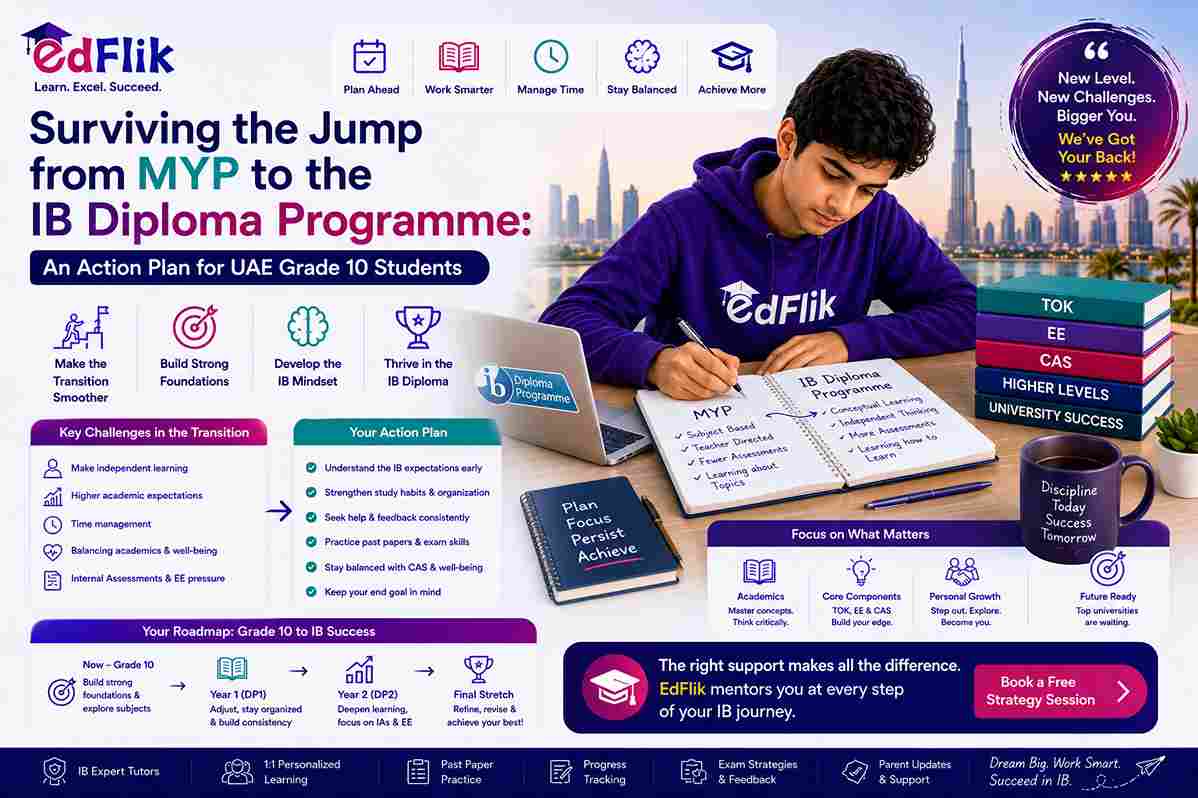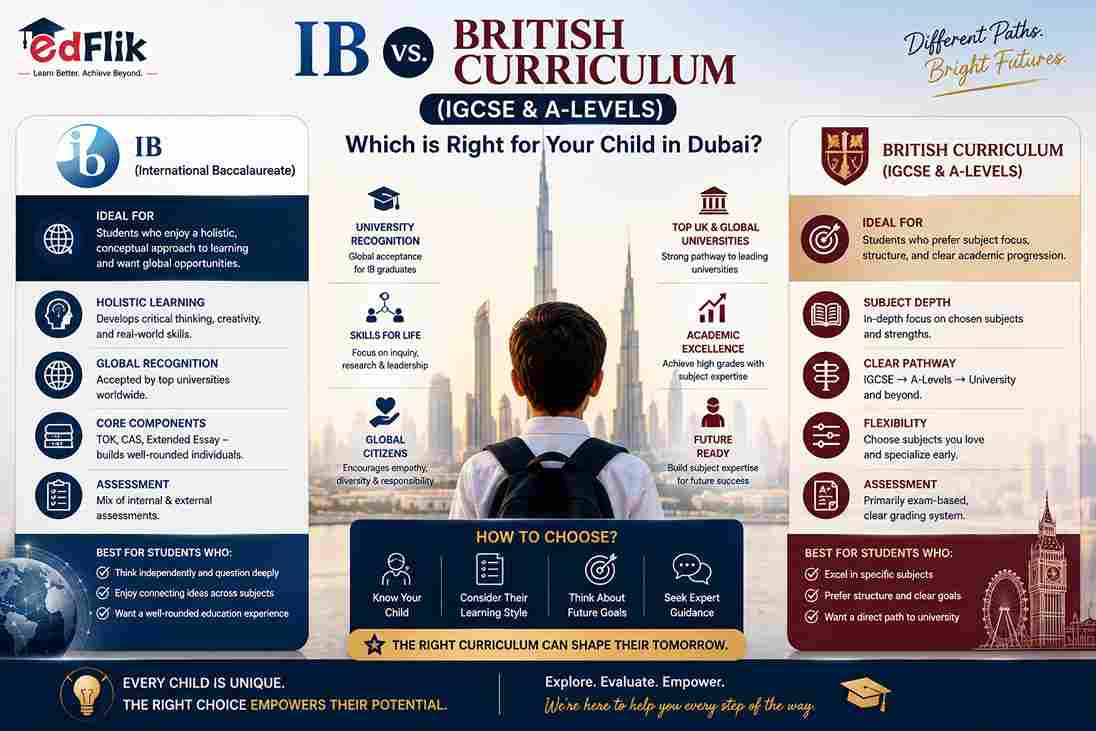
Navigating the British Curriculum: Your Ultimate Success Blueprint for Grade 10 and Year 11 (IGCSE / GCSE)

Last Updated: September 2026 | By EdFlik Education Team
For students and parents navigating the British Curriculum across international schools in the UAE, UK, and worldwide, Grade 10 and Year 11 represent the most pivotal academic milestone in secondary education: the IGCSE and GCSE examination years.
Transitioning from Key Stage 3 into these two intensive years means shifting away from general exploratory learning toward high-stakes, standardized external examinations administered by boards like Pearson Edexcel and Cambridge Assessment International Education (CAIE). The grades earned at the end of Year 11 form the academic gateway to Sixth Form, International Baccalaureate (IB) Diploma Programme entry, and eventually, top-tier universities globally.
In this comprehensive guide, our expert curriculum advisors break down the structural realities of Grade 10 and Year 11, share proven revision strategies, and explain how targeted academic support can turn exam stress into top-band $A^*$ success.
Part 1: Understanding the IGCSE / GCSE Landscape
The International General Certificate of Secondary Education (IGCSE) or GCSE is a two-year course typically spanning Grade 9/Year 10 (the foundational year) and Grade 10/Year 11 (the examination year).
1. Core Subject Structures and Tiering
- Core vs. Extended (Cambridge) / Foundation vs. Higher (Edexcel): In subjects like Mathematics and the Sciences, students are entered into tiers.
- Foundation / Core: Caps the maximum achievable grade (usually a Grade C or 5), designed for students requiring accessible foundational scaffolding.
- Higher / Extended: Unlocks the highest grades (Grades 4 through 9, or $C$ to $A^*$), designed for high-achieving students aiming for competitive university pathways.
- Coursework (NEA) vs. 100% Exam-Based Subjects: While subjects like English Literature and History rely heavily on terminal written essays, subjects like Computer Science, Art, and Design Technology may incorporate Non-Examined Assessment (NEA) or practical portfolios that count toward final marks.
Part 2: The Critical Timeline — Year 10 vs. Year 11
Success in Year 11 is built upon disciplined habits established early in Year 10.
Phase 1: Year 10 — Building the Foundation (The Concept Year)
- Focus: Mastery of core syllabus content, completing internal school assessments, and building robust laboratory or practical skills.
- The Trap: Many students treat Year 10 as a "buffer year" before exams, only to realize in Year 11 that foundational gaps in algebra, chemical bonding, or grammatical analysis have made advanced topics incomprehensible.
- Actionable Tip: Maintain organized revision notes from Day 1. Do not wait until mock exam season to summarize your textbook chapters.
Phase 2: Year 11 — The Exam Execution Year (The Revision Phase)
- Focus: Past paper drills, timing mastery, examiner report analysis, and targeted gap-filling.
- The Mock Exam Reality: January and February mock exams in Year 11 serve as realistic diagnostic tests. Universities and Sixth Forms frequently look at mock results for predicted grades during early applications.
- Actionable Tip: Shift your study ratio: spend 30% of your time reviewing textbook notes and 70% of your time actively working through past papers under strict timed conditions.
Part 3: Top 4 Strategies to Secure Top Grades ($A^*$ / Grades 8–9)
- Deconstruct Command Words: Examiners grade you based on precise instructions. Know the difference between describe (state what happens), explain (state why or how it happens using scientific/literary principles), and evaluate (weigh up evidence from multiple perspectives).
- Master the Mark Schemes, Not Just the Textbook: Knowing the content is only half the battle. Reading official Cambridge and Edexcel mark schemes teaches you the exact keywords and phrases examiners look for to award marks.
- Implement Spaced Repetition and Active Recall: Passive reading of revision guides creates an "illusion of competence." Use flashcards (Anki or physical cards) and blurting techniques (writing down everything you know from memory on a blank sheet of paper) to lock information into your long-term memory.
- Prioritize Self-Care and Sleep: Burnout is real during exam season. Consistent 7-8 hour sleep schedules, proper hydration, and structured study breaks are scientifically proven to enhance cognitive retention and reduce examination anxiety.
Part 4: Why Personalized Tutoring Matters in Year 11
With 6 to 9 subjects demanding rigorous preparation, school classrooms cannot always provide the individualized attention needed to target specific student weak spots.
Partnering with an expert 1-to-1 tutoring provider like EdFlik offers transformational advantages during Year 11:
- Customized Diagnostic Support: Pinpointing exact conceptual gaps (whether it's balancing redox equations, mastering trigonometry, or structuring English discursive essays) and fixing them immediately.
- Exam Technique Mastery: Training students how to allocate time across different sections of Paper 1 and Paper 2 without panicking.
- Unshakeable Academic Confidence: Providing a low-pressure, supportive mentorship environment where students can ask questions freely and build momentum leading up to final examinations.
Preparing for your IGCSE or GCSE exams in Grade 10 or Year 11? EdFlik offers expert, 1-to-1 online tutoring customized specifically for international school students following the British curriculum, helping you build mastery and secure top $A^$ grades.*Book a Free Demo Class Today!
Frequently Asked Questions (FAQs)
Q1: What is the difference between Edexcel IGCSE and Cambridge IGCSE?
Ans: Both are internationally recognized qualifications aligned with the British curriculum. While both cover rigorous academic standards, they are administered by different exam boards, featuring slightly different question formats, syllabus weightings, and grading scales (Edexcel uses a 9-1 scale for most subjects, while Cambridge offers both 9-1 and A*-G scales depending on the region).
Q2: How early should my child start revising for Year 11 final exams?
Ans: Structured revision should ideally begin at the start of Year 11 (September), building up to intensive past paper practice immediately after the January mock examinations.
Q3: Are IGCSE predicted grades important?
Ans: Extremely important. Schools use Year 10 end-of-year exams and Year 11 mock exam performance to generate official predicted grades, which are required for university foundation programs, local college admissions, and international Sixth Form applications.
Q4: How can EdFlik support British curriculum students in Grade 10 and Year 11?
Ans: EdFlik connects students with vetted, experienced 1-to-1 online tutors specializing in all major IGCSE and GCSE subjects (Mathematics, Sciences, English, Humanities, and Computer Science). Our personalized sessions focus on clarifying difficult topics, mastering past papers, and refining exam technique.