Navigating the IB Diploma Programme: Your Ultimate Success Blueprint for Grade 11 and DP1
Last Updated: September 2026 | By EdFlik Education Team
For students and parents stepping into Grade 11 and DP1 (Diploma Programme Year 1) across international schools in the UAE and worldwide, the International Baccalaureate is widely recognized as one of the most rigorous, holistic, and intellectually demanding pre-university frameworks in global education.
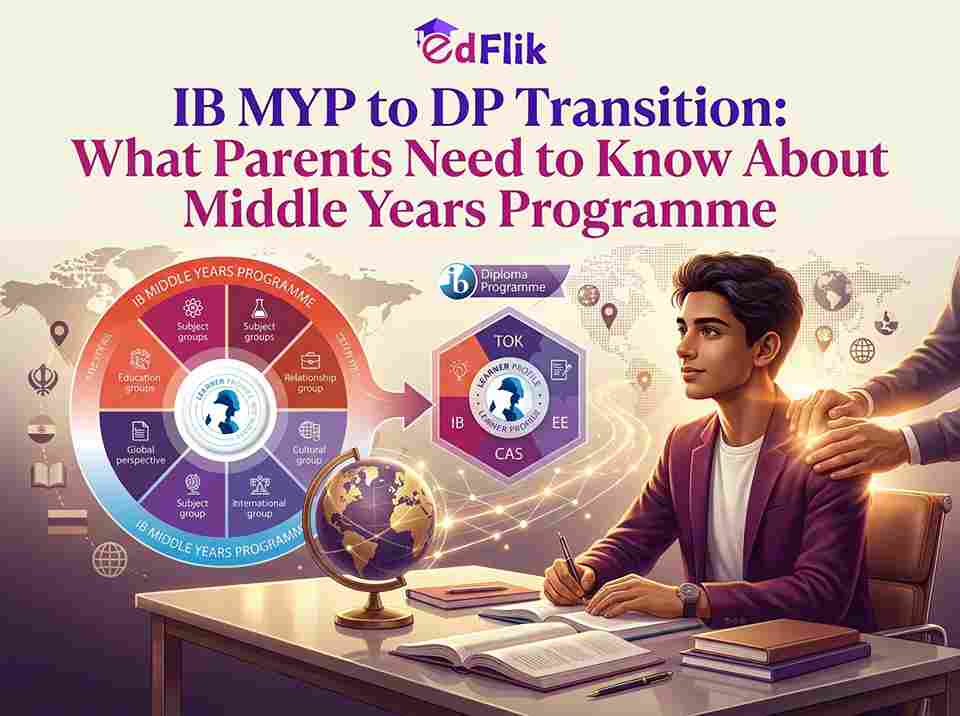
Moving away from the specialized framework of IGCSE or GCSE, DP1 requires students to balance six distinct subject groups, complete an independent Extended Essay (EE), engage in Theory of Knowledge (TOK), and fulfill the experiential requirements of Creativity, Activity, Service (CAS).
For many students, the sudden leap in academic depth, independent inquiry, and time management can feel overwhelming during the first few months. In this comprehensive guide, our expert IB curriculum advisors break down the structural realities of DP1, share proven study strategies, and explain how targeted academic support can transform early stress into top-band Grade 7 success.
Part 1: The Anatomy of the IB Diploma Programme
Unlike modular curricula where exams can be retaken semester by semester, the IB Diploma is a two-year holistic marathon culminating in terminal exams at the end of Grade 12 (DP2).
1. The Core Requirements (The Heart of the IB)
- Theory of Knowledge (TOK): A critical thinking course exploring how we know what we know, culminating in an external essay and an internal presentation.
- The Extended Essay (EE): An independent, self-directed research piece of up to 4,000 words on a topic of the student's choice from a chosen IB subject.
- Creativity, Activity, Service (CAS): A experiential learning framework that encourages students to engage in artistic pursuits, physical fitness, and community service projects.
2. Higher Level (HL) vs. Standard Level (SL) Subjects
Students choose three subjects at Higher Level (HL) and three at Standard Level (SL):
- HL Subjects: Involve greater depth, additional syllabus content, and more rigorous examination papers (usually requiring 240 teaching hours).
- SL Subjects: Provide breadth across disciplines (usually requiring 150 teaching hours).
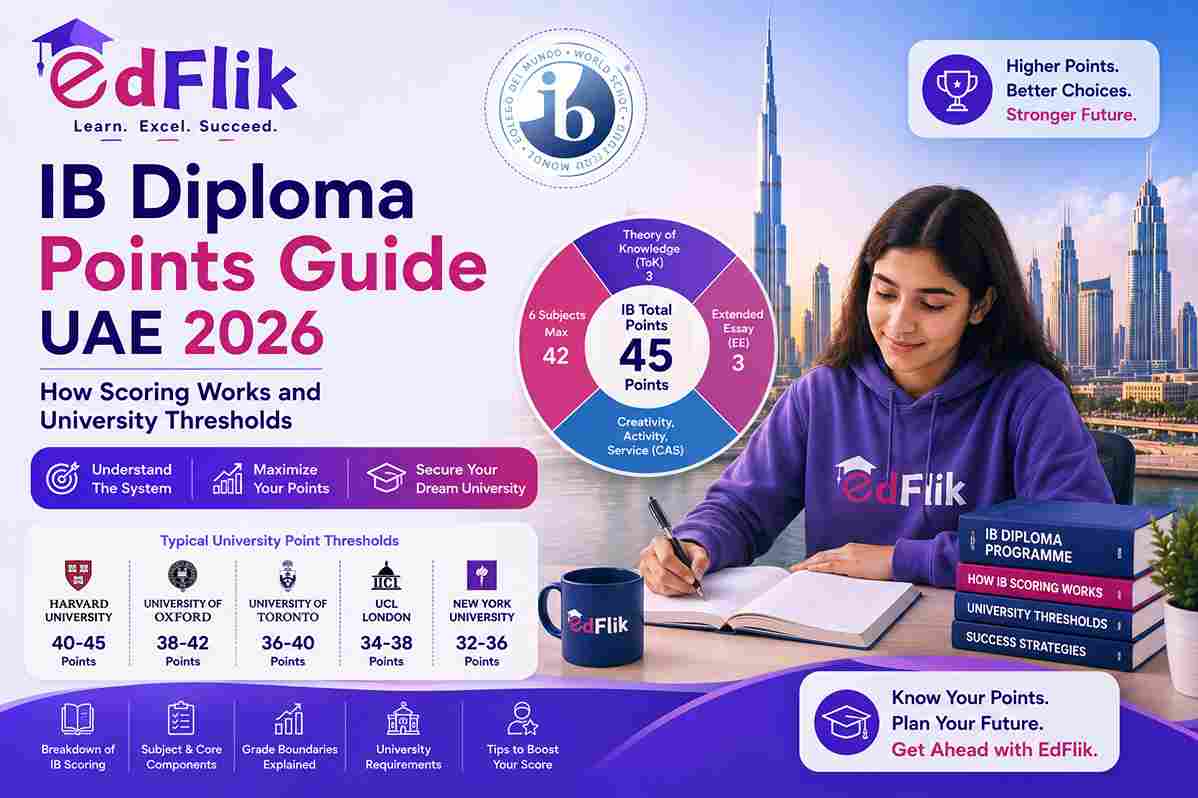
- The Scoring System: Each subject is graded from 1 to 7, with 7 being the highest. Achieving the maximum IB score requires a total of 42 points across six subjects, plus up to 3 bonus points awarded for exceptional combined performance in TOK and the Extended Essay (yielding a maximum possible total of 45 points).
Part 2: The Critical Timeline — Surviving and Thriving in DP1
Success in DP2 final exams is entirely determined by the habits and foundational structures built during DP1.
Phase 1: Semester 1 (September – January) — The Adjustment Shock
- Focus: Adapting to university-style independent learning, managing increased homework volumes, and selecting EE/TOK topics.
- The Trap: Treating DP1 like Year 10. Students who procrastinate or rely on last-minute cramming quickly find themselves falling behind as internal assessments (IAs) pile up.
- Actionable Tip: Build a weekly planner immediately. Dedicate specific blocks of time to review lecture notes on the same day they are taught to ensure active encoding.
Phase 2: Semester 2 (February – June) — Research and Internal Assessments
- Focus: Drafting the Extended Essay research question, completing initial IA data collection, and preparing for end-of-year promotional exams.
- The End-of-Year Reality: End-of-year DP1 promotional exams are critical because schools use these grades to generate official university predicted grades for early applications in DP2.
- Actionable Tip: Do not leave your Internal Assessments (IAs) until DP2. Use the summer break between DP1 and DP2 to complete rough drafts of your science labs, mathematics explorations, and language commentaries.
Part 3: Top 4 Strategies to Secure a Top IB Score (38+ Points)
- Master Time Management and Organization: The IB rewards consistency over cramming. Use digital project management tools (like Notion, Trello, or Google Calendar) to track deadlines for IAs, TOK essays, and CAS reflections simultaneously.
- Focus on Internal Assessments (IAs) Early: IAs account for 20% to 30% of your final grade in almost every subject. Because you control the research question and have teacher guidance, an exceptional IA is your best tool to lock in high grades before terminal exams.
- Deconstruct Command Words in Past Papers: IB examiners grade strictly against specific command words (evaluate, justify, contrast, deduce). Practice answering past paper questions under timed conditions to align your responses with official mark schemes.
- Prioritize Mental Well-Being: The pressure to achieve top scores can lead to burnout. Maintain consistent sleep schedules, protect time for physical activity through CAS, and don't hesitate to seek academic guidance early when struggling with complex topics.
Part 4: Why Personalized Tutoring Matters in DP1
With six demanding subjects, TOK, and the Extended Essay, school classrooms cannot always provide the individualized attention needed to target specific conceptual hurdles.
Partnering with an expert 1-to-1 tutoring provider like EdFlik offers transformational advantages during DP1:
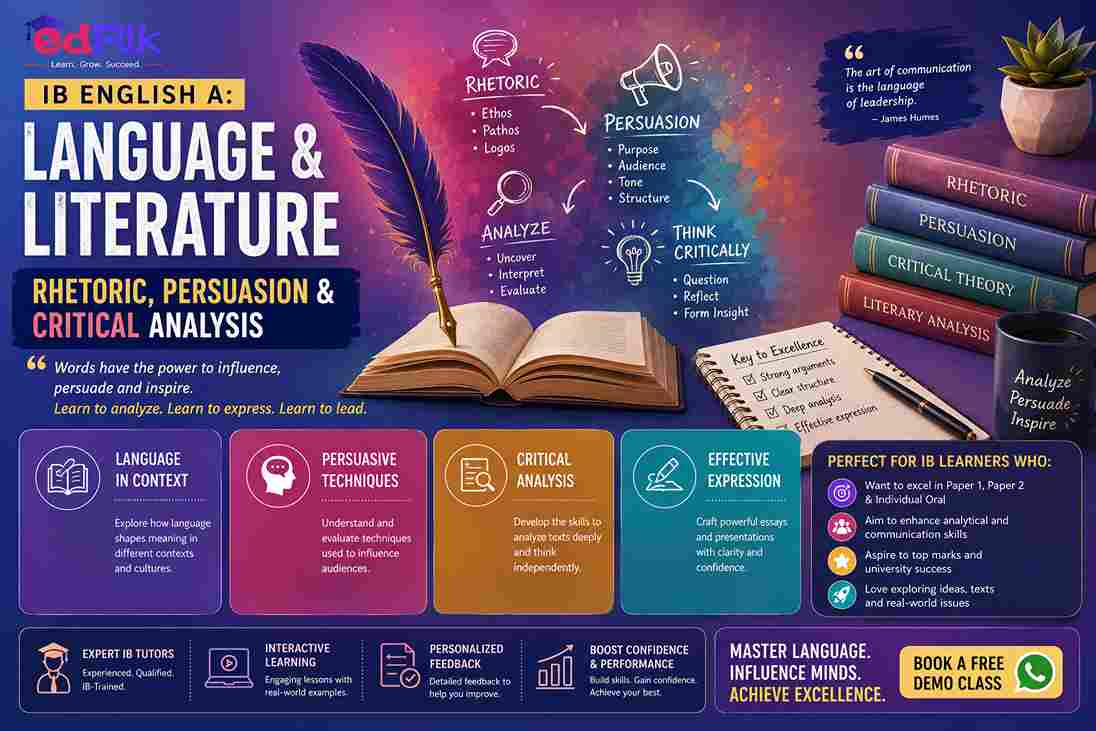
- Targeted Conceptual Support: Breaking down notoriously difficult IB topics (such as calculus in Math AA HL, reaction mechanisms in Chemistry HL, or literary commentary in English A) into digestible, manageable steps.
- IA and EE Mentorship: Guiding students through experiment design, data analysis, and structural formatting to ensure academic integrity and high rubric scoring.
- Unshakeable Academic Confidence: Providing a supportive mentorship environment where students can clarify doubts freely and build momentum leading up to university admissions.
Stepping into Grade 11 and DP1? EdFlik offers expert, 1-to-1 online tutoring customized specifically for international school students following the IB Diploma Programme, helping you build analytical mastery and secure top Grade 7 scores.Book a Free Demo Class Today!
Frequently Asked Questions (FAQs)
Q1: What is the difference between IB Mathematics: Analysis and Approaches (AA) and Applications and Interpretation (AI)?
Ans: Math AA focuses heavily on abstract algebraic thinking, calculus, and mathematical proof, making it ideal for engineering, pure mathematics, and physics. Math AI focuses on statistics, modeling, and the use of technology (graphing calculators), making it ideal for social sciences, business, and medicine.
Q2: How important are DP1 end-of-year exams?
Ans: Extremely important. Schools rely heavily on DP1 end-of-year exam results and formative assessments to determine official university predicted grades, which are submitted during early university applications in the first term of DP2.
Q3: Can I change my subject levels (HL to SL) during DP1?
Ans: Yes, most international schools allow students to adjust subject levels or switch courses during the first few months of DP1 (usually before December). However, changing too late can leave significant gaps in syllabus coverage.
Q4: How can EdFlik support IB Diploma students in Grade 11 and DP1?
Ans: EdFlik connects students with vetted, experienced 1-to-1 online tutors specializing in all major IB subjects across Groups 1 through 6, as well as TOK and EE guidance. Our personalized sessions focus on clarifying difficult topics, mastering internal assessments, and refining exam technique.