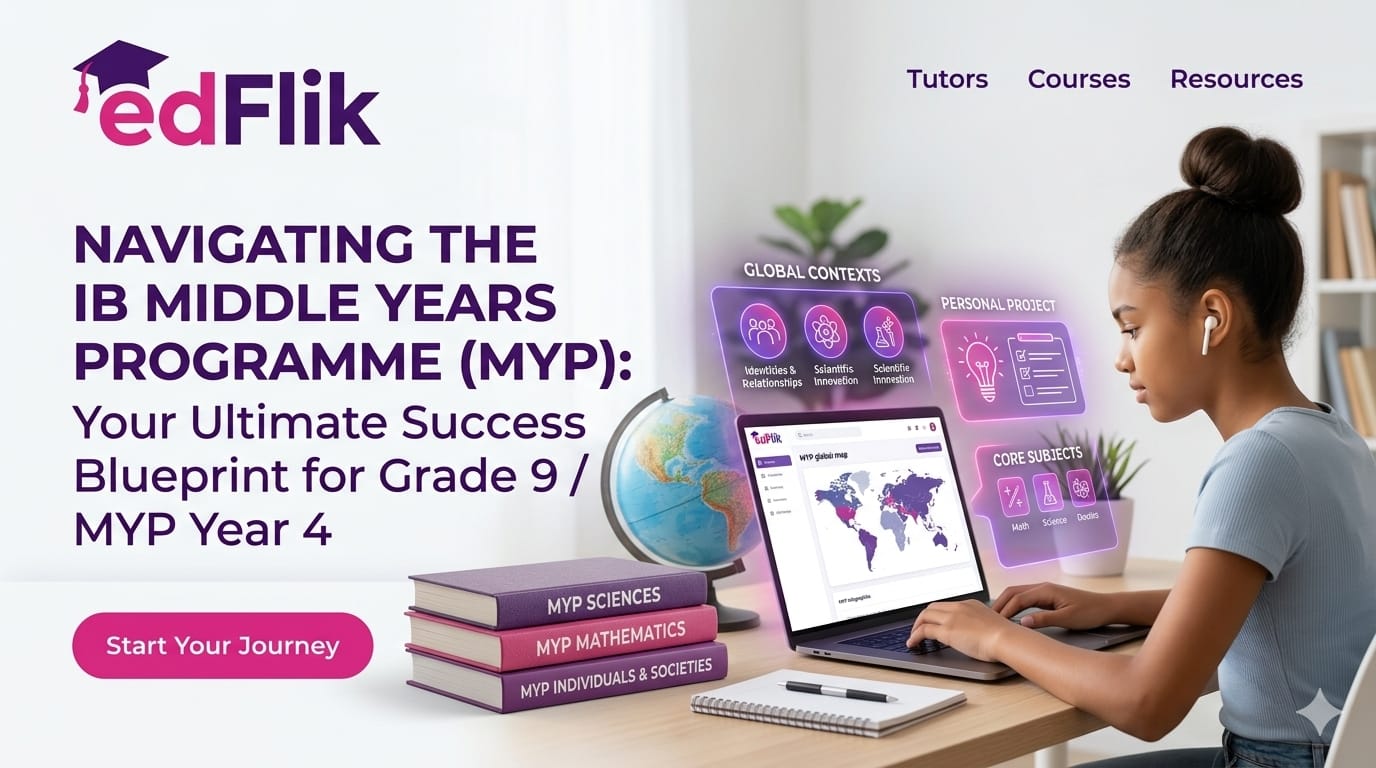
Navigating the IB Middle Years Programme: Your Ultimate Success Blueprint for Grade 9 and MYP Year 4
Last Updated: September 2026 | By EdFlik Education Team
For students and parents navigating international schools across the UAE and worldwide, stepping into Grade 9 and MYP Year 4 marks a critical transitional milestone in the International Baccalaureate (IB) continuum.
Moving away from the formative inquiry of early middle school, MYP Year 4 serves as the official foundation year for the IB Middle Years Programme. It bridges the gap between general secondary learning and the academic rigor required for the IB Diploma Programme (DP) or Career-related Programme (CP). With increased subject depth, formal criteria-based assessments, and the introduction of the MYP Personal Project, Grade 9 requires a proactive shift in time management, critical thinking, and independent research.
In this comprehensive guide, our expert IB curriculum advisors break down the structural realities of MYP Year 4, share proven study strategies, and explain how targeted academic support can turn early academic pressure into top-band success.
Part 1: The Anatomy of IB MYP Year 4
The Middle Years Programme (MYP) is designed to develop active learners and internationally minded young people who can empathize with others and pursue lives of purpose and meaning. Grade 9 is where this framework crystallizes into formal academic expectations.
1. The Eight Subject Groups
Unlike specialized curricula that allow students to drop subjects early, MYP Year 4 requires students to study across eight distinct subject groups:
- Language and Literature (Mother tongue)
- Language Acquisition (Second language)
- Individuals and Societies (Humanities / History / Geography)
- Sciences (Biology, Chemistry, Physics)
- Mathematics (Standard or Extended)
- Arts (Visual Arts, Music, Drama)
- Design (Product or Digital design)
- Physical and Health Education
2. The Assessment Model (Criteria A to D)
Every single subject in the IB MYP is graded using four objective criteria (Criterion A, B, C, and D), each scored on a scale of 1 to 4:
- Criterion A: Knowing and understanding
- Criterion B: Investigating / Applying
- Criterion C: Communicating / Processing
- Criterion D: Thinking critically / Reflecting
- The Final Grade Calculation: The four criterion scores are added together (maximum 32 raw points) and converted into an official final IB grade ranging from 1 to 7 using strict grade boundaries set by the International Baccalaureate Organization (IBO).
Part 2: The Critical Timeline — Surviving and Thriving in MYP Year 4
Success in MYP Year 5 (Grade 10) and smooth entry into the IB Diploma Programme depends entirely on the habits and foundational structures built during Grade 9.
Phase 1: Semester 1 (September – January) — The Complexity Leap
- Focus: Adapting to rigorous criteria-based rubrics, managing multi-subject project deadlines, and adjusting to higher-level MYP Extended Framework expectations.
- The Trap: Many students treat Grade 9 casually because MYP grades do not directly appear on university transcripts. However, schools use Grade 9 and Year 10 internal tracking to determine student recommendations for Higher Level (HL) vs. Standard Level (SL) DP courses.
- Actionable Tip: Stop looking at subjects as isolated silos. Actively look for connections between your Individuals and Societies research and your Science inquiries using Global Contexts.
Phase 2: Semester 2 (February – June) — The Personal Project Launch
- Focus: Initiating the MYP Personal Project (which officially begins in Year 4 and is submitted/evaluated in Year 5), completing summative criterion-based assessments, and preparing for end-of-year exams.
- The Personal Project Reality: The Personal Project is a massive independent inquiry project where students explore a personal interest of their choice. Starting your planning, goal-setting, and process journal in Grade 9 prevents overwhelming panic in Year 10.
- Actionable Tip: Maintain your Process Journal weekly. Document your successes, failures, and research reflections as you go—trying to fabricate a process journal retroactively is immediately spotted by moderators.
Part 3: Top 4 Strategies to Secure Top Grades (7s across MYP Criteria)
- Deconstruct the Criterion Rubrics: Never complete an assignment without looking at the specific rubric descriptors for Level 7-8. If a rubric asks you to "synthesize comprehensive conclusions" (Criterion D), ensure your writing goes beyond simple summary to evaluate broader implications.
- Master Inquiry-Based Writing: MYP assessments heavily reward critical thinking over rote memorization. Practice asking "Why?" and "So what?" when evaluating historical sources, scientific experimental data, or mathematical models.
- Embrace the Global Contexts: The IB framework requires you to connect local learning to global realities (e.g., Globalization and sustainability, Fairness and development, Scientific and technical innovation). Weaving Global Contexts explicitly into your essays and design portfolios elevates your work to top bands.
- Balance Formative and Summative Tasks: Formative tasks are practice runs designed to give you feedback before summative grading. Take teacher feedback on formatives seriously—fixing those structural errors before the summative task is the secret to consistent 7s.
Part 4: Why Personalized Tutoring Matters in Grade 9
With eight demanding subjects, interdisciplinary units, and early Personal Project preparation, school classrooms cannot always provide the individualized attention needed to target specific conceptual hurdles.
Partnering with an expert 1-to-1 tutoring provider like EdFlik offers transformational advantages during MYP Year 4:
- Targeted Conceptual Support: Breaking down notoriously difficult topics (such as algebraic generalization in Extended Mathematics, chemical bonding in Sciences, or analytical writing in Language and Literature) into manageable steps.
- Criterion Mastery Training: Teaching students how to align their assignments directly with IB rubric descriptors (Criteria A–D) to eliminate lost marks.
- Unshakeable Academic Confidence: Providing a supportive mentorship environment where students can clarify doubts freely and build absolute readiness for the transition into IB Diploma years.
Stepping into Grade 9 and MYP Year 4? EdFlik offers expert, 1-to-1 online tutoring customized specifically for international school students following the IB Middle Years Programme, helping you build analytical mastery and secure top-band Grade 7 scores.Book a Free Demo Class Today!
Frequently Asked Questions (FAQs)
Q1: What is the difference between MYP Standard Mathematics and Extended Mathematics?
Ans: MYP Standard Mathematics covers the core foundational curriculum required for everyday mathematical literacy and standard secondary progression. MYP Extended Mathematics includes additional rigorous concepts (such as advanced algebra, trigonometry, and functions) designed to prepare students specifically for IB DP Mathematics: Analysis and Approaches (AA) HL.
Q2: How important is the MYP Personal Project?
Ans: Extremely important. The Personal Project is a mandatory capstone requirement of the IB MYP. While it does not count toward university entrance directly, successful completion and moderation of the Personal Project is required for official IB MYP certificate eligibility in many international schools.
Q3: How are MYP grades calculated from 1 to 7?
Ans: Teachers assess student work using four criteria (A, B, C, D) per subject, each graded from 1 to 4 (giving a maximum raw score of 16 or 32 depending on task design). These final criterion scores are added together at the end of the academic year and converted into an overall grade from 1 to 7 using official IBO grade boundary scales.
Q4: How can EdFlik support IB MYP students in Grade 9 and Year 4?
Ans: EdFlik connects students with vetted, experienced 1-to-1 online tutors specializing in all major IB MYP subject groups, as well as Personal Project guidance. Our personalized sessions focus on clarifying difficult topics, mastering criterion-based rubrics, and refining academic study skills.