
Overcoming Procrastination: How 1-on-1 Online Tutors Help Students Build Effective Study Habits
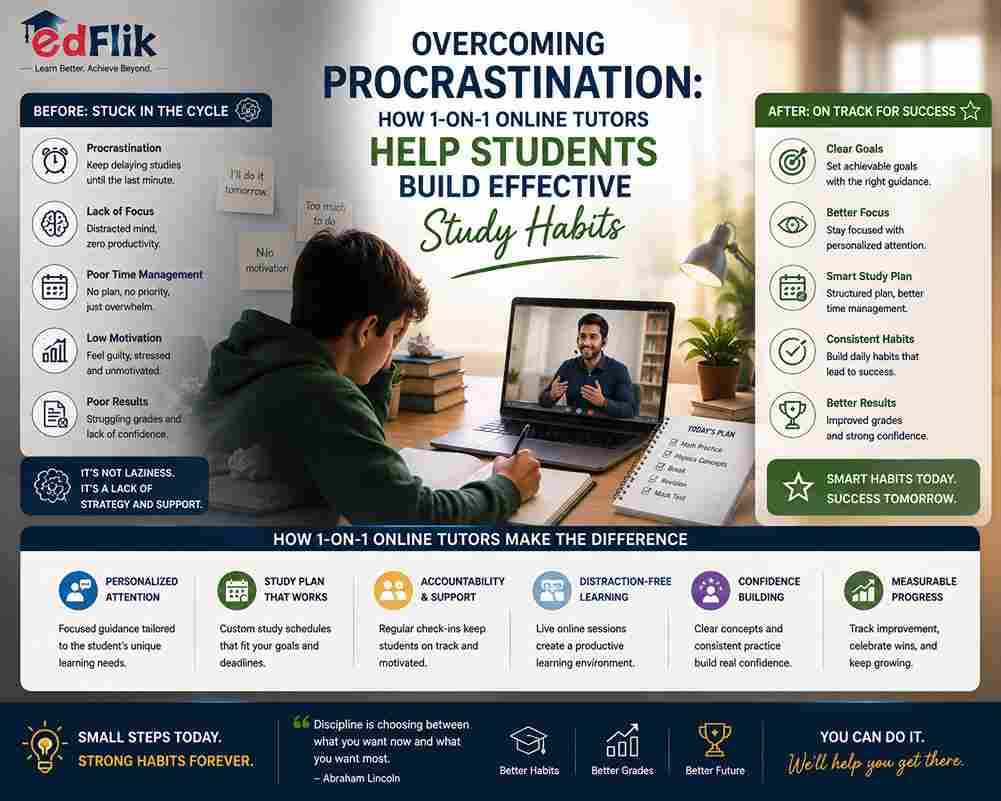
Last Updated: August 2026 | By: EdFlik Education Team
Quick Contact: Looking for an online tutor in Dubai & UAE 2026 to help your child overcome procrastination and build lasting study routines? WhatsApp us at +91 88788 96600 | Sessions starting from AED 55–75/hour | Book a Free Trial Class today viawww.edflik.com.
Introduction: The Silent Battle at the Study Desk
Picture a familiar evening scene in family homes across Dubai, Abu Dhabi, Sharjah, and around the globe: It is 8:00 PM. A high school student sits at their desk with a chemistry textbook open and a blank document glowing on their laptop screen. They intend to write a 1,500-word essay or revise organic reaction mechanisms.
Yet, two hours later, the textbook remains untouched, the laptop screen has morphed into three open streaming tabs and an active smartphone chat, and nothing has been accomplished. Panic sets in, followed by late-night exhaustion, guilt, and a desperate, last-minute rush to finish work before the morning school bell.
If this cycle sounds painfully familiar, you are witnessing the universal struggle of academic procrastination.
For decades, parents, teachers, and well-meaning mentors have labeled procrastinating students as "lazy," "unmotivated," or "disorganized." However, modern educational psychology reveals a starkly different truth: procrastination has almost nothing to do with laziness and everything to do with emotional regulation, cognitive overwhelm, and a lack of structured scaffolding.
This comprehensive guide explores why students procrastinate, why traditional willpower alone fails to fix the problem, and how personalized 1-on-1 online tutoring acts as the ultimate catalyst for building lifelong, unbreakable study habits.
Section 1: The Real Psychology Behind Procrastination
To solve procrastination, we must first understand what triggers it in the human brain. Procrastination is fundamentally an emotional coping mechanism, not a time-management issue. When a student stares down a massive, complex academic task—such as preparing for a Cambridge IGCSE Physics mock exam or drafting an International Baccalaureate (IB) Extended Essay—their brain perceives that task as a threat to comfort and competence.
- Fear of Failure and Perfectionism: High-achieving students often procrastinate the most. Why? Because they hold themselves to impossibly high standards. If a student fears they cannot write a "perfect" essay, their brain whispers, "If I don't try, I can't fail." Delaying the task protects their ego in the short term.
- The Dopamine Escape Hatch: Modern digital environments are engineered to hijack human attention spans. When a student feels stressed by an ambiguous math problem, their smartphone offers an immediate, effortless hit of dopamine via social media notifications or video games. The brain naturally chooses instant comfort over delayed gratification.
- Task Ambiguity (The Fog of War): When a task is too broad—such as "Study biology" or "Work on math"—the student's brain freezes because it does not know where to start. Without a clear starting action, avoidance becomes the default reaction.
Section 2: The Myth of "Laziness" and Why Willpower Fails
Parents frequently tell struggling students, "You just need more discipline" or "You need to try harder." Unfortunately, telling a stressed student to simply "exercise more willpower" is like telling someone with a fractured ankle to just run faster.
Willpower is a finite biological resource. By the time a student has navigated a grueling 7-hour school day in the UAE heat, attended after-school clubs, and managed social pressures, their cognitive energy reserves are completely depleted. Relying on sheer willpower at 7:00 PM to tackle complex calculus problems is a recipe for failure.
Sustainable academic success does not come from waiting for motivation to strike; it comes from establishing systems, external accountability, and frictionless routines.
Section 3: Proven Actionable Strategies to Break the Cycle
Before exploring how external mentorship helps, students can implement several evidence-based cognitive strategies to minimize daily friction:
1. Task Micro-Chunking (The Five-Minute Rule)
Never tell a student to "study for two hours." That feels insurmountable. Instead, break the assignment down into ridiculously small micro-tasks: "Open the document and write three bullet points." Tell the student they only have to work for five minutes. Once the friction of starting is overcome, momentum usually takes over.
2. Externalizing the Schedule (Visual Time-Blocking)
Keep study schedules off smartphone screens where notifications lurk. Use a physical wall calendar or a dedicated whiteboard to map out study blocks clearly, separating "focus time" from "recovery time."
3. Creating a Friction-Free Study Environment
During focus blocks, smartphones must be placed in another room entirely. Out of sight truly means out of mind. Additionally, closing extraneous browser tabs and using website blockers prevents accidental drift into distraction.
Section 4: How 1-on-1 Online Tutors Provide the Ultimate Accountability Shield
While self-help strategies are valuable, students trapped in chronic procrastination rarely possess the objective distance required to fix their habits alone. This is where expert 1-on-1 online tutoring serves as a transformative intervention.
1. External Scaffolding and Structure
A dedicated online tutor acts as an external executive function partner. Knowing that an expert mentor will review their progress on Tuesday afternoon provides the healthy external pressure a student needs to complete their weekly milestones ahead of time.
2. Breaking Down Overwhelming Syllabi
When a student looks at an entire A-Level Chemistry syllabus and panics, an experienced tutor steps in to triage the material. They break massive revision topics into bite-sized, weekly micro-goals, removing the ambiguity that triggers procrastination in the first place.
3. Cultivating Psychological Safety and Error Tolerance
Many students procrastinate because they are afraid of feeling stupid when they get stuck. A compassionate 1-on-1 tutor creates a judgment-free zone where making mistakes is celebrated as a vital part of learning. When the fear of looking foolish is removed, the urge to avoid studying vanishes.
Section 5: Common Parent Pitfalls When Managing Procrastination
Even with the best intentions, parents can inadvertently reinforce a student's procrastination habits through common behavioral traps:
- Micromanaging Every Minute: Hovering over a child's shoulder while they study creates intense anxiety, turning the study desk into a battleground and pushing the child toward secretive procrastination.
- Using Punishments That Backfire: Taking away sports, hobbies, or social time in response to poor grades often increases stress and lowers emotional resilience, worsening the cycle of avoidance.
- Nagging Instead of Collaborating: Constantly repeating "Did you finish your homework?" trains the child to rely on parental nagging rather than developing their own internal accountability clock.
Section 6: The EdFlik Approach to Building Sustainable Study Habits
At EdFlik Education, our specialized 1-on-1 online tutoring model goes far beyond basic subject instruction. We focus heavily on instilling metacognitive skills, executive functioning, and robust study habits for students across Dubai, Abu Dhabi, and the UAE:
- Empathetic, Personalized Mentorship: Our tutors build genuine, supportive relationships with students, helping them unpack the emotional roots of their academic avoidance.
- Interactive Virtual Sessions: Using collaborative digital whiteboards and real-time screen sharing, sessions are engaging, dynamic, and completely hands-on—leaving zero room for passive daydreaming.
- Exceptional Affordability: Premium 1-on-1 academic coaching and habit-building mentorship starting at just AED 55–75/hour, delivering elite educational value without exorbitant agency markups.
Success Stories & Testimonials
"My son used to leave all his IGCSE revision until the night before exams, paralyzed by stress and procrastination. His EdFlik tutor didn't just teach him math; she taught him how to break assignments into weekly micro-tasks and hold himself accountable. His confidence and grades have completely transformed!"
— Parent in Dubai Marina
"I used to spend hours sitting at my desk scrolling through my phone instead of writing my essays because I felt overwhelmed. My EdFlik tutor helped me organize my workflow and taught me how to start without fear. Now I actually finish my work on time!"
— High School Student, Abu Dhabi
Frequently Asked Questions (FAQ)
Why do bright students procrastinate so much?
High-achieving students often procrastinate due to perfectionism and fear of failure. When a task feels daunting, their brain uses avoidance as a defense mechanism to protect their self-image.
How can 1-on-1 tutoring help a student who avoids homework?
A private tutor provides external accountability, breaks overwhelming assignments into manageable micro-goals, and creates a supportive, judgment-free environment that reduces study anxiety.
How much do expert online tutoring sessions cost with EdFlik?
EdFlik offers expert 1-on-1 online tutoring focused on academic mastery and study habit formation starting at an accessible AED 55–75/hour.
Ready to Help Your Child Break the Procrastination Cycle?
Equip your child with the executive functioning tools, accountability, and expert mentorship they need to thrive. Experience the EdFlik difference today.
- WhatsApp Us:+91 88788 96600
- Visit Us:www.edflik.com
- Special Offer: Book your Free Trial Class now!